South Asia · India
The
Sitar · for yoga
Raga Yaman as an evening alap, slowed and stretched until each gliding note matches the unhurried transitions of a yin yoga practice.
Quick answer
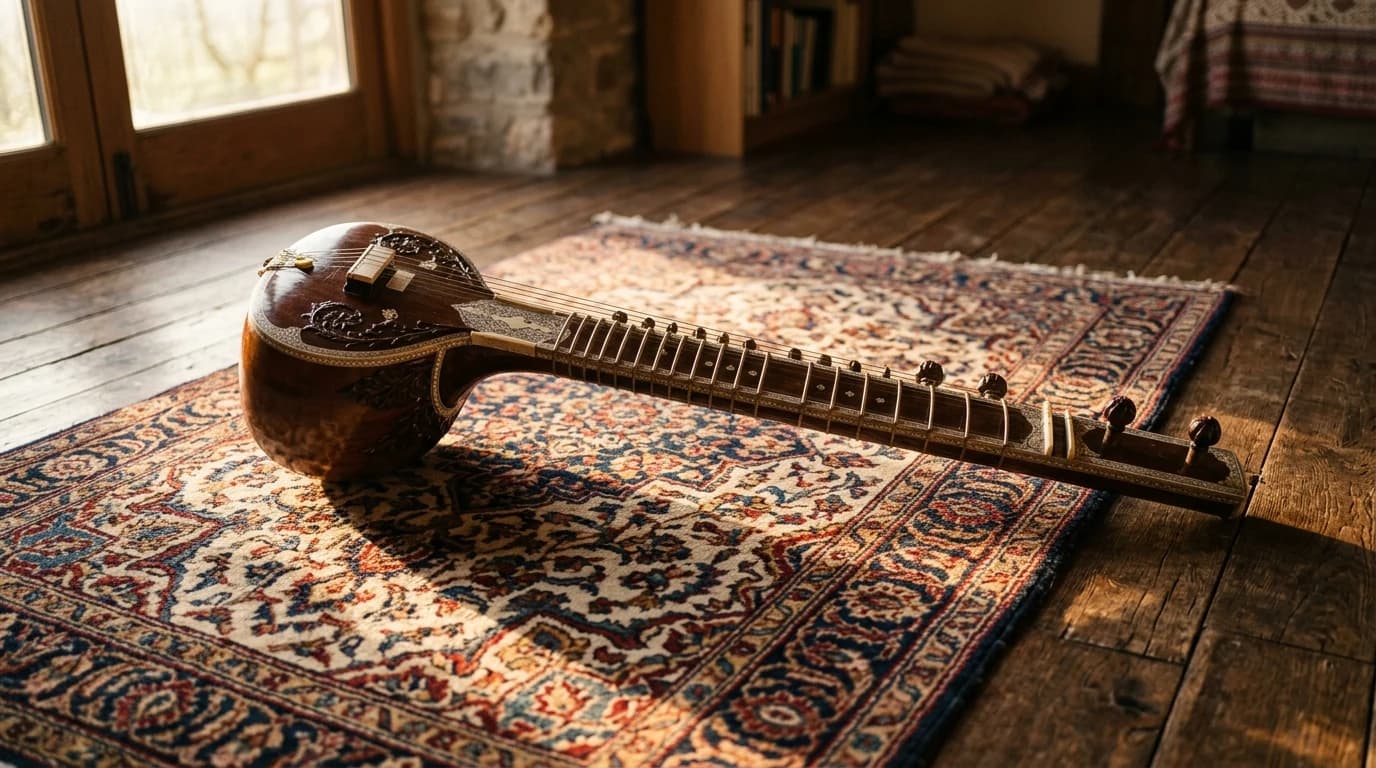
This is sitar alap — the slow, unmetered opening of a raga performance, with no tabla and nothing to count — chosen here around raga Yaman, a bright evening mode. Notes arrive one at a time and hang in the sympathetic strings, so the music expands rather than progresses. For yin practice or a long hold it gives the room a pulse-free floor to rest on.
01 · The mood
What yoga listeners need that meditation music does not provide.
Yoga music is often confused with meditation music, but the use cases are subtly different. Meditation listening is still: the listener is seated, the breath is even, the body does not move. Yoga listening is in motion: the listener transitions between poses, holds long stretches, sometimes shifts attention between body and breath.
For yin-style yoga in particular — long-held poses, breath as the metronome, mind as the witness — the music wants slightly more melodic motion than meditation requires, but still nothing that surprises the body. Predictable arcs. Continuous sound. No silences long enough to break a held stretch.
This piece is calibrated to that brief. Raga Yaman in slow alap form is, by tradition, exactly the music for evening unhurried listening. Slowed further for this recording — to 48 BPM — and threaded together with the continuous shimmer of the sitar's thirteen sympathetic strings, it asks the body to keep moving slowly while it does its work.
02 · The raga
Yaman — evening, uplifted, Lydian-bright.
Raga Yaman is one of the foundational evening ragas of the Hindustani tradition. Its scale is Lydian — the major scale with a raised fourth — which gives the mode a peculiar brightness that contrasts with the modal gravity of most ragas. The raised fourth (tivra ma) carries an unmistakable yearning quality that lifts every phrase.
The alap is the slow, unmetered exploration of a raga that traditionally opens a Hindustani performance. It has no tabla, no fixed tempo, no climax. It is meditation through systematic exploration of the raga's pitches, with long held tones and the characteristic meend — the gliding slide between pitches — connecting them.
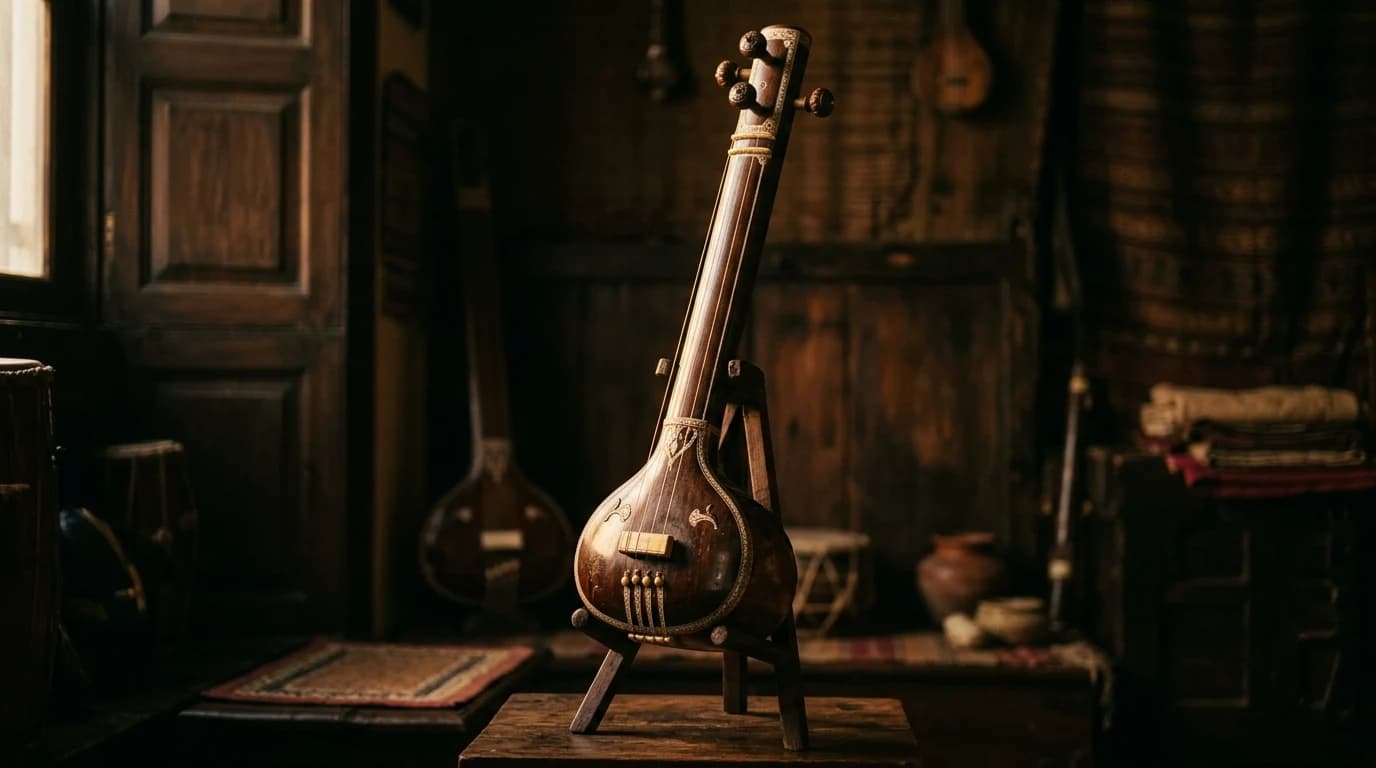
The sitar's thirteen tarab strings — sympathetic strings that ring without being plucked, in resonance with whatever the player touches — produce a continuous shimmering halo. The halo is the trance signature. It is also why this piece moves so well alongside a slow yoga practice: the resonance fills the room with a sustained harmonic field the body can stretch into.
03 · The listening
Let the sitar pace the practice.
Set the piece running before your practice begins. The first two or three minutes of the alap will establish the raga; this is a natural opening for a centering practice, light stretches, or three breaths of stillness before you begin moving.
Across the following twenty-five minutes the alap will continue at its unhurried pace. There are no peaks. There are no crescendos. The sympathetic strings will be present continuously, providing the harmonic ground your held poses can settle into. The piece is designed not to ask you to listen — it is designed to be a tonal environment you practice inside of.
Volume low. Speakers preferable to headphones for yoga. The shimmer is most effective when it fills the room rather than the ear.
A listening guide
What to listen for
The tarab shimmer. The thirteen sympathetic strings ring continuously without being plucked. The halo around every note.
The meend. The signature gliding slide between pitches — produced by pulling the playing string across the fret. Three to five seconds per glide.
The raised fourth. Yaman's defining interval. It gives the raga a quality of suspended brightness — never resolved, always slightly ascending.
The tanpura. The continuous low four-note drone underneath. The reference for the entire raga's pitch field.
The lack of rhythm. No tabla, no fixed pulse. The piece moves at the speed of the alap's breath. Match it with your own.
Common questions
Questions people ask about the sitar · for yoga
Why use alap rather than a full raga performance for yoga?
Once the tabla enters, the music acquires a cycle and a tempo, and your body tends to follow it. Alap has neither, so it can sit underneath a practice at any pace without pulling it.
What is raga Yaman?
Yaman is one of the foundational ragas of Hindustani music, traditionally placed in the early evening and often the first raga a student learns. It is widely described as serene and expansive rather than sombre.
Is Indian classical music appropriate to use as yoga background?
Raga is a devotional and concert tradition in its own right, not written as accompaniment, and it is worth knowing that. Listening to it during practice is common and unobjectionable; treating it as generic wallpaper is the part worth avoiding.
A SlowHum sitar · for yoga piece is in the making.
We're composing a thirty-minute piece for this tradition. Subscribe to be first — and watch the performances above in the meantime.
Subscribe on YouTubeFree · No email required
More from this tradition
Other pieces for the sitar
Continue the atlas
Other traditions
Duduk
Armenia
Shakuhachi
Japan
Quena
Peru & Bolivia
Celtic Harp
Ireland & Scotland
Kora
Mali & Senegal
Santur
Iran
Oud
Turkey & Syria
Guzheng
China
Morin Khuur
Mongolia
Kantele
Finland
Slack Key
Hawaii · soon
Mbira
Zimbabwe
Bansuri
India
Ney
Turkey
Tagelharpa
Norway · soon
Begena
Ethiopia · soon
Gayageum
Korea · soon
Ngoni
Mali · soon
Guqin
China
Erhu
China
Koto
Japan
Pipa
China
Setar
Iran
Sarod
India
Sarangi
India
Xiao
China
Kaval
Bulgaria
Dizi
China
Nyckelharpa
Sweden
Hurdy-gurdy
France
Saz
Turkey