Andes · Peru & Bolivia
The
Quena
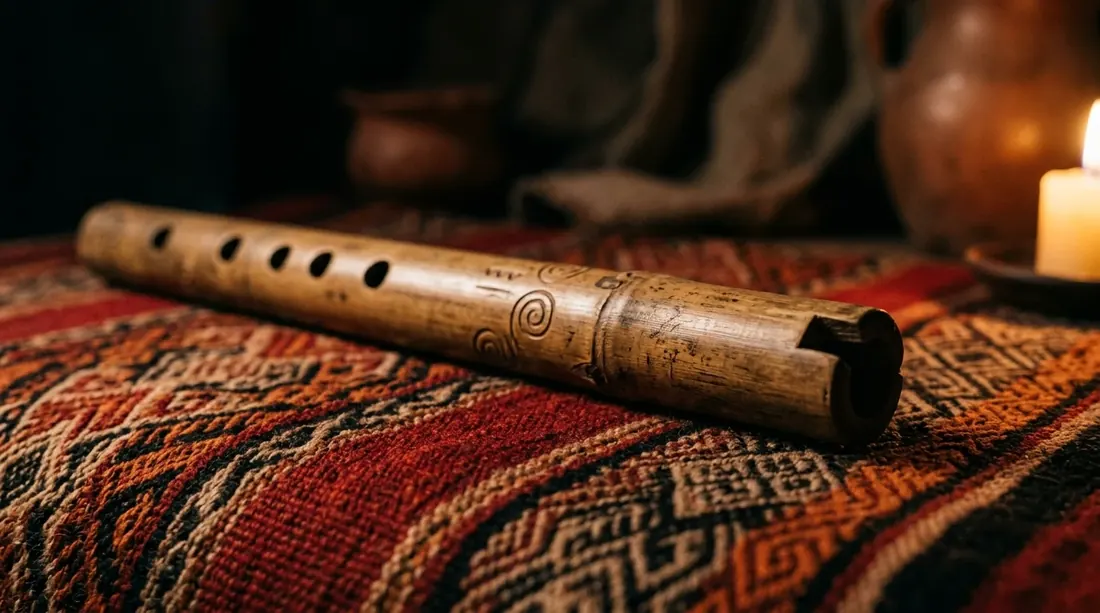
A notched bamboo flute from the high Andes. Older than the Inca. Still played in the same way, from the same thin air.
Quick answer
The quena is the notched end-blown flute of the Andes, traditionally cut from cane or bone, with six finger holes and a thumb hole. Its voice is thin, airy and slightly plaintive — the sound most people associate with high-altitude Andean music — and it is often heard beside the zampoña, the paired panpipes. Its narrow dynamic range and gentle breathiness make it easy to keep on quietly while the mind settles.
Listen now
01 · Origins
Older than an empire.
The quena is one of the oldest instruments on the American continent. Archaeologists have pulled bone flutes out of burial sites in the high Andes that date to 1500 BCE — three thousand years before Francisco Pizarro first climbed up from the coast and into the thin air of the Inca heartland. Those bone instruments, made from pelican or condor wing bone, were the grandparents of the modern quena: six finger holes, a sharp notch cut into the top edge, a pentatonic scale that remains, to this day, the sonic signature of the high cordillera.
The word quena comes from Quechua — qina, meaning the instrument — but the tradition around it predates Quechua speech and spans every people who has lived at altitude on that continent. It was played by the Moche and the Nazca and the Chavín. It was played in the courts of the Inca. It is played today, by nearly unchanged methods, from the altiplano of Bolivia through the sierras of Peru and Ecuador, into the Andes of Colombia. No other Andean instrument has had that kind of continuity.
In most traditional ensembles the quena does not play alone. It pairs with the zampoña — a bundled pan-flute in two interlocking halves, each played by a different musician so that a single melody is produced by two pairs of lungs, breathing in alternation. In this piece the zampoñas provide a quiet harmonic floor beneath the solo quena, the way a single clear voice sounds against a distant choir.

02 · The instrument
Why it sounds thin in a good way.
The quena’s defining sound is its thinness. This is not a criticism. It is the reason the instrument works at altitude: a thick-toned instrument would not carry across the kind of distances the Andes imposes on sound. What the quena produces instead is a high, airy, narrow line — a voice that can travel across a canyon without losing its edge.
Like the shakuhachi, the quena is played by blowing across a sharp edge cut into the rim (the escotadura), and the tone depends almost entirely on how the player shapes their lips and breath. There is no reed. There is no mouthpiece. Just bamboo, a notch, and a body of air trapped inside.
What the instrument does especially well is bend a note. The pentatonic scale produces only five pitches per octave, so every emotional nuance of a phrase has to be conveyed by how the player approaches each note — slowly from below, sharply from above, with a trill that tapers, with a breath that catches. This is why Andean melodies feel so profoundly wistful even when their harmonic material is simple. The feeling is in the bend.
03 · The feeling
Music for when the air is thin.
There is a practical reason the quena’s music feels the way it does. At 3,500 metres — the elevation of Cusco, where the Inca kept their capital — the air holds roughly thirty percent less oxygen than it does at sea level. People who live there breathe slower, speak slower, walk slower. A quena phrase is, in a sense, the sound of a body regulating itself to that air.
When you put this piece on in a room that is not at altitude, something curious happens. The melody still carries its original pace. Your breath, without asking, begins to match it. Over fifteen or twenty minutes, most listeners find they have dropped into a slower rhythm — not because the music is manipulating them, but because the music already knows what rhythm the body wants when it is allowed to slow down.
We have placed this piece under the banner For anxiety relief because that is what our listeners most often tell us it does. The quena does not dramatize your state. It offers a rhythm older than whatever you are feeling, and lets you meet it.

A listening guide
What to listen for
The notch tone. The slight hiss around each note is the sound of air passing across the bamboo edge. It’s not an audio flaw — it’s the instrument’s voice.
The zampoña pad underneath. It never has a melody of its own. Its job is to be the distance — the space inside which the quena sings.
How the quena approaches each note. A clean attack is rare; most phrases slide into pitch from below. The glide is expression.
The pentatonic floor. There are only five pitches per octave. Once you notice, you’ll hear them repeating; once you hear the pattern, you’ll stop needing to follow it and you’ll just listen.
Around the ten-minute mark, your breath will probably have synced with the melody’s tempo. If you are restless, let that happen. The instrument was designed for exactly that.
From the listener to the player
If the quena pulled you in
Where to begin, if you want to put your own breath through a flute like this.
The instrument
~$60
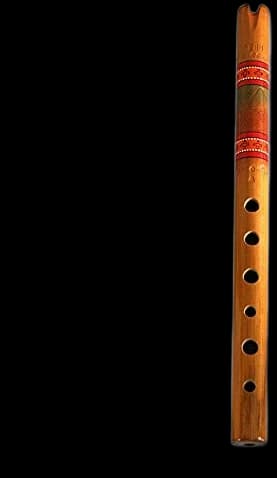
NOVICA Andean Quena Flute
A hand-carved quena from a Peruvian artisan, fair-trade through NOVICA — a real, playable instrument with the warm, breathy voice you heard, not a souvenir.
Buy on Amazon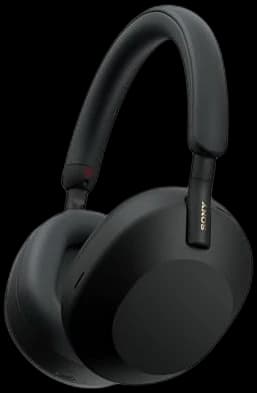
To hear it
~$298
Sony WH-1000XM5 Headphones
The quena is almost all breath and air. That texture needs headphones that don't flatten it — a comfortable, quiet pair you'll keep on for the full thirty minutes.
Buy on AmazonA concert-grade quena
For a professional bone or hardwood quena, Reverb's marketplace and specialist sellers are the place to look.
Affiliate links
These are honest recommendations — the ones we’d point a friend toward. As an Amazon Associate, SlowHum earns from qualifying purchases; we may also earn from other links. It costs you nothing extra, and prices are approximate. Full disclosure.
Common questions
Questions people ask about the quena
What is the difference between a quena and a zampoña?
The quena is a single flute with finger holes, so one player produces a continuous melodic line. The zampoña is a set of stopped pipes tuned to fixed pitches, traditionally split between two players who interlock their notes to build one melody between them.
Why does Andean flute music sound so open?
Much of the repertoire sits on pentatonic scales and leaves wide intervals between notes, and the quena’s breathy tone carries a lot of air with each phrase. The effect is space rather than density.
Is quena music helpful for anxiety?
Many listeners use it that way. The phrasing follows the player’s breath, so the music keeps returning to an unhurried inhale-and-release shape — easier to follow than beat-driven ambient music when you are trying to slow down.
Listen to the quena.
The full 30-minute piece lives on the channel. Subscribe to catch each new tradition as it arrives.
Subscribe on YouTubeFree · No email required
Continue the atlas
Other traditions
Duduk
Armenia
Shakuhachi
Japan
Celtic Harp
Ireland & Scotland
Kora
Mali & Senegal
Santur
Iran
Oud
Turkey & Syria
Sitar
India
Guzheng
China
Morin Khuur
Mongolia
Kantele
Finland
Slack Key
Hawaii · soon
Mbira
Zimbabwe
Bansuri
India
Ney
Turkey
Tagelharpa
Norway · soon
Begena
Ethiopia · soon
Gayageum
Korea · soon
Ngoni
Mali · soon
Guqin
China
Erhu
China
Koto
Japan
Pipa
China
Setar
Iran
Sarod
India
Sarangi
India
Xiao
China
Kaval
Bulgaria
Dizi
China
Nyckelharpa
Sweden
Hurdy-gurdy
France
Saz
Turkey