Sahel · Mali· coming soon
The
Ngoni
A Malian hunter’s lute, the deep ancestor of the banjo. Four or seven strings, a calabash body, and a tradition that crossed the Atlantic.
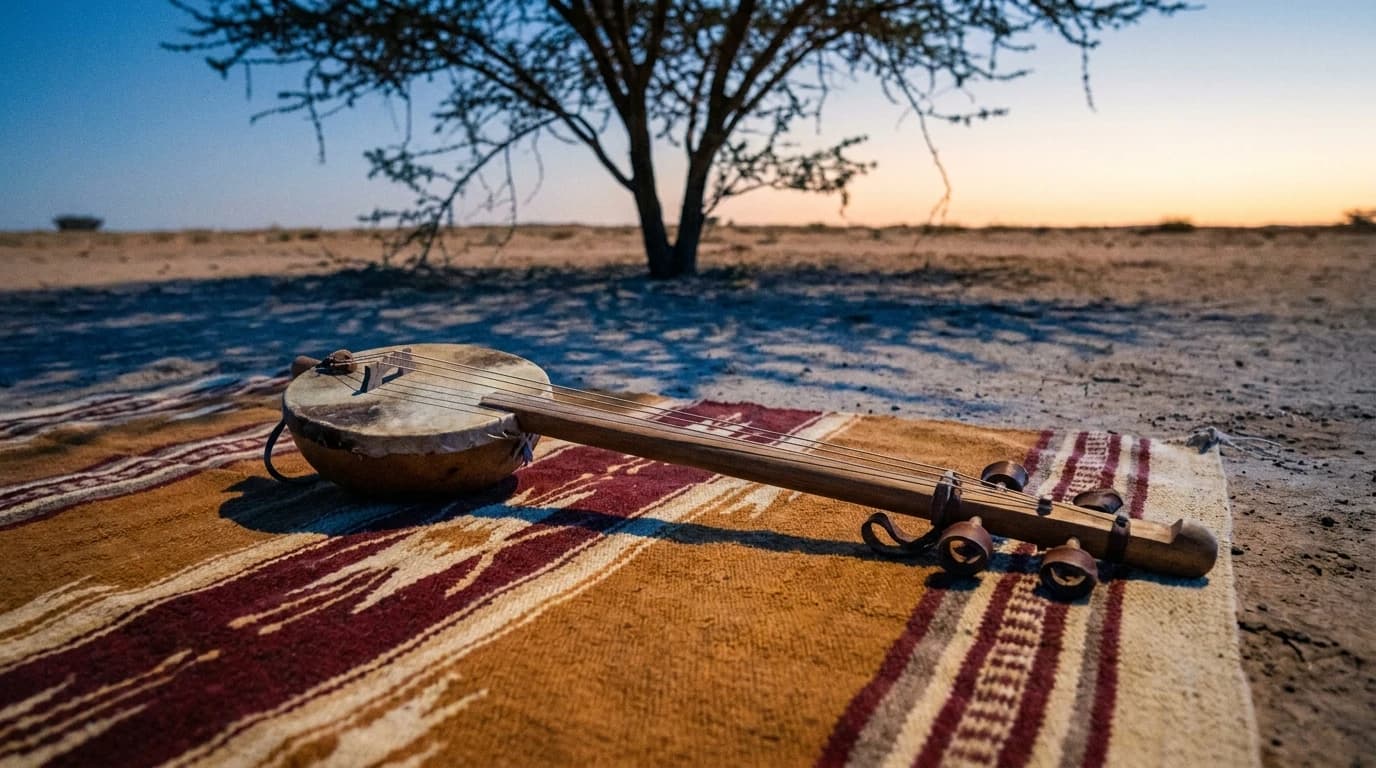
In preparation
Quick answer
The ngoni is a West African plucked lute from Mali: a hollowed canoe-shaped wooden body covered with hide, a fretless neck, and a handful of strings tied to leather rings. It is played fast and dry, with a snapping attack and very little sustain, over repeating patterns rather than chord changes. It is commonly cited as a forerunner of the banjo, and the family resemblance is easy to hear.
The ngoni is a small West African plucked lute from Mali and the surrounding Sahel, with a hollowed-out calabash body covered in dried animal skin, a long wooden neck without frets, and traditionally four to seven strings. It is one of the oldest stringed instruments in West Africa, with documentary references in 14th-century Mali. When enslaved West Africans were brought to the Caribbean and the American South, the ngoni’s descendants — the akonting, the xalam, eventually the banjo — travelled with them.
Within Mande culture the ngoni is the instrument of the jeli — hereditary historians, praise-singers, and oral genealogists who carry generations of family history in memory. Its sound is bright, plucked, melodically restless. Slower repertoires exist within the tradition — moonlit fireside playing, contemplative solo work — and that is the territory our piece will sit in: one player, four strings, a calabash, and the long Sahel evening.
A new piece for this tradition is in preparation. Subscribe on YouTube to be notified when it releases.
Common questions
Questions people ask about the ngoni
How many strings does an ngoni have?
Traditional hunter’s and griot ngoni carry a small number of strings, often between four and seven depending on the region and the player. Modern makers build extended versions with more.
What is the difference between a hunter’s ngoni and a griot ngoni?
They come from different social roles: the donso ngoni belongs to hunters’ societies and its repertoire is tied to their ceremonies, while the jeli ngoni is played by hereditary griot musicians. The instruments differ in size, tuning and repertoire.
Is the ngoni really the ancestor of the banjo?
Instruments of this West African lute family are widely regarded as the banjo’s ancestors, carried across the Atlantic by enslaved people. Exactly which instrument and route is a matter of scholarly debate rather than settled fact.
Be the first to hear the ngoni.
New traditions release on the SlowHum channel each week. Subscribe to catch this one when it drops.
Subscribe on YouTubeFree · No email required
Continue the atlas
Other traditions
Duduk
Armenia
Shakuhachi
Japan
Quena
Peru & Bolivia
Celtic Harp
Ireland & Scotland
Kora
Mali & Senegal
Santur
Iran
Oud
Turkey & Syria
Sitar
India
Guzheng
China
Morin Khuur
Mongolia
Kantele
Finland
Slack Key
Hawaii · soon
Mbira
Zimbabwe
Bansuri
India
Ney
Turkey
Tagelharpa
Norway · soon
Begena
Ethiopia · soon
Gayageum
Korea · soon
Guqin
China
Erhu
China
Koto
Japan
Pipa
China
Setar
Iran
Sarod
India
Sarangi
India
Xiao
China
Kaval
Bulgaria
Dizi
China
Nyckelharpa
Sweden
Hurdy-gurdy
France
Saz
Turkey