West Africa · Mali & Senegal
The
Kora
Twenty-one strings stretched over a hemisphere of dried gourd. Played for a thousand years along the Niger River.
Quick answer
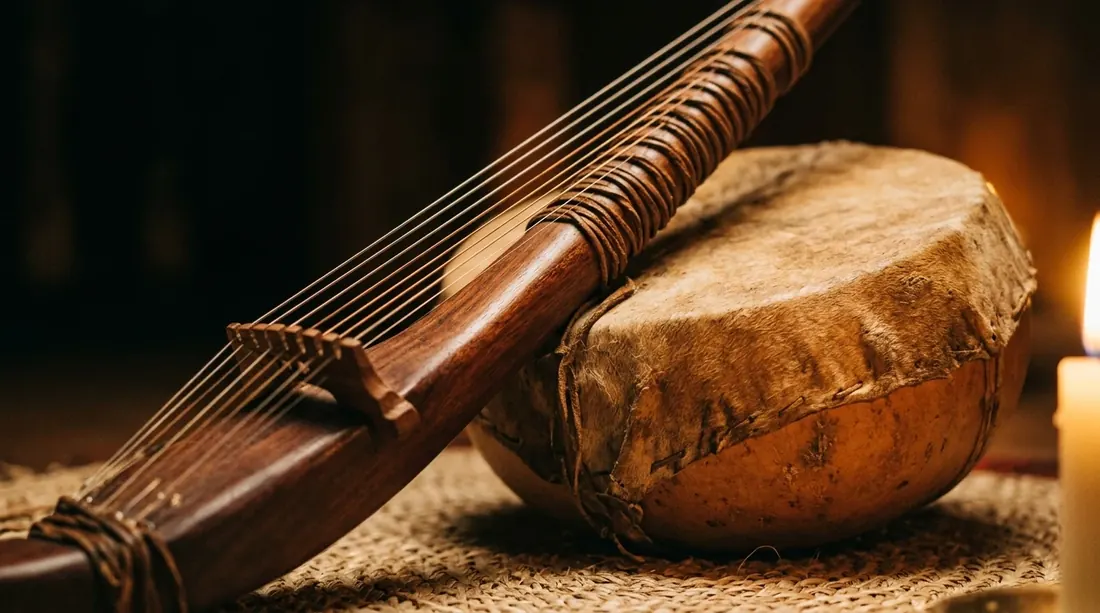
The kora is a 21-string West African harp-lute built on a large calabash gourd covered in cowhide, with the strings rising in two parallel ranks either side of a tall notched bridge. The player plucks with both thumbs and forefingers, so melody, bass and a rippling ostinato run at once — it sounds closer to a harp than a guitar. That constant, even motion is why it works so well as focus music: it moves without ever arriving anywhere abrupt.
Listen now
01 · Origins
The instrument of a thousand-year memory.
The kora is the instrument of the Mande — a family of peoples whose cultural and linguistic world stretches across what are today Mali, Senegal, Gambia, Guinea, Burkina Faso, and Côte d’Ivoire. The instrument itself is old; the tradition around it is older. Long before the kora took its modern 21-string form sometime in the 16th or 17th century, its ancestors — smaller harp-lutes with fewer strings — were played at the courts of the Mali Empire, whose emperor Mansa Musa became, during his 1324 pilgrimage to Mecca, the first globally famous West African.
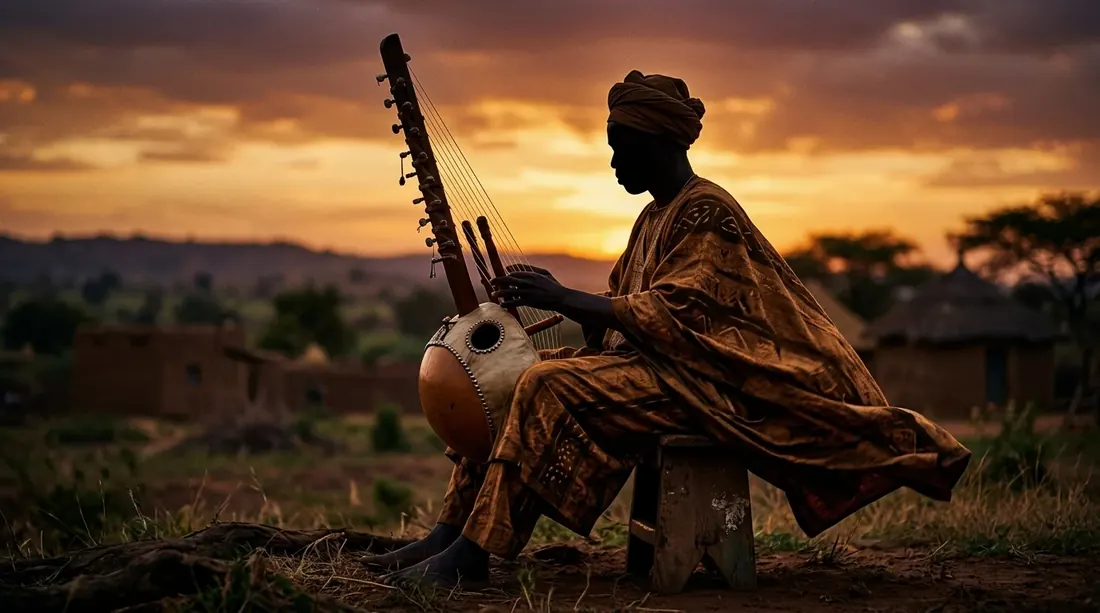
The kora is built the way a good poem is built: with inherited material, arranged in a form that almost nothing escapes. The body is a calabash gourd — a dried squash — cut in half and stretched over with cow hide. A long hardwood neck rises from the body like a mast; twenty-one fishing-line strings (originally leather) are tied to the neck with knotted leather rings and pulled taut by the player’s own hand every morning, because the rings are tuned by sliding them along the neck.
The players of the kora are called jali (or griots in French) — a word that names a role, not a job. The jali are hereditary musicians, historians, and oral genealogists. Their families have carried regional memory — who is descended from whom, what kings fought what wars, what debts are owed, which marriages must not happen — for centuries, often more than a thousand years. When a jali plays the kora, they are not performing. They are remembering, out loud, in music.
02 · The instrument
Why it sounds like a river.
The kora’s first surprise is that it is not one instrument but two. The 21 strings are arranged in two parallel ranks, one on each side of a vertical bridge at the front of the gourd. The player’s two hands work independently: thumbs on the bass side, establishing a rolling ostinato in the lower register; index fingers on the treble side, weaving the melody and its answers above.
This is why a solo kora sounds like two players. The thumbs say one thing; the fingers reply. Sometimes the two converse for hours. The conversation is rarely the same twice — kora music is largely improvised within an inherited framework, in the same way a jazz standard is — but the framework is more than a scaffold. It is a tuning, a set of characteristic patterns called kumbengo, and an attitude.
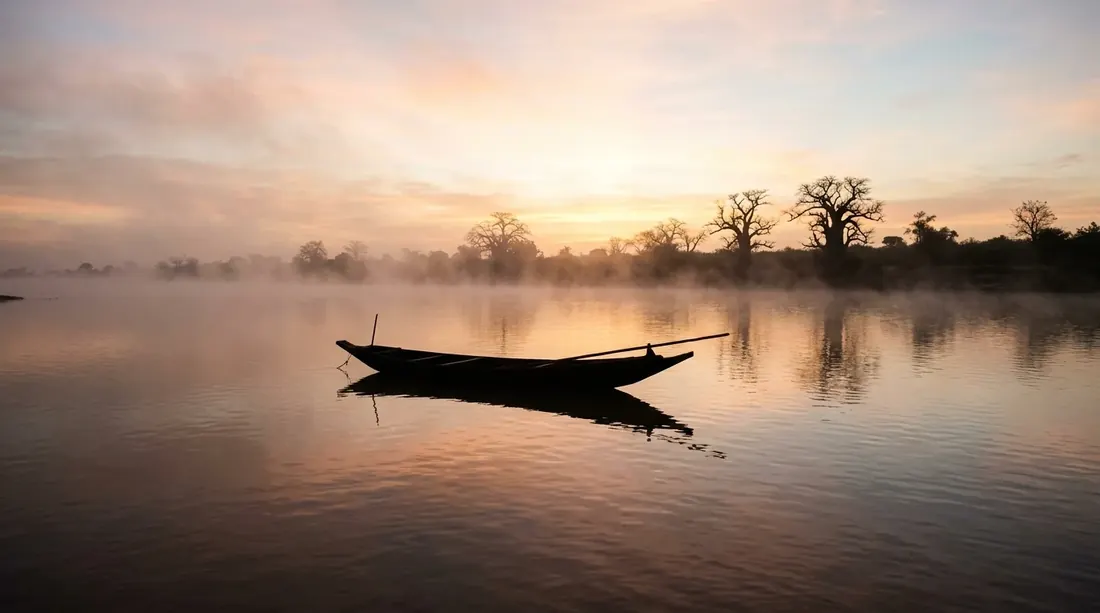
The 21 strings are tuned to a diatonic scale — closest, in Western terms, to the Lydian mode, though each tradition has its own preferences. Because so many strings are tuned to related pitches, the instrument rings with a dense, sympathetic resonance: every plucked string sets the others humming. Hearing this in person, listeners often describe it as the same sensation as looking at moving water. Nothing stays still. Nothing hurries, either.
03 · The feeling
Music for the first half of the day.
There is a reason we’ve placed this piece under the banner For focus. Unlike most ambient music, which invites you to drift, the kora invites you to stay present. Its tempo is gentle but never still — the bass thumbs keep the piece walking. Its melodies are not dramatic; they repeat, turn, and return to patterns the ear learns quickly. What the instrument produces, over thirty minutes, is not trance but continuity. The quality of attention you sometimes have in the first clear hour of the morning, before anything has interrupted it.
For the jali who first played this music, that was the point. Kora music was the soundtrack of the court — played at the beginning of a ruler’s day, sometimes for long stretches while business was conducted. It did not entertain; it supported. It held the room’s attention at a steady low level so that the room could do its work.
We suspect you’ll find the same thing in front of a desk, a book, or a quiet morning. The instrument that held a thousand-year genealogy in its strings can, it turns out, also hold your own afternoon.
Watch the tradition
Watch the kora become a river
The kora is easiest to understand when you can see both hands separating bass pattern from treble line.
Sona Jobarteh
Gambia
A widely loved doorway into the instrument: bright, public, melodic, and culturally rooted.
Ballake Sissoko ft. Sona Jobarteh
Djourou
A slower view of two master string voices, useful for hearing the kora's clean resonance.
A listening guide
What to listen for
The thumbs. If you focus only on the low register, you’ll hear a rolling ostinato that barely changes. That is the engine of the piece. Everything else is what’s built on top of it.
The ringing. Every plucked note sets unrelated strings humming in sympathy. It’s the same physics that makes a well-tuned piano sound rich — but far more pronounced on the kora because every string is untempered.
Returning patterns. Short four- or eight-bar figures (called kumbengo) anchor the piece; the player leaves them and returns to them throughout. Noticing the return is part of the pleasure.
The absence of percussion. The kora produces its own rhythm through the bass-string pattern. Once you hear it, you won’t want a drum.
Around the fifteen-minute mark, the piece settles into a sustained middle section. Let your attention widen here. This is the quality the instrument was designed to produce — steady, unhurried, open.
From the listener to the player
If the kora pulled you in
A full kora is a serious, hand-made instrument. Here's the most accessible way into its world.
Start here
~$76
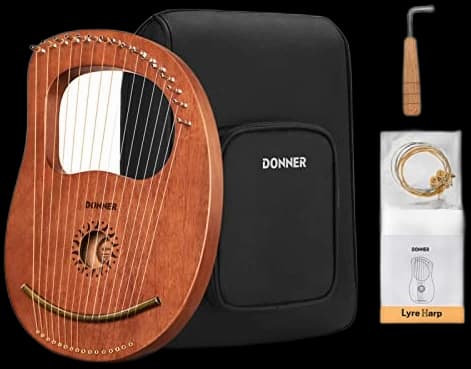
Donner 16-String Lyre Harp
Not a kora — but the same world: plucked strings ringing over a resonant body. A 16-string lyre harp is the gentlest, most affordable way to start, and a genuinely lovely instrument in its own right.
Buy on Amazon
To hear it
~$298
Sony WH-1000XM5 Headphones
The kora's cascading overtones and the soft buzz of its bridge live in detail that laptop speakers throw away. Worth hearing properly at least once.
Buy on AmazonA real West African kora
Hand-made koras are a serious purchase, often direct from makers. Reverb's marketplace is the best place to find one, new or used.
Affiliate links
These are honest recommendations — the ones we’d point a friend toward. As an Amazon Associate, SlowHum earns from qualifying purchases; we may also earn from other links. It costs you nothing extra, and prices are approximate. Full disclosure.
Common questions
Questions people ask about the kora
Who traditionally plays the kora?
In Mande society the kora belongs to jali, the hereditary musician-historian families often called griots in English. Their role is to hold and perform genealogy, praise and history, so the repertoire is tied to remembering rather than entertainment alone.
Why does one kora sound like several instruments?
The two ranks of strings are divided between the hands, so a player can hold a repeating bass-and-accompaniment figure with the thumbs while the forefingers improvise above it. What sounds like two or three musicians is the interlocking of four fingers.
Is kora music good for working?
It is one of the better traditions for it. The cyclical accompaniment gives a steady undertow with no percussion spikes and no vocal line to read, so attention slides past it.
Listen to the kora.
The full 30-minute piece lives on the channel. Subscribe to catch each new tradition as it arrives.
Subscribe on YouTubeFree · No email required
Continue the atlas
Other traditions
Duduk
Armenia
Shakuhachi
Japan
Quena
Peru & Bolivia
Celtic Harp
Ireland & Scotland
Santur
Iran
Oud
Turkey & Syria
Sitar
India
Guzheng
China
Morin Khuur
Mongolia
Kantele
Finland
Slack Key
Hawaii · soon
Mbira
Zimbabwe
Bansuri
India
Ney
Turkey
Tagelharpa
Norway · soon
Begena
Ethiopia · soon
Gayageum
Korea · soon
Ngoni
Mali · soon
Guqin
China
Erhu
China
Koto
Japan
Pipa
China
Setar
Iran
Sarod
India
Sarangi
India
Xiao
China
Kaval
Bulgaria
Dizi
China
Nyckelharpa
Sweden
Hurdy-gurdy
France
Saz
Turkey