Levant · Turkey & Syria
The
Oud
The ancestor of the European lute. A pear-shaped body, five courses of doubled strings, and a thousand years of poetry written about it.
Quick answer
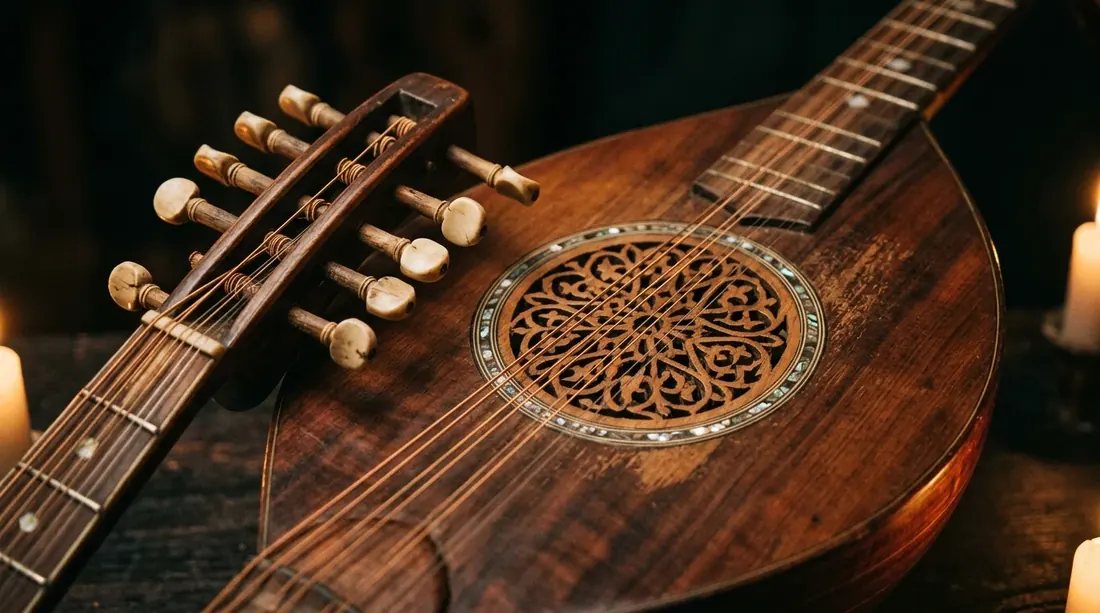
The oud is the short-necked, fretless lute at the centre of Arabic, Turkish and Levantine music, with a deep pear-shaped body and courses of strings plucked with a long thin plectrum. Having no frets lets players slide between pitches and sit on the microtonal intervals of the maqam system, which is why the instrument sounds like speech more than like a guitar. Its natural register is low and warm, and it suits late evenings better than any other instrument in the atlas.
Listen now
01 · Origins
The instrument that became the lute that became the guitar.
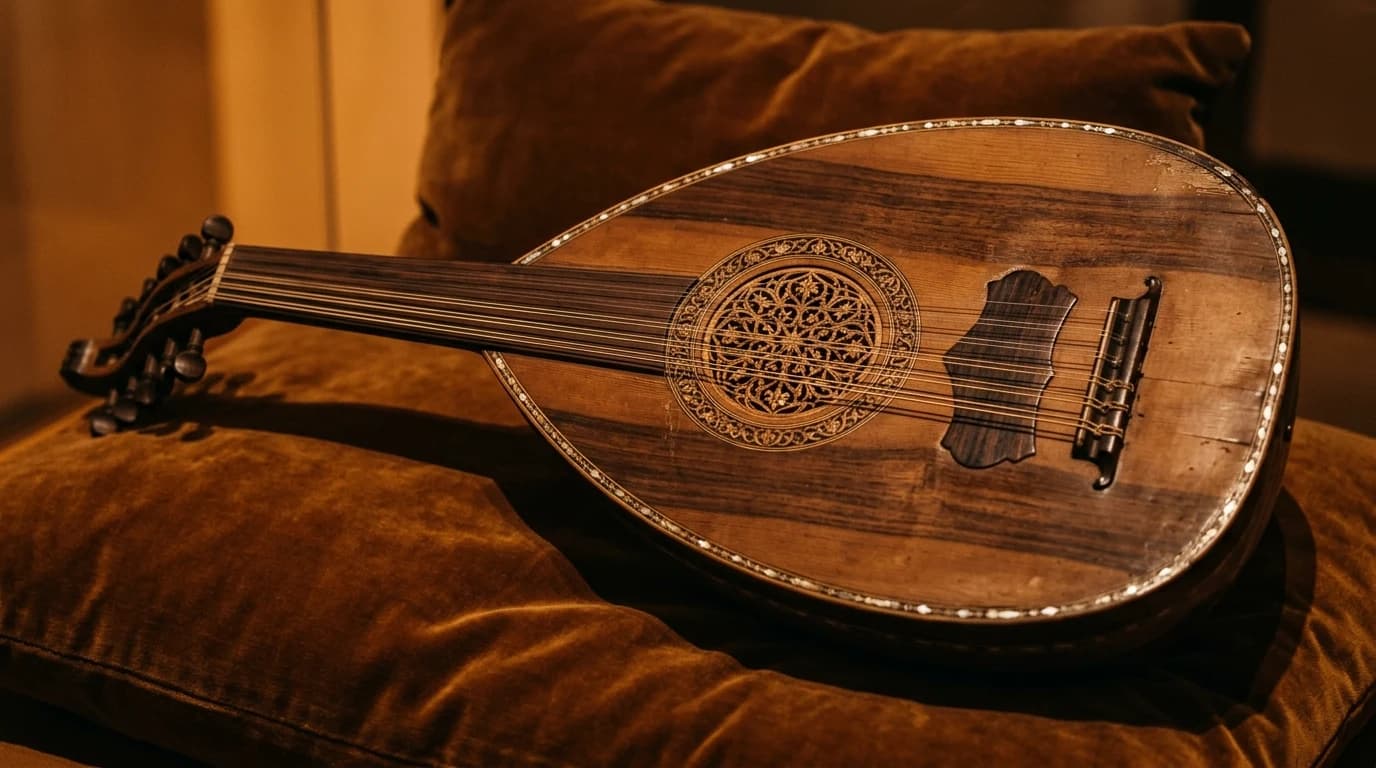
The oud — from the Arabic al-ʿūd, “the wood” — is a short-necked, fretless, pear-shaped lute strung in five or six courses of doubled strings. It is the central instrument of Arab, Turkish, and Persian classical music, and has been for at least a thousand years. Its body is carved from many narrow staves of light wood — walnut, mahogany, sometimes rosewood — bent and glued into a deep half-pear; its soundhole is a single ornate rosette in the center of the face.
When Moorish musicians carried the oud across the Strait of Gibraltar into the Iberian Peninsula in the 8th century, European builders adapted it: they added frets to the neck and a new name, drawn through medieval Spanish from al-ʿūd into laúd — the lute. From the lute came the vihuela, and from the vihuela the guitar. Nearly every European fretted string instrument in use today is a descendant.
The fretless neck is what the European versions left behind. Without frets, the oud can move continuously between pitches, sliding through intervals smaller than the half-steps of a piano. The entire maqam tradition depends on that freedom.
02 · The maqam
Microtones, and what they are for.
Arab classical music is built on the maqam system — modal frameworks whose intervals are subtler than the twelve equal semitones of Western chromaticism. The famous quartertone — half of a Western half-step — is one feature; in practice the maqamat use many more inflections, some unique to particular regions and lineages.
Hijaz, the mode this piece inhabits, is one of the oldest and most beloved. Built on a scale with an augmented second between its second and third degrees, it carries associations of longing, the evening call to prayer, and the kind of stillness that arrives in quiet rooms after dark. It is the mode of distance — geographic, temporal, emotional.
There is no percussion here and no fixed tempo. The oud plays alone, in the chamber-music tradition called taqsim — an unmetered, improvised exploration that unfolds the maqam at the player's own pace.
03 · The listening
How to be in the room with it.
The oud is, more than perhaps any other instrument, made for intimacy. It is not loud. Its sustain is short. To hear it properly you have to lean toward it — physically, or attentionally.
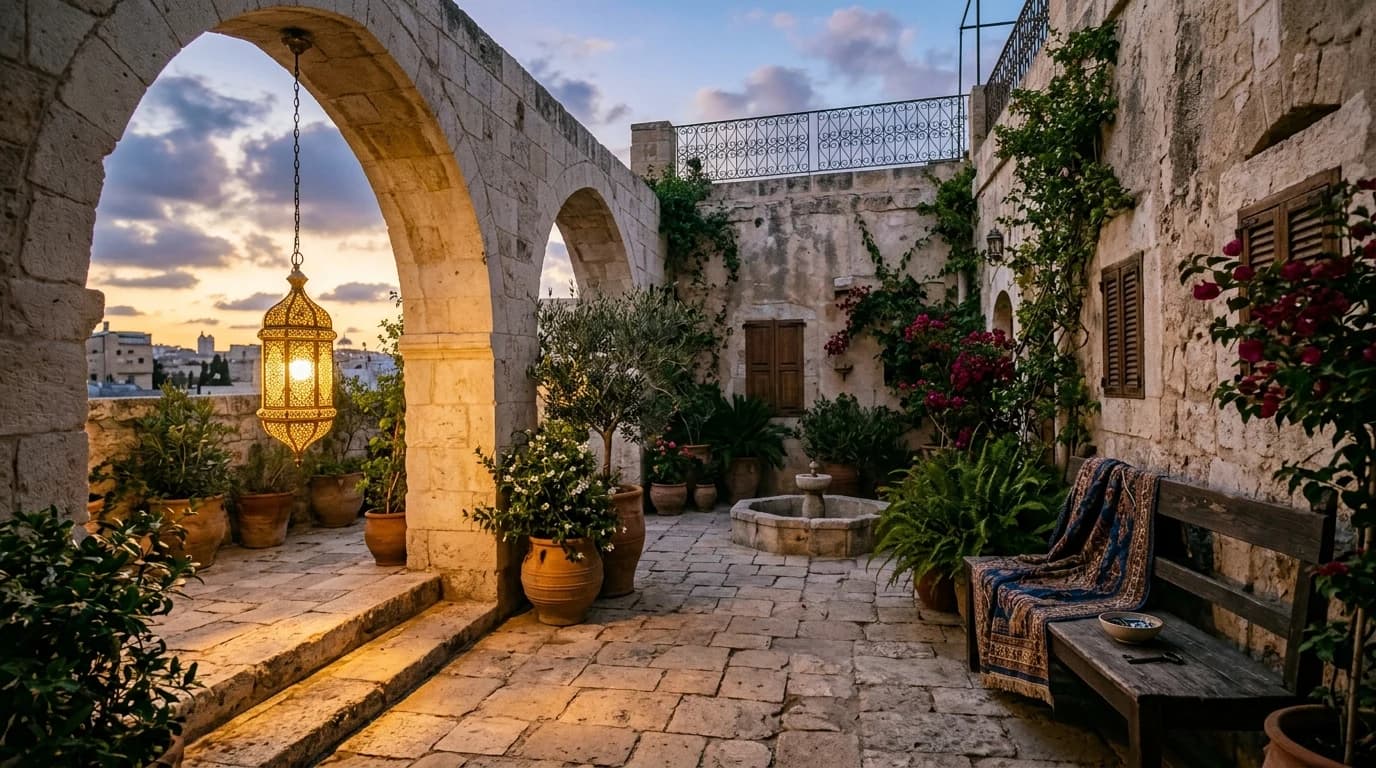
Traditional listening contexts were small: a courtyard at dusk, a coffeehouse back room, a private chamber with cushions on the floor. The player would tune in front of the audience, take a long breath, and begin. The first phrase is rarely the strongest; the maqam reveals itself gradually, almost shyly, before settling into its full color.
This piece is built for that kind of attention. Headphones help. A low lamp helps. The slow unfolding will eventually become the only thing in the room — the way a good conversation, halfway in, makes you forget what hour it is.

Watch the tradition
Watch the oud think out loud
The oud reveals itself in taqsim: unmetered improvisation, short decay, and pitch that slides like speech.
Naseer Shamma
Dasht Taqsim
A clear example of the oud as a solo speaking instrument: phrases, pauses, and small turns of pitch.
Naseer Shamma
Master of Oud
A broader performance frame for hearing how the instrument can move from intimacy to virtuosity.
A listening guide
What to listen for
The fretless slide. Notes do not jump from pitch to pitch; they slide, sometimes through intervals smaller than a Western half-step. The slide is structural — not ornament.
The microtones. Several pitches in Hijaz sit between the notes of a piano keyboard. They will sound, on first listen, slightly out of tune. They are not.
The risha. The plectrum the player uses — traditionally an eagle feather, today usually shaped plastic or horn — gives each note a distinctive percussive attack before the pitch settles.
The pauses. Taqsim has no meter and no rhythm section. The silences between phrases are intentional; they are where the maqam settles into the room.
The shape of longing. Hijaz does not resolve the way Western minor does. It opens, deepens, and leaves you somewhere you did not start.
From the listener to the player
If the oud pulled you in
The oud is a serious fretless instrument, but there are honest beginner paths if what moved you was that intimate, speech-like sound.

To hear the wood
~$110
Sony MDR-7506
A clear closed-back reference for hearing short decay, pick attack, and fretless slides without hyping the low end.
Buy on AmazonHandmade walnut Arabic oud (AAO-108)
A plain walnut oud from a seller with a return policy. Setup matters more than decorative inlay, and fresh strings can transform a student instrument.
D'Addario EJ95A Arabic oud strings
Fresh strings can rescue a dull student instrument, and oud tuning means strings are part of the learning curve.
A specialist oud
For Turkish or Arabic ouds above the starter tier, shop maker and specialist listings rather than generic marketplace bundles.
Affiliate links
These are honest recommendations — the ones we’d point a friend toward. As an Amazon Associate, SlowHum earns from qualifying purchases; we may also earn from other links. It costs you nothing extra, and prices are approximate. Full disclosure.
Common questions
Questions people ask about the oud
What is a maqam?
A maqam is a melodic mode in Arabic and Turkish music: a set of pitches, typical phrases and a sense of where the melody should rest, each carrying its own emotional colour. Some maqamat use intervals that fall between the notes of a piano keyboard.
Why does the oud have no frets?
Fretlessness is what allows those in-between intervals and the continuous slides between them. Frets would lock the instrument to fixed semitones and make most of the maqam repertoire unplayable.
Is the oud the ancestor of the European lute?
The European lute descends from the oud, which reached Europe through Al-Andalus and the Mediterranean — the word lute itself comes from al-‘ud. The European instrument later took on frets and a different tuning.
Listen to the oud.
The full 30-minute piece lives on the channel. Subscribe to catch each new tradition as it arrives.
Subscribe on YouTubeFree · No email required
More from this tradition
Other pieces for the oud
Continue the atlas
Other traditions
Duduk
Armenia
Shakuhachi
Japan
Quena
Peru & Bolivia
Celtic Harp
Ireland & Scotland
Kora
Mali & Senegal
Santur
Iran
Sitar
India
Guzheng
China
Morin Khuur
Mongolia
Kantele
Finland
Slack Key
Hawaii · soon
Mbira
Zimbabwe
Bansuri
India
Ney
Turkey
Tagelharpa
Norway · soon
Begena
Ethiopia · soon
Gayageum
Korea · soon
Ngoni
Mali · soon
Guqin
China
Erhu
China
Koto
Japan
Pipa
China
Setar
Iran
Sarod
India
Sarangi
India
Xiao
China
Kaval
Bulgaria
Dizi
China
Nyckelharpa
Sweden
Hurdy-gurdy
France
Saz
Turkey