Levant · Turkey & Syria
The
Oud · for anxiety relief
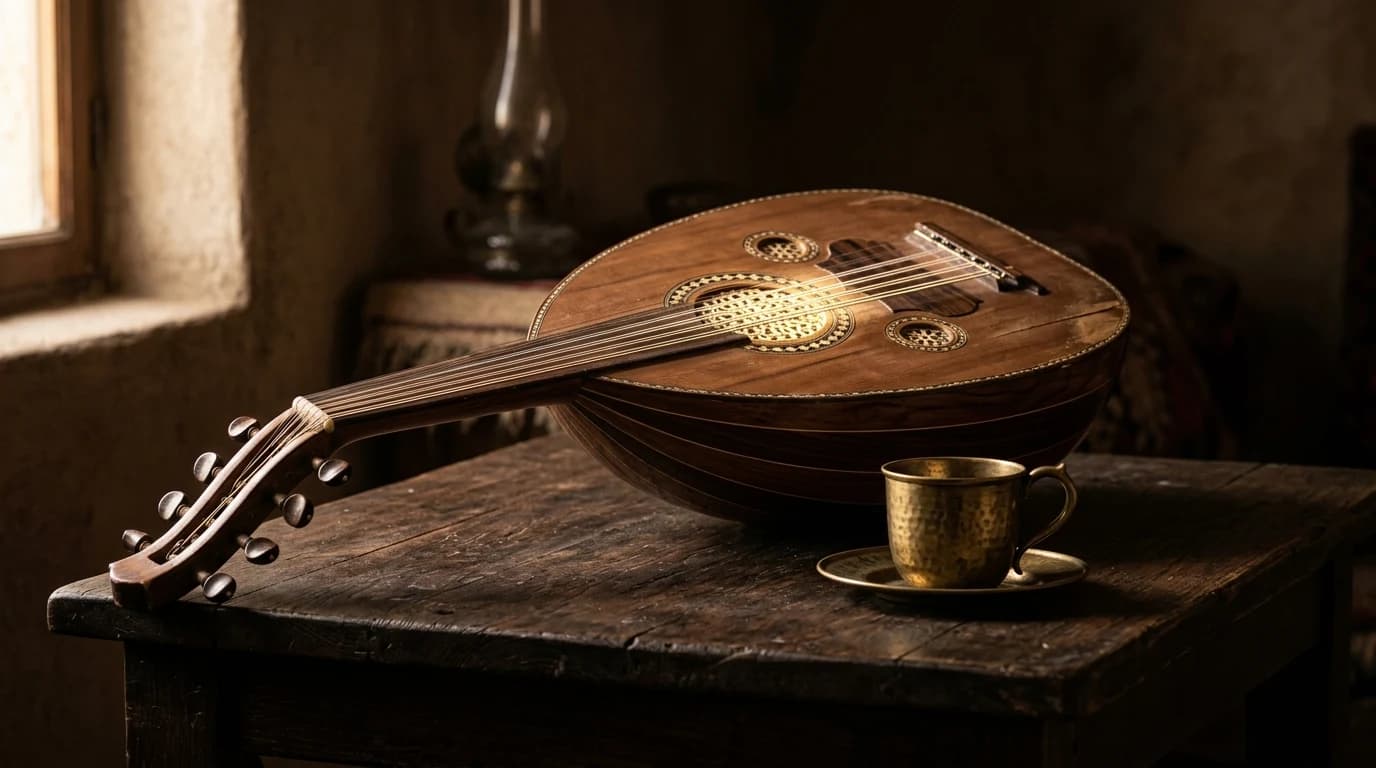
The oud in maqam Hijaz, paced to the rhythm of a slow human exhale, designed to slow the listener's nervous system phrase by phrase.

Quick answer
This is oud music chosen for pace rather than repertoire: slow taqsim improvisation in Hijaz, the maqam with the wide step near the bottom of the scale that gives Levantine music its longing quality. Phrases are short, spaced by rests, and follow the length of a hand rather than a metre. That breath-sized phrasing is why it suits an anxious evening better than continuous ambient sound.
01 · The mood
Why an instrument made for longing is also an instrument for calming the body.
The oud's particular emotional register — longing, intimacy, evening hours — is not, on its face, the obvious choice for an anxiety-relief piece. The associations seem inward, melancholic, possibly even amplifying for a listener already running anxious.
But the instrument's actual acoustic profile is doing something very different from its emotional profile. The oud is quiet. Its sustain is short. It plays in narrow dynamic ranges, in the chamber tradition of taqsim (unmetered improvisation), with audible breath-paced spacing between phrases. The body, listening to it, slows.
This piece deliberately leans into that mechanism. Phrases of six to ten seconds. Silences of three to four seconds between phrases — the length of a slow human exhale. The oud is, for these thirty minutes, less a musical instrument than a metronome for breathing.
02 · The maqam
Hijaz, the mode of longing — but also of release.
Maqam Hijaz is the mode this piece inhabits. Its defining feature is an augmented-second interval between the second and third scale degrees — an interval that sounds, to ears tuned by Western chromaticism, simultaneously bright and grieving. The maqam carries associations across the Arab and Turkish traditions of evening, of distance, of the call to prayer.
Within the maqam's emotional field, the slow taqsim form lets the instrument explore one phrase, settle into its resonance, and only then move toward the next. This is the opposite of how anxious thinking works. The instrument is, in effect, modeling a different cognitive style — and asking the listener's attention, gently, to follow.
There is no percussion. There is no other instrument. The fretless slide between pitches characteristic of the oud is the only motion in the piece. Microtonal — never jumps.
03 · The listening
Sit. Match the spacing.
Sit somewhere reasonably quiet. Set the volume so that the silences between phrases feel as present as the phrases themselves. Let the first three or four phrases pass without trying to do anything.
Then, if it helps, try to align your breathing with the piece's pacing — inhale during the silence between phrases, exhale through the next phrase. This is not a yoga instruction; it is a description of what tends to happen on its own after about four minutes with this recording. The taqsim was built for this.
If your thoughts continue racing for the first ten minutes, that is also fine. The piece is patient. So is the instrument. So is the mode. Stay with it.
A listening guide
What to listen for
The phrase length. Six to ten seconds. Each is a single exhale.
The silence length. Three to four seconds between phrases. Each is a slow inhale.
The augmented second. Hijaz's signature interval. You will know it when you hear it — it sounds both yearning and hopeful.
The fretless slide. Notes do not jump from pitch to pitch. They slide, microtonally, sometimes through intervals smaller than a Western half-step.
The narrow dynamics. Never louder than a quiet voice in a small room. The whole piece sits in the dynamic range that calms.
Common questions
Questions people ask about the oud · for anxiety relief
What is a taqsim?
A taqsim is an unmetered solo improvisation that explores a maqam. There is no fixed beat and no accompaniment to keep up with, so the music can pause for as long as the player wants.
What makes maqam Hijaz sound the way it does?
Hijaz has a lowered second degree and a wide gap up to the third, so the scale contains an interval much larger than a whole step. That stretch is what gives the mode its characteristic ache.
Why choose slow oud over ambient music for anxiety?
Ambient pads are continuous, so there is nothing to follow and nothing to rest on. A taqsim gives your attention short phrases with real silence between them, which some listeners find easier to settle their breathing against.
A SlowHum oud · for anxiety relief piece is in the making.
We're composing a thirty-minute piece for this tradition. Subscribe to be first — and watch the performances above in the meantime.
Subscribe on YouTubeFree · No email required
More from this tradition
Other pieces for the oud
Continue the atlas
Other traditions
Duduk
Armenia
Shakuhachi
Japan
Quena
Peru & Bolivia
Celtic Harp
Ireland & Scotland
Kora
Mali & Senegal
Santur
Iran
Sitar
India
Guzheng
China
Morin Khuur
Mongolia
Kantele
Finland
Slack Key
Hawaii · soon
Mbira
Zimbabwe
Bansuri
India
Ney
Turkey
Tagelharpa
Norway · soon
Begena
Ethiopia · soon
Gayageum
Korea · soon
Ngoni
Mali · soon
Guqin
China
Erhu
China
Koto
Japan
Pipa
China
Setar
Iran
Sarod
India
Sarangi
India
Xiao
China
Kaval
Bulgaria
Dizi
China
Nyckelharpa
Sweden
Hurdy-gurdy
France
Saz
Turkey