South Asia · India
The
Sitar
Seven strings you play. Thirteen strings that play themselves, ringing in sympathy with whatever you touch.
Quick answer
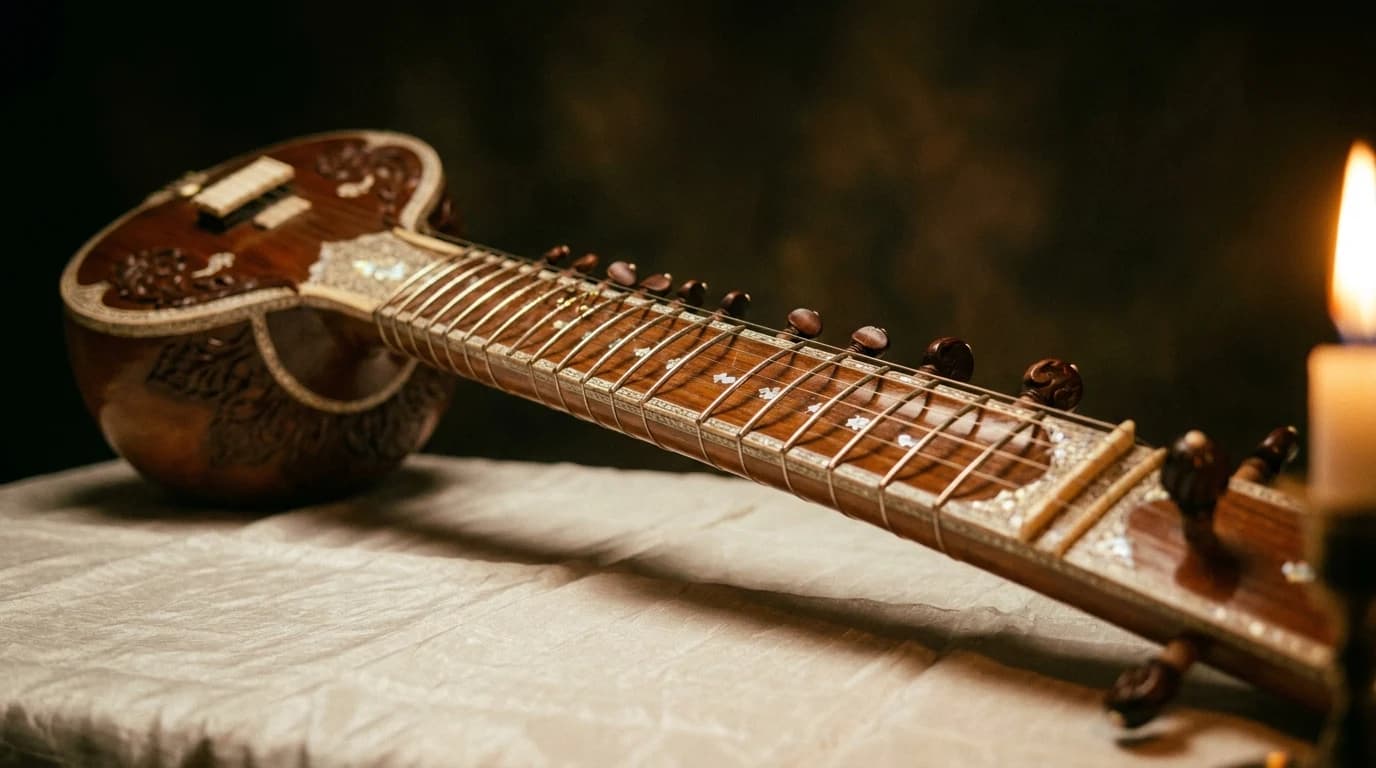
The sitar is a long-necked North Indian lute with a gourd resonator, curved movable frets, and a second set of sympathetic strings running underneath the frets that are never plucked but ring on their own. That resonance is the halo you hear around every note. Performances open with alap, a slow unmetered exploration of the raga with no drum, which can run for a long time before any pulse appears — ideal listening for sustained deep work.
Listen now
01 · Origins
The court instrument of a long patience.
The sitar evolved in North India between the 13th and 16th centuries, a confluence of the Persian setar (three-string lute) and the indigenous vichitra veena, transformed by centuries of refinement at the Mughal courts in Agra, Delhi, and Lahore. By the time the instrument reached its modern form — long neck, movable curved frets, gourd resonator body, full set of sympathetic strings — it had become the primary vehicle for Hindustani classical music, the northern tradition that branched from the pan-subcontinental raga system sometime around the 12th century.
The word sitar comes from the Persian seh (three) and tar (string). The instrument has kept the name even as it has grown to seven main playing strings and up to thirteen tarab — sympathetic resonance strings — running beneath the frets.
What the sympathetic strings do is exceptional. They are never plucked directly. They ring by vibration: when you play a note, any sympathetic string tuned to a harmonically related pitch begins to vibrate on its own. The result is a shimmering halo of sound around every note the player touches, as if the room itself were resonating. It is the defining acoustic signature of Indian classical music — one note played, four or five heard.

02 · The raga
Not a scale. A world.
Western music is organized around keys and chords. Indian classical music is organized around ragas — a word that translates loosely as “colour” or “mood” and that means, in practice, a complete sonic world: specific pitches, specific ornaments for each pitch, a characteristic ascending and descending melodic pattern, associations with a particular time of day, season, and emotional state, and a body of compositions and improvisational frameworks developed over centuries of practice.
Raga Yaman, which this piece inhabits, is an evening raga — most purely performed after sunset, before full dark. It is built on a Lydian scale (a raised fourth gives it a peculiar brightness that contrasts with the modal gravity of most ragas) and carries associations of longing, devotion, and the kind of expectancy that arrives in the first hour of dusk. Its proper performance begins with an alap: an unmetered, unpulsed exploration of the raga's pitches and characteristic phrases, lasting anywhere from twenty minutes to an hour.
The alap is where this piece lives. There is no percussion. There is no fixed tempo. The player moves through the raga slowly, introducing notes one at a time in a process that is as much meditation as performance — each phrase a complete statement, each silence between phrases as intentional as the notes themselves.
03 · The listening
How to be in the room with it.
Indian classical music was not designed for concert halls. It was designed for small rooms with an intimate audience — the darbar of a princely court, the drawing room of a wealthy patron, eventually the small gatherings of music lovers known as a mehfil. The relationship between performer and listener was understood to be participatory: the listener's attention and appreciation were considered part of the performance, and a truly receptive audience could lift a musician to music they would not otherwise have played.
This piece asks for that kind of listening. Not passive consumption but something closer to accompaniment — letting the music set the pace of your breathing, following the movement of a phrase without needing to know where it's going, staying with the long spaces between notes without filling them mentally with anticipation.
The sympathetic strings will do some of the work for you. The halo of resonance they produce means that any moment of apparent silence actually contains sound — the ringing of strings that were never touched, still vibrating from something played three beats ago. Once you begin to hear that layer, the music opens up considerably.

A listening guide
What to listen for
The sympathetic strings. You do not need to identify them. Simply notice the shimmer around every note — the way a single plucked pitch seems to fill more space than one string could fill alone.
The meend. The characteristic slide or glide between notes, produced by pulling the main string across the fret. A pitch does not simply arrive; it is pulled toward its destination from below.
The pauses. In alap, silence is structural. The player stops, waits, lets the resonance fully decay, and begins the next phrase fresh. These pauses are not hesitations. They are considered.
The raised fourth. Raga Yaman's defining feature is a sharp, raised fourth scale degree — a pitch that adds a slight, yearning brightness to what would otherwise be a more ordinary modal scale. You will hear it lift each phrase.
The time it takes. The alap does not build toward a climax. It simply deepens. Somewhere around the fifteen-minute mark, if the piece has you, you will realize you are no longer tracking phrases — you are simply inside the raga.
From the listener to the player
If the sitar pulled you in
The sitar is a deep, lifelong instrument. If what moved you was that buzzing, resonant voice, here's an honest way to begin understanding it.
Learn it
~$18
Hal Leonard Sitar Method
A clear, reputable starting method — tuning, the sympathetic strings, right-hand technique, and first ragas — before you commit to an instrument.
Buy on Amazon
To hear the strings
~$110
Sony MDR-7506
A neutral reference for hearing the sitar's sympathetic-string shimmer and the meend that slides between notes.
Buy on AmazonA real sitar
Student sitars vary wildly in setup. Reverb's specialist sellers are a far safer place to find a playable instrument than a generic marketplace bundle.
Affiliate links
These are honest recommendations — the ones we’d point a friend toward. As an Amazon Associate, SlowHum earns from qualifying purchases; we may also earn from other links. It costs you nothing extra, and prices are approximate. Full disclosure.
Common questions
Questions people ask about the sitar
What are the sympathetic strings for?
They are tuned to the notes of the raga and vibrate on their own whenever the player sounds a matching pitch. Nobody touches them; they are what makes a single plucked note bloom into a shimmering cloud.
What is meend?
Meend is the sitar’s glide between pitches, produced by pulling a string sideways across the curved fret. A player can travel several notes on one pluck, which is why sitar lines sound like they bend rather than step.
What is alap and why is it so long?
Alap is the opening section in which the raga is revealed note by note without rhythm or accompaniment beyond the drone. It is unhurried by design — the point is to establish the mode’s character before anything begins to move.
Listen to the sitar.
The full 30-minute piece lives on the channel. Subscribe to catch each new tradition as it arrives.
Subscribe on YouTubeFree · No email required
More from this tradition
Other pieces for the sitar
Continue the atlas
Other traditions
Duduk
Armenia
Shakuhachi
Japan
Quena
Peru & Bolivia
Celtic Harp
Ireland & Scotland
Kora
Mali & Senegal
Santur
Iran
Oud
Turkey & Syria
Guzheng
China
Morin Khuur
Mongolia
Kantele
Finland
Slack Key
Hawaii · soon
Mbira
Zimbabwe
Bansuri
India
Ney
Turkey
Tagelharpa
Norway · soon
Begena
Ethiopia · soon
Gayageum
Korea · soon
Ngoni
Mali · soon
Guqin
China
Erhu
China
Koto
Japan
Pipa
China
Setar
Iran
Sarod
India
Sarangi
India
Xiao
China
Kaval
Bulgaria
Dizi
China
Nyckelharpa
Sweden
Hurdy-gurdy
France
Saz
Turkey