East Asia · Japan
The
Shakuhachi
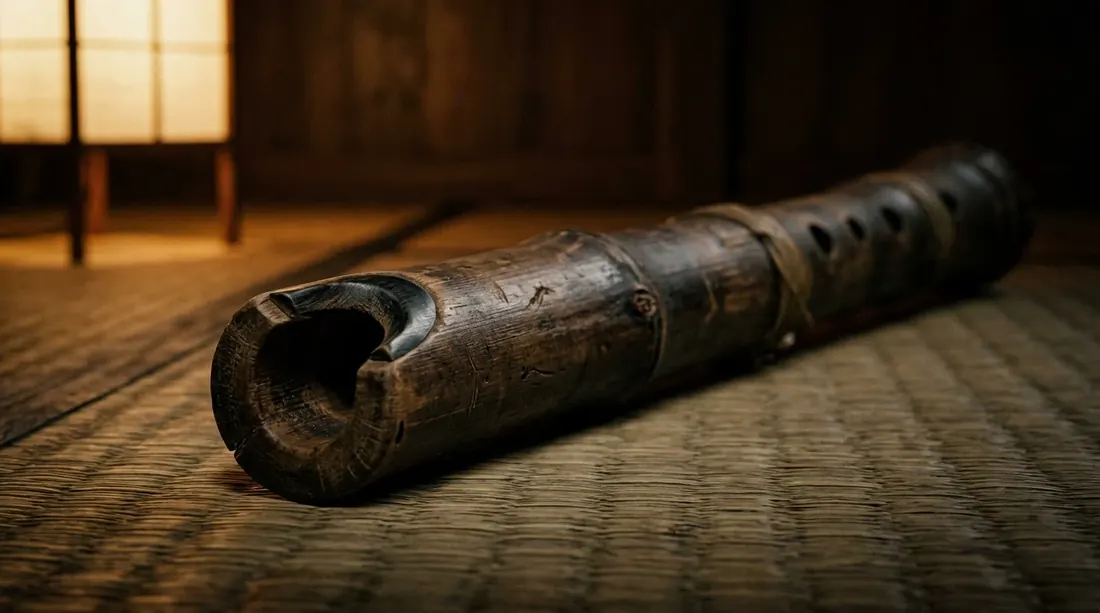
A length of bamboo with five holes and a notch at the top. For seven centuries, the breath-instrument of Zen.
Quick answer
The shakuhachi is a Japanese end-blown bamboo flute with four finger holes in front and one behind, played by aiming the breath across a sharpened outer edge. Its sound is airy and deliberately imperfect: breath noise, bent pitches and long silences are part of the music rather than flaws in it. Fuke Zen monks used it for suizen, blowing meditation, which is why the old solo repertoire feels unhurried and unmetered.
Listen now
01 · Origins
The blowing of Zen.
The shakuhachi takes its name from its length. Historically it measured one shaku and eight sun — about 54 centimetres — and that awkward, almost clumsy word became the instrument’s name, the way a carpenter might name a tool after the length of its handle. It is a humble object: a single piece of bamboo, five finger holes, a sharp diagonal notch carved into the rim. Nothing else.
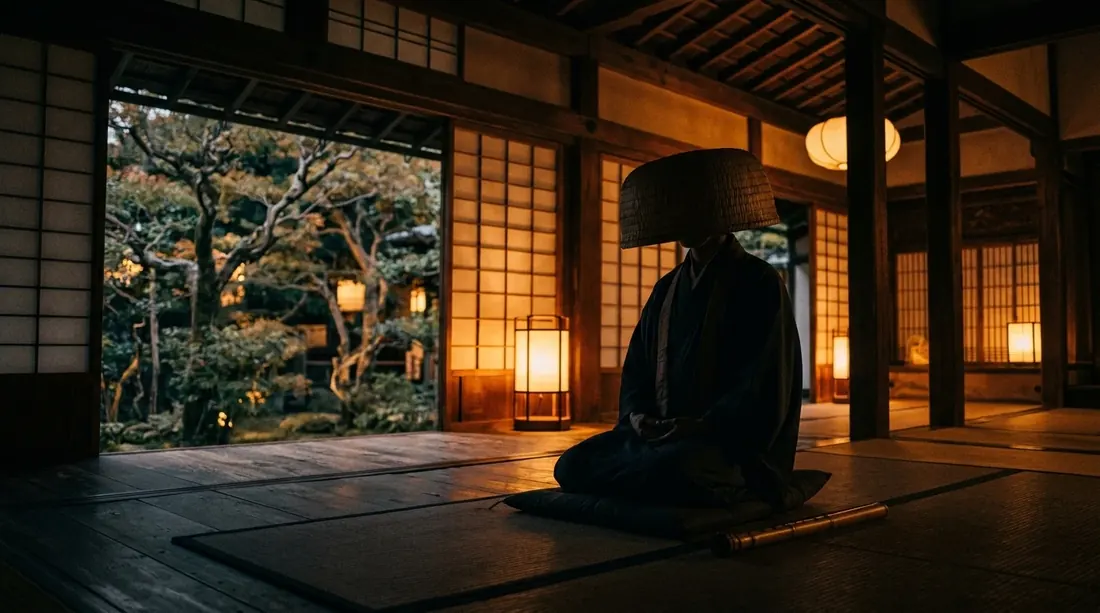
For most of its modern history, the shakuhachi was not played as music. It was played as suizen — blowing Zen — a meditative discipline practised by the komusō, the wandering mendicant monks of the Fuke sect who walked the roads of Edo-period Japan wearing tall woven baskets over their heads. The basket, called a tengai, hid the face completely, obscuring identity and ego alike. What remained was the breath, the bamboo, and the road.
The repertoire the komusō carried is called honkyoku — original pieces. These are not compositions in the Western sense; they are breath-forms, each one the length of a single exhalation followed by a single inhalation, repeated until the piece ends of its own accord. There is no tempo. There is no meter. There is only the player’s lungs and the room they are standing in.
02 · The instrument
Why it sounds like weather.
The shakuhachi’s tone is unmistakable on first hearing: breathy, woody, a little rough, with a hiss of air around every note. That hiss is not a flaw. It is the sound of the bamboo itself, and of the musician’s breath moving through an instrument that refuses to pretend to be anything other than what it is — a tube, a notch, and a human lung.
A good shakuhachi player bends pitch constantly. The five holes give only a pentatonic scale, so every chromatic note — every sharp, every flat, every microtone — has to be produced by angling the chin and covering the utaguchi (the mouthpiece notch) partially with the lip. This is called meri and kari: dark notes and bright notes. It is the reason the shakuhachi can sound, in one phrase, like wind moving over stone.
In this piece the solo shakuhachi is accompanied only by a distant shō — a small mouth organ used in Japanese court and temple music — which holds a continuous, unchanging harmonic cloud underneath the melody. The effect is a little like looking at calligraphy on silk: a single line drawn with great care, against a surface that has its own quiet texture.
03 · The feeling
What the notch teaches you.
There is an old exchange in the shakuhachi tradition, attributed to the Fuke sect: a student complains that his tone is thin and weak. The teacher says, Don’t blow harder. Make the notch wider. The student goes away, carves the notch a little deeper, and the tone finds its body.
The point of the story is practical — a wider utaguchi does admit more breath — but the teaching lives somewhere else. What the shakuhachi asks of a player is not effort but opening. The air has to be given somewhere to go. The ego has to be given somewhere to set itself down. What comes out is the room, and the bamboo, and whatever is left of the player when they are not trying.
This is also, we suspect, why the shakuhachi has endured for so long as an instrument of rest. It does not try to move you. It simply offers you a shape to breathe along with. Most listeners find that after eight or ten minutes, their own breath has lengthened without their noticing — which is exactly what the komusō had in mind when they went for a walk down a road and let the instrument do the rest.
Watch the tradition
Watch the breath do the work
These videos are useful because they show the instrument as an act of breathing, not only a flute line.
Riley Lee
Shakuhachi Sleep Music
A long, spare performance for noticing the air at the start and end of every tone.
Riley Lee
Shakuhachi music for rest
Listen for how the silences remain active; the pause is part of the phrase.
A listening guide
What to listen for
The breath between phrases. These are not rests — they are the other half of the piece. Give them the same attention you give the notes.
The hiss at the start of each note. That is the bamboo, not a flaw in the audio. Traditional shakuhachi players consider it part of the tone.
Microtonal bends, especially on long notes. Pitch slides a few cents down (meri) and back up (kari). The instrument speaks in a scale that Western notation can’t quite capture.
The shō drone underneath. It never changes, but it breathes along with the piece — the reeds respond slightly to the air in the room. Let your ear settle onto it when the shakuhachi is silent.
At around the ten-minute mark, something shifts. The phrases get longer; the silences lengthen with them. If you are working, you may find your shoulders have dropped. If you are resting, you may find you have stopped thinking.
From the listener to the player
If the shakuhachi left room
The shakuhachi is a breath practice before it is a repertoire. Start with a learner-friendly flute and patient expectations.

Quiet-room listening
~$85
Philips SHP9500
Open-back headphones are excellent for shakuhachi because they keep the bamboo tone airy and let silence feel like the room, not a sealed box.
Buy on AmazonShakuhachi Yuu (plastic, 1.8)
A durable plastic 1.8 is more useful than a beautiful unplayable wall piece, and plastic shrugs off the dry air and humidity swings that crack bamboo.
Shakuhachi: Fundamental Technique Guidance
The first battle is tone production. A method book gives you embouchure, posture, and breathing drills before songs.
A maker-made shakuhachi
When you know the length and school you want, Reverb is the better place to compare real instruments from specialist sellers.
Affiliate links
These are honest recommendations — the ones we’d point a friend toward. As an Amazon Associate, SlowHum earns from qualifying purchases; we may also earn from other links. It costs you nothing extra, and prices are approximate. Full disclosure.
Common questions
Questions people ask about the shakuhachi
Why does the shakuhachi sound so breathy?
The player blows across an open notched edge rather than into a mouthpiece, so a portion of the air never becomes tone. In this tradition that breath is wanted — it is the sound of the person playing, not a defect to be polished out.
What is honkyoku?
Honkyoku are the solo pieces handed down through the Fuke Zen temples, played without accompaniment and without a fixed beat. Phrases are shaped by the length of one breath, which is why the music seems to pause and restart on its own.
Is shakuhachi good for morning listening?
It suits mornings well. It is austere and spacious rather than lush, so it wakes a room without filling it, and the long rests leave room for thought instead of demanding attention.
Listen to the shakuhachi.
The full 30-minute piece lives on the channel. Subscribe to catch each new tradition as it arrives.
Subscribe on YouTubeFree · No email required
Continue the atlas
Other traditions
Duduk
Armenia
Quena
Peru & Bolivia
Celtic Harp
Ireland & Scotland
Kora
Mali & Senegal
Santur
Iran
Oud
Turkey & Syria
Sitar
India
Guzheng
China
Morin Khuur
Mongolia
Kantele
Finland
Slack Key
Hawaii · soon
Mbira
Zimbabwe
Bansuri
India
Ney
Turkey
Tagelharpa
Norway · soon
Begena
Ethiopia · soon
Gayageum
Korea · soon
Ngoni
Mali · soon
Guqin
China
Erhu
China
Koto
Japan
Pipa
China
Setar
Iran
Sarod
India
Sarangi
India
Xiao
China
Kaval
Bulgaria
Dizi
China
Nyckelharpa
Sweden
Hurdy-gurdy
France
Saz
Turkey