Central Asia · Mongolia
The
Morin Khuur
A horsehair fiddle, an open steppe, and the wind that never stops moving across both. Thirty minutes of nature blend, played outside.

Quick answer
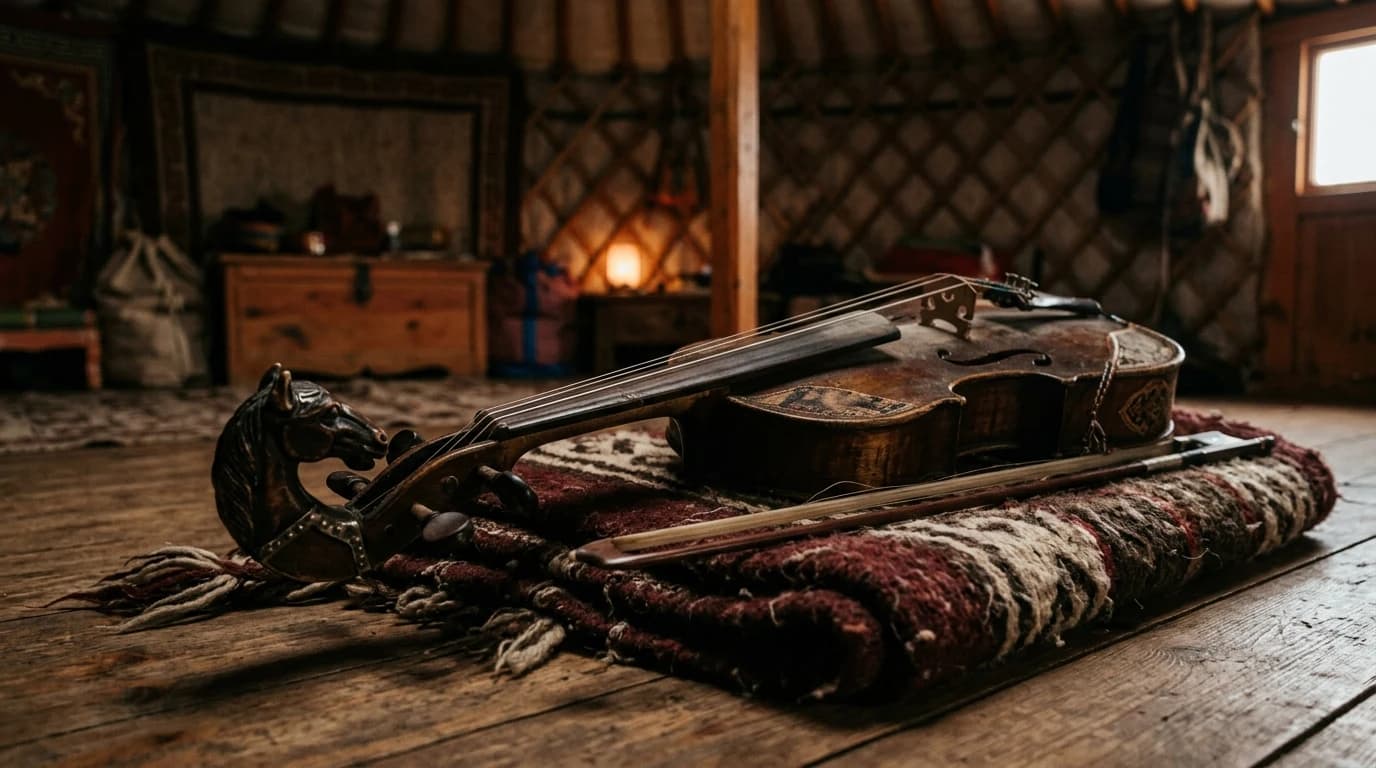
The morin khuur is the Mongolian horsehead fiddle: two strings of bundled horsehair bowed with a loose horsehair bow, and a carved horse’s head at the top of the neck. Its tone is broad, slightly rough and open, made to carry across grassland rather than fill a concert hall. It is often heard alongside khoomei, the overtone singing in which one voice produces a low fundamental and a whistling melody above it at the same time.
Listen now
01 · Origins
Two horsehair strings, a horsehair bow, and a country built around the horse.
The morin khuur — literally “horse-headed fiddle” — is the national instrument of Mongolia and has been played on the steppe for at least nine hundred years. Its two strings are made of horsehair. It is bowed with a third bundle of the same material. The neck is traditionally carved to resemble a horse; Mongolian legend holds that the first morin khuur was built by a man grieving the death of his favourite mount.
The instrument's tone is unmistakable: slightly nasal, slightly woody, with a sustained bowed warmth no other fiddle quite matches. Played outdoors — its traditional context — its long held tones carry across grassland in a way that suggests the instrument was tuned to the steppe itself.
It is often paired with khoomei (Mongolian overtone throat-singing). This piece features the morin khuur alone, so the instrument's voice has the full space to itself. Khoomei will get its own piece, with the attention it deserves.
02 · The piece
Morin khuur on top of the steppe wind itself.
This recording is built differently from the rest of the SlowHum catalog. Underneath the morin khuur — for the whole thirty minutes — there is a continuous low layer of high-altitude steppe wind. Not intermittent ambience. Not weather sound effects between sections. A constant, gentle, sustained wind, present at low volume throughout.
The morin khuur plays on top of it. Long bowed tones, five to eight seconds each. Pentatonic phrases evoking the open steppe. Subtle vibrato and occasional grace-note ornaments at phrase ends. Pacing at 52 BPM. Between phrases — and there are many — only the wind remains audible.
The recording space is no recording space at all. There is no reverb, no walls, no room. Just the open-air acoustic of the instrument with the wind providing the only spatial signature. This is the nature-blend format — a category of healing music that doubles its addressable audience by giving listeners both the instrument and the environment in one piece.

03 · The listening
Outside, ideally.
This is the SlowHum piece most suited to outdoor listening — a walk, a porch, a window left open in autumn. The wind layer was designed to consonate with whatever ambient sound your environment already has, rather than compete with it.
Indoors, headphones reveal the depth of the wind layer more clearly than speakers do. The wind is at very low volume in the mix; on speakers it can disappear into the room, which is also fine — that's how it would sound on the steppe.
If the silence between phrases makes you uncomfortable, this piece is doing what it was made to do. The morin khuur tradition is full of long silences. The wind fills them.

A listening guide
What to listen for
The wind. Continuous, low, sustained. Not a sound effect — the second instrument in the piece.
The bowed warmth. The morin khuur's signature slightly-nasal woody resonance. Closer in feeling to a viola than a violin.
The pentatonic phrases. Five-note scales evoking the steppe. The phrases never resolve forcefully; they suggest a horizon rather than a destination.
The silences. Long pauses between phrases. The wind is what occupies them.
The grace notes. Small ornaments at the end of held tones — a quick upward flick. The morin khuur's traditional sigh.
From the listener to the player
If Mongolian throat singing pulled you in
Khoomei is sung, not bought — the instrument is your own voice. But there's a real way to begin, and a related instrument worth knowing.

Learn the technique
~$33
Overtone Singing (Mark van Tongeren)
The standard book on overtone and throat singing — the physics, the cultures, and exercises for finding your own harmonics. The honest place to start.
Buy on Amazon
To hear the overtones
~$298
Sony WH-1000XM5 Headphones
Khoomei's magic is a second pitch whistling above the drone. Detailed headphones make those overtones unmistakable — and easier to learn to hear.
Buy on AmazonA morin khuur (horsehead fiddle)
The bowed instrument that so often accompanies khoomei. For a real one, browse specialist sellers on Reverb.
Affiliate links
These are honest recommendations — the ones we’d point a friend toward. As an Amazon Associate, SlowHum earns from qualifying purchases; we may also earn from other links. It costs you nothing extra, and prices are approximate. Full disclosure.
Common questions
Questions people ask about the morin khuur
What is khoomei?
Khoomei is Mongolian and Tuvan overtone singing, in which a singer shapes the mouth and throat so that one of the harmonics above a sustained low note becomes audible as a separate whistling melody. One person appears to be singing two lines at once.
Why is the morin khuur strung with horsehair?
Both the strings and the bow are made from bundled horsehair, which gives the instrument its soft-edged, slightly airy attack rather than the focused bite of a gut or steel string. The horse is central to the instrument’s form and its repertoire.
Does this music work layered with nature sound?
It layers unusually well. The bowed drone and the overtone voice both sit in narrow frequency bands, so wind and open-air recordings fill the space around them instead of competing with them.
Listen to the morin khuur.
The full 30-minute piece lives on the channel. Subscribe to catch each new tradition as it arrives.
Subscribe on YouTubeFree · No email required
Continue the atlas
Other traditions
Duduk
Armenia
Shakuhachi
Japan
Quena
Peru & Bolivia
Celtic Harp
Ireland & Scotland
Kora
Mali & Senegal
Santur
Iran
Oud
Turkey & Syria
Sitar
India
Guzheng
China
Kantele
Finland
Slack Key
Hawaii · soon
Mbira
Zimbabwe
Bansuri
India
Ney
Turkey
Tagelharpa
Norway · soon
Begena
Ethiopia · soon
Gayageum
Korea · soon
Ngoni
Mali · soon
Guqin
China
Erhu
China
Koto
Japan
Pipa
China
Setar
Iran
Sarod
India
Sarangi
India
Xiao
China
Kaval
Bulgaria
Dizi
China
Nyckelharpa
Sweden
Hurdy-gurdy
France
Saz
Turkey