East Asia · China
The
Guzheng
Twenty-one strings on a long wooden zither, a teahouse in late afternoon, and the slow cascading hands of a tradition two and a half millennia old.
Quick answer
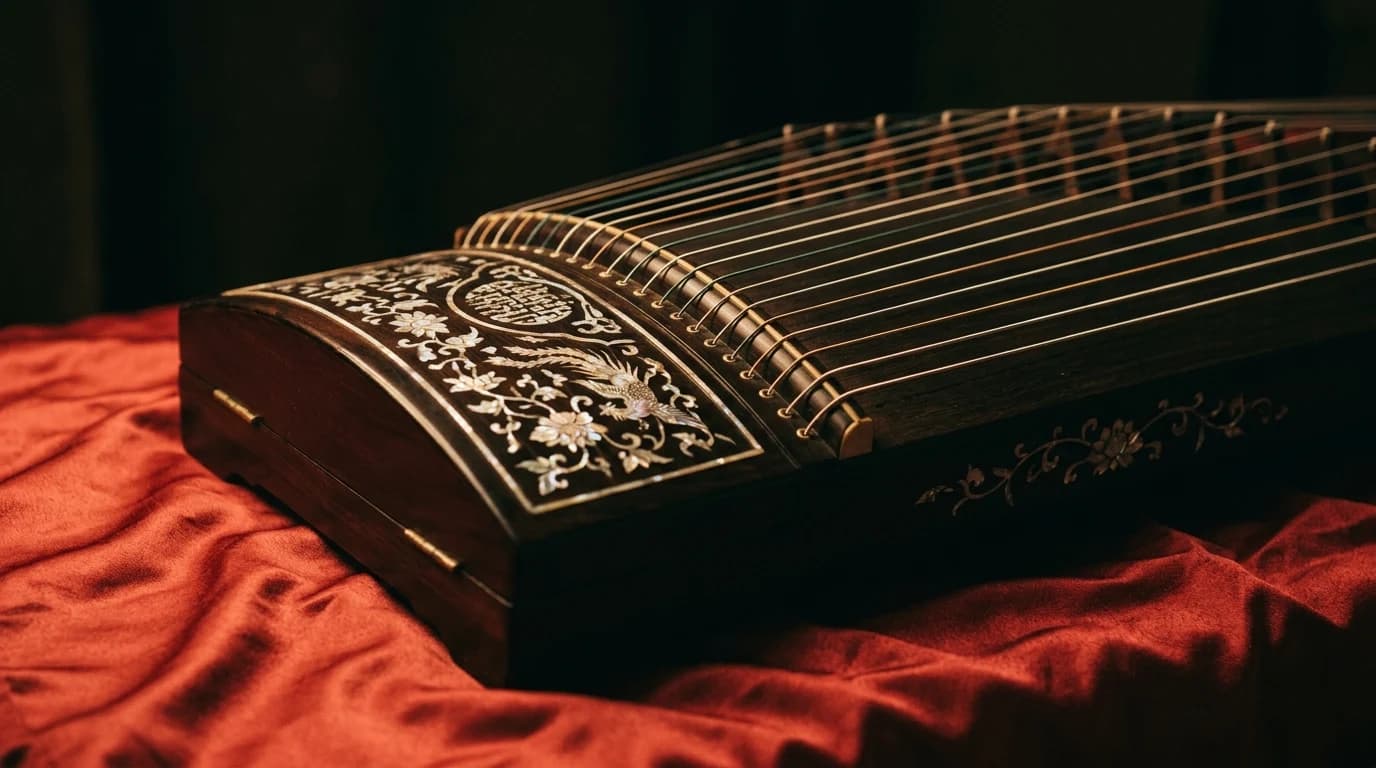
The guzheng is a long Chinese zither, traditionally strung with twenty-one strings, each raised on its own movable wooden bridge so the player can slide it to change the tuning. Notes are plucked with picks on one hand while the other presses the strings behind the bridges to bend and colour the pitch. Its sound is crystalline and cascading rather than sustained, which is why it is so often chosen for treatment rooms and slow bodywork.
01 · Origins
The crystalline ancestor of every Chinese zither.
The guzheng is one of the oldest continuously played instruments in the world. Archaeological fragments date to the Warring States period around the 5th century BCE; written references are older still. It is a long narrow wooden box traditionally strung with twenty-one strings, each supported by a movable wooden bridge the player slides to change pitch. Its sound is crystalline, cascading, bell-like — closer in feel to a harp than to any Western zither.
Across two-and-a-half millennia the guzheng has been a scholar's instrument, a court instrument, an opera instrument, and a teahouse instrument. Its repertoire spans piercingly fast virtuoso pieces, slow contemplative meditations, and everything in between. The same instrument can fill an opera house or steady a meditation room.
What identifies the guzheng instantly is its right-hand cascade — the fingerpicked descending or ascending arpeggios that move down or up the strings like water across stone. Its left hand carries pitch-bending and vibrato (yin and rou) — the slow expressive ornaments that give the instrument its scholarly voice.
02 · The piece
Slow cascades, for hands that are doing nothing else.
This piece is paced at 55 BPM in a traditional D minor pentatonic tuning. Long flowing phrases with full natural decay. The right hand carries gentle cascading figures across the strings — never fast, never percussive, more like a slow stream than a waterfall. The left hand supplies the pitch-bending (yin) and vibrato (rou) ornaments that have been the instrument's signature for two millennia.
It is positioned for spa, bodywork, and the long unhurried interval that good massage opens up. The strings ring out fully between phrases — three- to five-second decays where the room itself becomes part of the music — and there are no climactic gestures, no flourishes, nothing that would pull attention back from the body to the mind.
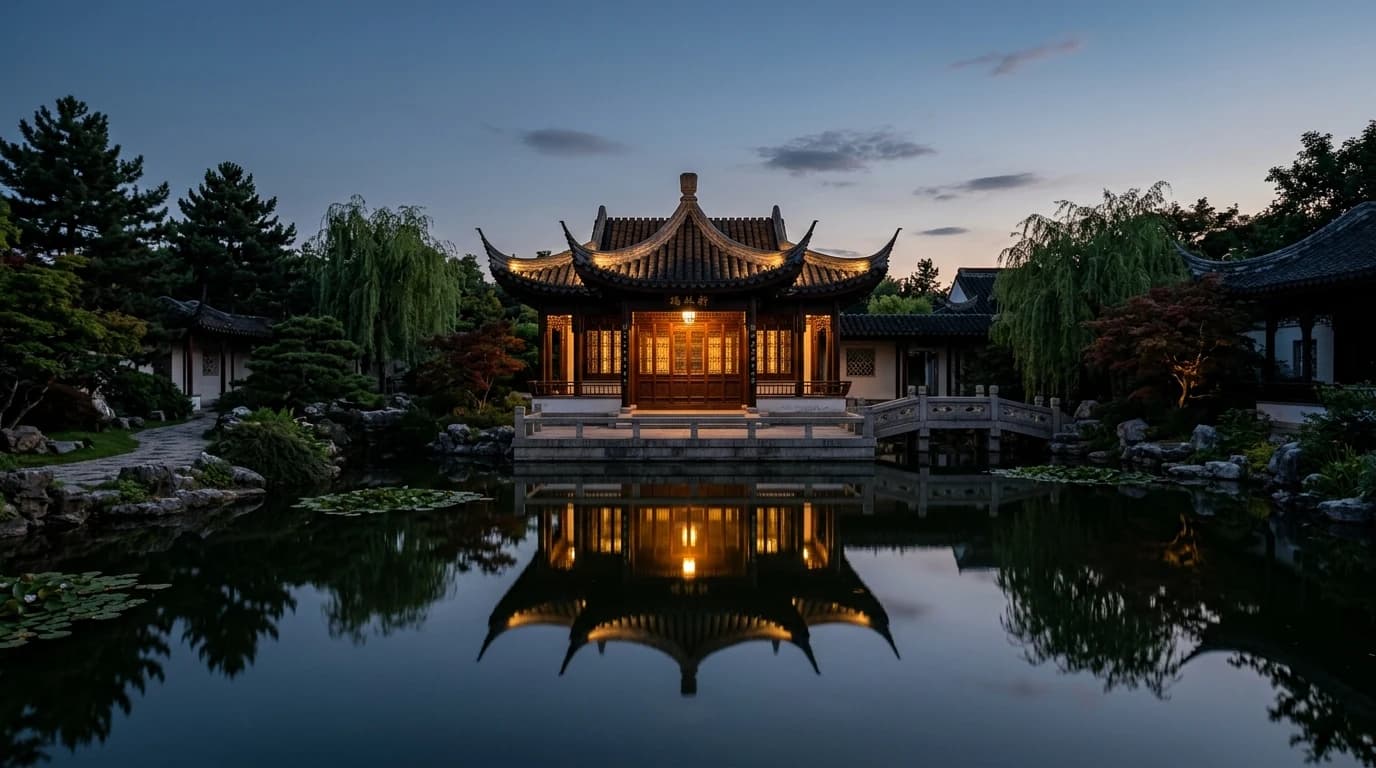
The recording space is a small Chinese garden pavilion at twilight: warm dry acoustics, very short natural reverb. The instrument is the only sound. There is no percussion, no other melodic instrument, no synth, no environmental noise.

03 · The listening
Have the body in the room, not the mind.
This is one of the few SlowHum pieces designed for use during another activity — specifically, the kind of bodywork or stretching where attention rests inside the body rather than on the music. The guzheng's cyclical cascades, full of small variations but always returning home, give the body something to time itself against without distracting the mind.
It is also, perhaps unexpectedly, excellent for quiet reading at the end of a long day. The same qualities that make it spa-correct — predictable motion, full sustain, no surprises — make it reader-correct.
If you are alert and want to be transported, listen to a faster guzheng piece. This one is for the times you have already arrived.
A listening guide
What to listen for
The cascade. The right hand moves down or up the strings in slow flowing figures. Listen for the way the strings ring on top of each other.
The yin. Left-hand pitch-bending — a string is pulled or pressed after it has been plucked, sliding its pitch downward. The slow expressive ornament that defines the instrument's voice.
The rou. Left-hand vibrato — a fast tremolo on a sustaining note. Subtler than yin; gives each long note a living quality.
The decay. Three to five seconds per ringing note. The pauses are the music breathing.
The pentatonic field. Only five notes per octave. Whatever phrase the right hand plays will consonate with whatever the left hand has just bent.
Common questions
Questions people ask about the guzheng
What is the difference between a guzheng and a guqin?
The guzheng is large, bridged and bright, with twenty-one strings and a repertoire that includes fast, virtuosic pieces. The guqin is small, has seven strings and no bridges, and is quiet and austere — a scholar’s private instrument rather than a performing one.
How does a guzheng bend notes?
The right hand plucks in front of the bridges; the left presses down on the same string behind them. That pressure raises the pitch and creates the vibrato and slides that make the instrument sound vocal.
Is guzheng music suitable for massage or spa settings?
It is a common choice because the texture is even and the attacks are soft, with no sudden dynamic jumps in the slower repertoire. Fast virtuoso pieces exist too, so the selection matters more than the instrument.
A SlowHum guzheng piece is in the making.
We're composing a thirty-minute piece for this tradition. Subscribe to be first — and watch the performances above in the meantime.
Subscribe on YouTubeFree · No email required
Continue the atlas
Other traditions
Duduk
Armenia
Shakuhachi
Japan
Quena
Peru & Bolivia
Celtic Harp
Ireland & Scotland
Kora
Mali & Senegal
Santur
Iran
Oud
Turkey & Syria
Sitar
India
Morin Khuur
Mongolia
Kantele
Finland
Slack Key
Hawaii · soon
Mbira
Zimbabwe
Bansuri
India
Ney
Turkey
Tagelharpa
Norway · soon
Begena
Ethiopia · soon
Gayageum
Korea · soon
Ngoni
Mali · soon
Guqin
China
Erhu
China
Koto
Japan
Pipa
China
Setar
Iran
Sarod
India
Sarangi
India
Xiao
China
Kaval
Bulgaria
Dizi
China
Nyckelharpa
Sweden
Hurdy-gurdy
France
Saz
Turkey