Caucasus · Armenia
The
Duduk
A double-reed flute of apricot wood. Closer to the human voice than any other instrument.
Quick answer
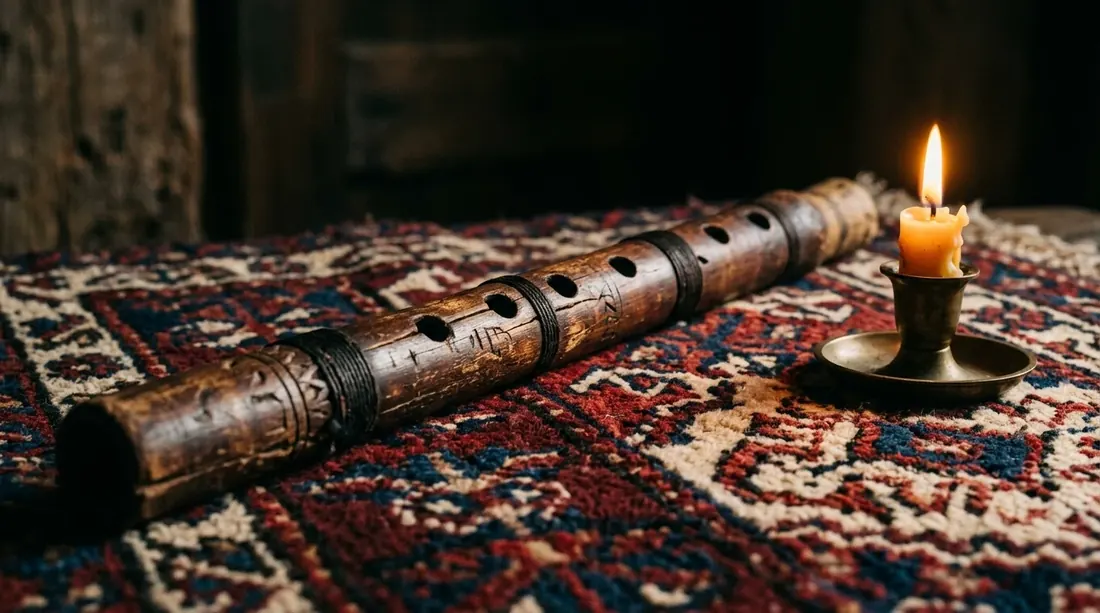
The duduk is an Armenian double-reed woodwind carved from apricot wood, with a wide reed that gives it a soft, slightly breathy voice close to a human alto. It is usually played over a second duduk holding a continuous drone, so the melody never leaves silence behind it. That unbroken drone and the instrument’s narrow, vocal range make it one of the easiest traditions to fall asleep to.
Listen now
01 · Origins
Three thousand years of breath.
The duduk is old. Archaeologists place its ancestor in the kingdom of Urartu around 1200 BCE, which means that for longer than there has been a city called Yerevan, there have been people in these hills shaping apricot wood into short pipes and learning how to make them sing.
It is a humble instrument. No silver keys. No elaborate mechanism. Nine tone holes, a broad double reed, and a body cut from a single piece of dried apricot — the wood that grows everywhere in Armenia and holds sound better than any other.
Traditionally it is never played alone. A melody duduk carries the line; a second duduk, the dum, holds a single low drone underneath, unbroken, for the length of the piece. The player of the drone breathes in through the nose while blowing through the mouth — a technique called circular breathing that is as old as the instrument itself.

02 · The instrument
Why it sounds the way it sounds.
The duduk’s tone is often described as mournful, but that word undersells it. Its range — a modest octave and a half — sits directly inside the middle of the human singing voice, which is why it can feel, on first hearing, that a person is speaking in a language you almost understand.
The broad reed produces a complex, slightly breathy sound rich in upper harmonics, which is why the instrument carries so well in stone buildings: Armenian chapels, with their natural reverb of four or five seconds, are the concert halls the duduk was designed for.
A skilled player bends notes microtonally, between the written pitches of Western scales, inhabiting the cracks in the staff. This is where the instrument becomes expressive — and why no synth emulation quite captures it.
03 · The feeling
A sorrow that rests you.
There is a paradox in Armenian music: the sadder the melody, the more settled the listener. This isn’t a contradiction so much as a long-known fact about grief — that when the music names what you feel, you stop arguing with it, and something releases.
The duduk is often used in film scores for exactly this reason. Watch the soundtrack credits of the films that moved you most — Gladiator, The Crow, Blood Diamond — and the duduk is there. It does not impose an emotion. It gives you permission to meet the one you already had.
For rest, the drone is what matters most. A continuous low tone, held underneath everything, functions the way a hand on your back functions. It says: you can let go. Nothing moves without me.

Watch the tradition
Watch the duduk in human hands
Start here after the SlowHum piece: two performances that keep the instrument close to its traditional center of gravity.
Levon Minassian
They Have Taken the One I Love
The essential close listen: breath, dum drone, and a melody that almost refuses to become public.
Levon Minassian
Doudouk
A second angle on the same voice, useful for hearing how little movement the duduk needs to carry a room.
A listening guide
What to listen for
The drone underneath. It never changes pitch. If you focus on it, the melody will seem to float.
The breath between phrases. This is not silence — the player is inhaling. The pauses have shape.
Microtonal bends. Notes slide into each other rather than snapping between pitches. The slide is the expression.
The reverb. Every note you hear is the duduk, then the stone chapel answering. Give the reply time to die before the next note arrives.
After about eight minutes, a stillness takes over. Don’t fight it. That’s the instrument doing what it has done for three thousand years.
From the listener to the player
If the duduk moved you
The duduk is not an easy first instrument. Begin with listening, then choose a real starter only if you want to learn the breath.

To hear the breath
~$298
Sony WH-1000XM5 Headphones
The duduk's power is in low detail: reed pressure, dum drone, vibrato, and air at the edge of the tone. Noise cancelling helps those small signals survive a real room.
Buy on AmazonApricot-wood Armenian duduk in A
Apricot wood, the common key of A, and two reeds in the box. Souvenir duduks rarely state a key or include a spare reed; this one does.
Three duduk reeds in A
The reed is half the instrument. Beginners often struggle because the reed, not the body, is wrong for them.
A maker-grade duduk
For a serious instrument, browse specialist sellers and maker listings rather than anonymous souvenir sets.
Affiliate links
These are honest recommendations — the ones we’d point a friend toward. As an Amazon Associate, SlowHum earns from qualifying purchases; we may also earn from other links. It costs you nothing extra, and prices are approximate. Full disclosure.
Common questions
Questions people ask about the duduk
What does the duduk sound like?
Warm, reedy and close to a low human voice, with very little brightness at the top. Two players are typical: one carries the melody while the other sustains a drone note called the dam, so the sound has no gaps in it.
Why is the duduk always made of apricot wood?
Apricot is the traditional body wood in Armenia, and players hold that it is what gives the instrument its particular softness — other woods are considered brighter and harder. UNESCO lists the duduk and its music as intangible cultural heritage.
Is duduk music good for sleep or for grief?
Both, and the repertoire genuinely differs. Slow, low, drone-backed pieces suit sleep; the descending laments the instrument is most famous for suit grief and are better listened to awake. Our separate duduk for grief page collects the second kind.
Listen to the duduk.
The full 30-minute piece lives on the channel. Subscribe to catch each new tradition as it arrives.
Subscribe on YouTubeFree · No email required
More from this tradition
Other pieces for the duduk
Continue the atlas
Other traditions
Shakuhachi
Japan
Quena
Peru & Bolivia
Celtic Harp
Ireland & Scotland
Kora
Mali & Senegal
Santur
Iran
Oud
Turkey & Syria
Sitar
India
Guzheng
China
Morin Khuur
Mongolia
Kantele
Finland
Slack Key
Hawaii · soon
Mbira
Zimbabwe
Bansuri
India
Ney
Turkey
Tagelharpa
Norway · soon
Begena
Ethiopia · soon
Gayageum
Korea · soon
Ngoni
Mali · soon
Guqin
China
Erhu
China
Koto
Japan
Pipa
China
Setar
Iran
Sarod
India
Sarangi
India
Xiao
China
Kaval
Bulgaria
Dizi
China
Nyckelharpa
Sweden
Hurdy-gurdy
France
Saz
Turkey