Caucasus · Armenia
The
Duduk · for grief
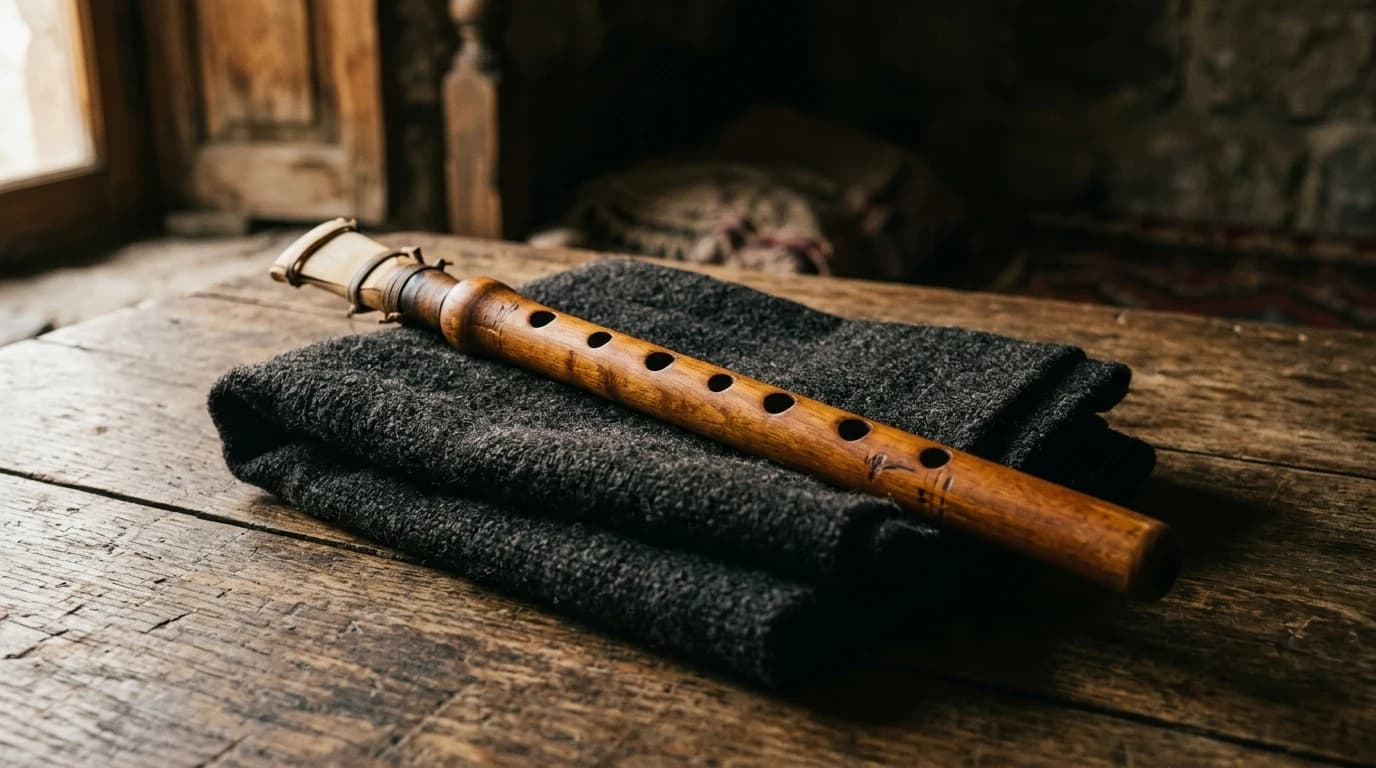
The Armenian duduk in its canonical role — the instrument of mourning, played in an old stone monastery, at the pace of a slow held breath.

Quick answer
This is the duduk in its oldest role: the instrument Armenians have turned to for mourning. The playing sits low, the phrases fall rather than rise, and a second duduk holds an unbroken drone underneath so the sound never fully stops. It is music made for grief rather than around it, and it is better listened to awake than used as sleep sound.
01 · The mood
Why this piece exists separately from the deep-sleep duduk.
SlowHum's primary duduk piece — the one on the main duduk page — is paced for sleep. It is gentle, low, descending, but never specifically mournful. That choice was deliberate. The duduk has many moods, and the sleep version asks the instrument to do its most pacifying work.
This piece is different. This is the duduk in its canonical role: the instrument of Armenian funerary tradition, of grief, of the kind of music that exists specifically to carry weight that the listener cannot carry alone. It is mournful by design and unhurried by design. The 44 BPM pacing — even slower than the sleep version — leaves time for each held tone to fully decay before the next one enters.
If you are using this piece, you probably already know why.
02 · The tradition
What Armenian grief sounds like.
The duduk has been an instrument of Armenian mourning for at least fifteen hundred years. Its apricot-wood body produces a tone whose grain is unmistakable — slightly nasal, breath-led, with a small but irreducible vibrato that gives every held note the quality of a voice on the edge of weeping.
Traditional funerary playing uses the dum — a second duduk holding a continuous low root drone underneath the melodic instrument — to create the harmonic field that carries the lament. The two duduks are not in dialogue. The drone is the ground, the lament is the figure, and the relationship between them is fixed for the duration of the piece.
Descending melodic gestures dominate. Phrases tend to start higher and sigh downward. Cadences do not resolve cleanly. The piece does not promise relief, only company.
03 · The listening
Permission to feel without doing anything.
The duduk does not require active engagement. Its gift, in grief contexts, is that it carries the weight of the emotional moment without asking you to participate beyond being in the room with it. You can sit with this piece, walk slowly through a house with it on, or lie down with the lights low — and the music will hold the space while you do whatever you need to do.
The recording is built with deep stone-chapel reverb. The four-to-five second reverb tail is part of the piece, not an effect; the held tones bloom and fade into the room itself.
If your context is not active grief but emotional release more broadly — the kind that follows a difficult conversation, a long week, a moment of unexpected weight — this piece works there too. The duduk has been doing this work for a very long time.

A listening guide
What to listen for
The dum drone. A second duduk holding a continuous low root note throughout. It never changes pitch. It is the floor the lament walks on.
The descending phrases. Almost every melodic gesture starts higher and sighs downward. The shape of weeping.
The breath. Audible at the start of long held tones. Not a flaw — the duduk's traditional voice keeps the body of the player present.
The vibrato. A small but constant pitch-tremor on held notes. It is what makes the duduk sound nearly human.
The four-second reverb. The stone-chapel acoustic is not an effect. The room is the second instrument.
Common questions
Questions people ask about the duduk · for grief
Why is the duduk associated with mourning?
Its range and timbre sit close to a low human voice, and the traditional laments move in slow descending phrases that resemble weeping speech. The association is long-standing in Armenian practice, not a modern film-music invention.
Should I listen to grief music or avoid it?
That is personal and we are not qualified to advise on it. What we can say is that this repertoire does not try to lift the mood — it accompanies it, which some people find is what they wanted and others do not.
How is this different from the main duduk page?
The main duduk page covers the instrument and its whole repertoire, including the slow, low pieces people use for sleep. This page collects the laments specifically.
A SlowHum duduk · for grief piece is in the making.
We're composing a thirty-minute piece for this tradition. Subscribe to be first — and watch the performances above in the meantime.
Subscribe on YouTubeFree · No email required
More from this tradition
Other pieces for the duduk
Continue the atlas
Other traditions
Shakuhachi
Japan
Quena
Peru & Bolivia
Celtic Harp
Ireland & Scotland
Kora
Mali & Senegal
Santur
Iran
Oud
Turkey & Syria
Sitar
India
Guzheng
China
Morin Khuur
Mongolia
Kantele
Finland
Slack Key
Hawaii · soon
Mbira
Zimbabwe
Bansuri
India
Ney
Turkey
Tagelharpa
Norway · soon
Begena
Ethiopia · soon
Gayageum
Korea · soon
Ngoni
Mali · soon
Guqin
China
Erhu
China
Koto
Japan
Pipa
China
Setar
Iran
Sarod
India
Sarangi
India
Xiao
China
Kaval
Bulgaria
Dizi
China
Nyckelharpa
Sweden
Hurdy-gurdy
France
Saz
Turkey