Nordic · Norway· coming soon
The
Tagelharpa
A Nordic bowed lyre with three or four horsehair strings, played upright on the lap, in a tradition that nearly disappeared and was rebuilt from museum fragments in the twentieth century.
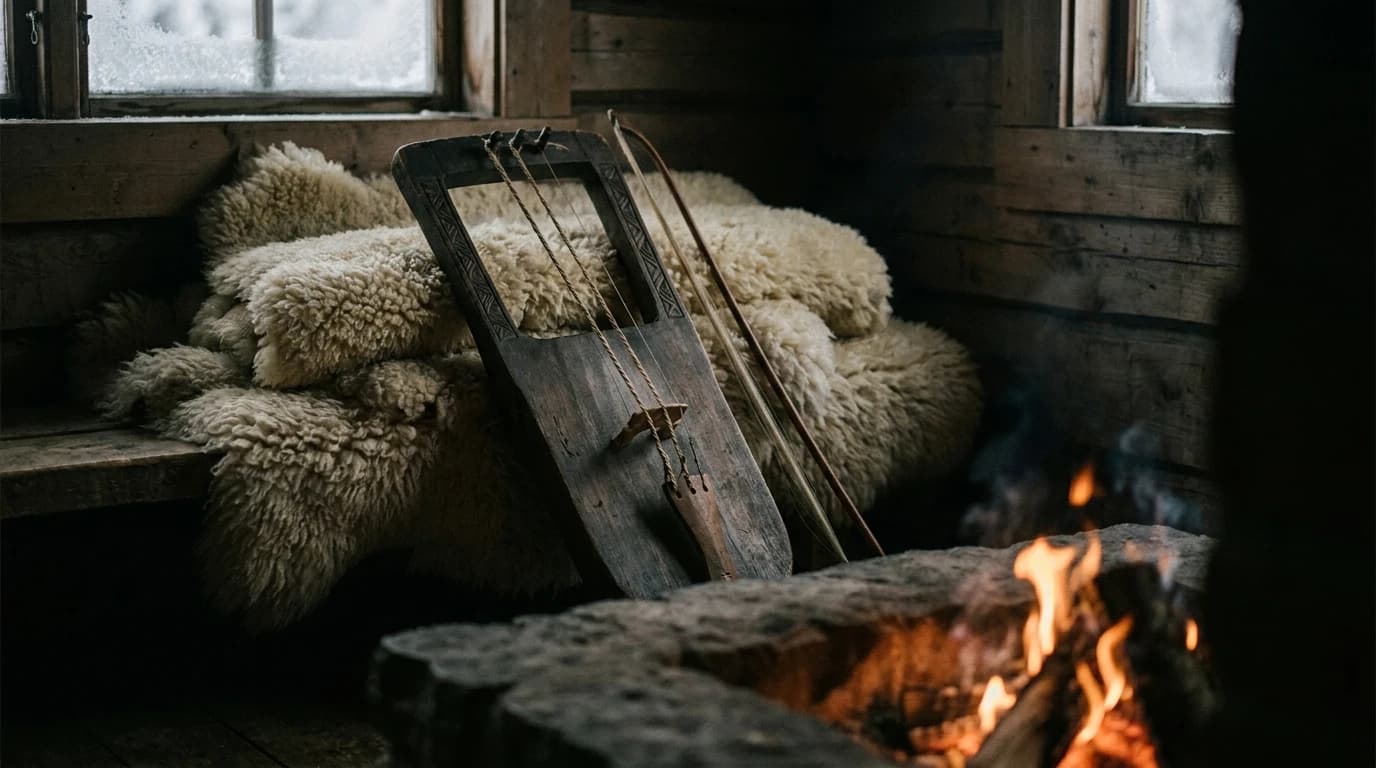
In preparation
Quick answer
The tagelharpa is a bowed lyre from the Nordic and Baltic world — a rectangular wooden frame with an open hand hole, strung with twisted horsehair and bowed rather than plucked. Because the strings sit in a flat plane, the bow tends to catch more than one at a time, so the instrument naturally produces a rough two-note drone under any melody. Its close relative in Finland and Karelia is the jouhikko, and the sound of both is ancient, scraping and firelit.
The tagelharpa (Swedish; also jouhikko in Finnish) is a small bowed lyre from the Nordic and Karelian regions, with three or four strings traditionally made of tagel — horsehair. It is played upright, held against the knee, with the fingers of the left hand touching the strings from behind rather than pressing them onto a fingerboard. Its sound is rough, archaic, slightly hollow — closer to a bowed drone instrument than to any modern violin family member.
By the twentieth century the playing tradition had nearly vanished. The instruments survived in folk-museum collections; the technique had to be reconstructed by ethnomusicologists working from sparse field recordings and oral memory. Today it is enjoying a slow revival, often paired with the kantele in the same Finno-Karelian runo-song repertoire. Our piece, when it arrives, will sit in that revived tradition — bowed long tones, the dark resonance of horsehair on horsehair, and the kind of firelight quiet that the instrument was built to fill.
A new piece for this tradition is in preparation. Subscribe on YouTube to be notified when it releases.
Common questions
Questions people ask about the tagelharpa
How is a bowed lyre played?
The player reaches through an opening in the frame and stops the strings from behind with the backs or sides of the fingers, rather than pressing them onto a fingerboard. There is no fingerboard at all — the strings are stopped in mid-air.
Is the tagelharpa the same as a jouhikko?
They are close relatives within the same family of Nordic and Baltic bowed lyres, with regional names and slightly different shapes and string counts. The playing principle is the same in each.
Why does it sound so harsh compared with a violin?
Horsehair strings, a flat bridge and no fingerboard all push the instrument toward a raw, drone-heavy sound. It was never refined toward the smooth tone the violin family pursued, which is exactly why it suits solitude and firelight.
Be the first to hear the tagelharpa.
New traditions release on the SlowHum channel each week. Subscribe to catch this one when it drops.
Subscribe on YouTubeFree · No email required
Continue the atlas
Other traditions
Duduk
Armenia
Shakuhachi
Japan
Quena
Peru & Bolivia
Celtic Harp
Ireland & Scotland
Kora
Mali & Senegal
Santur
Iran
Oud
Turkey & Syria
Sitar
India
Guzheng
China
Morin Khuur
Mongolia
Kantele
Finland
Slack Key
Hawaii · soon
Mbira
Zimbabwe
Bansuri
India
Ney
Turkey
Begena
Ethiopia · soon
Gayageum
Korea · soon
Ngoni
Mali · soon
Guqin
China
Erhu
China
Koto
Japan
Pipa
China
Setar
Iran
Sarod
India
Sarangi
India
Xiao
China
Kaval
Bulgaria
Dizi
China
Nyckelharpa
Sweden
Hurdy-gurdy
France
Saz
Turkey