Nordic · Finland
The
Kantele
Five horsehair strings, a Karelian cabin in winter, and the patience to let each note ring out before the next one enters.

Quick answer
The kantele is the Finnish box zither and national instrument, in its oldest form a small carved body with five strings plucked directly with the fingers. It is quiet, silvery and sparse — a few notes ringing into a lot of room. That thinness is the point: there is very little to hold on to, which is why it works so well for falling asleep.
Listen now
01 · Origins
The small instrument of Finland's long winters.
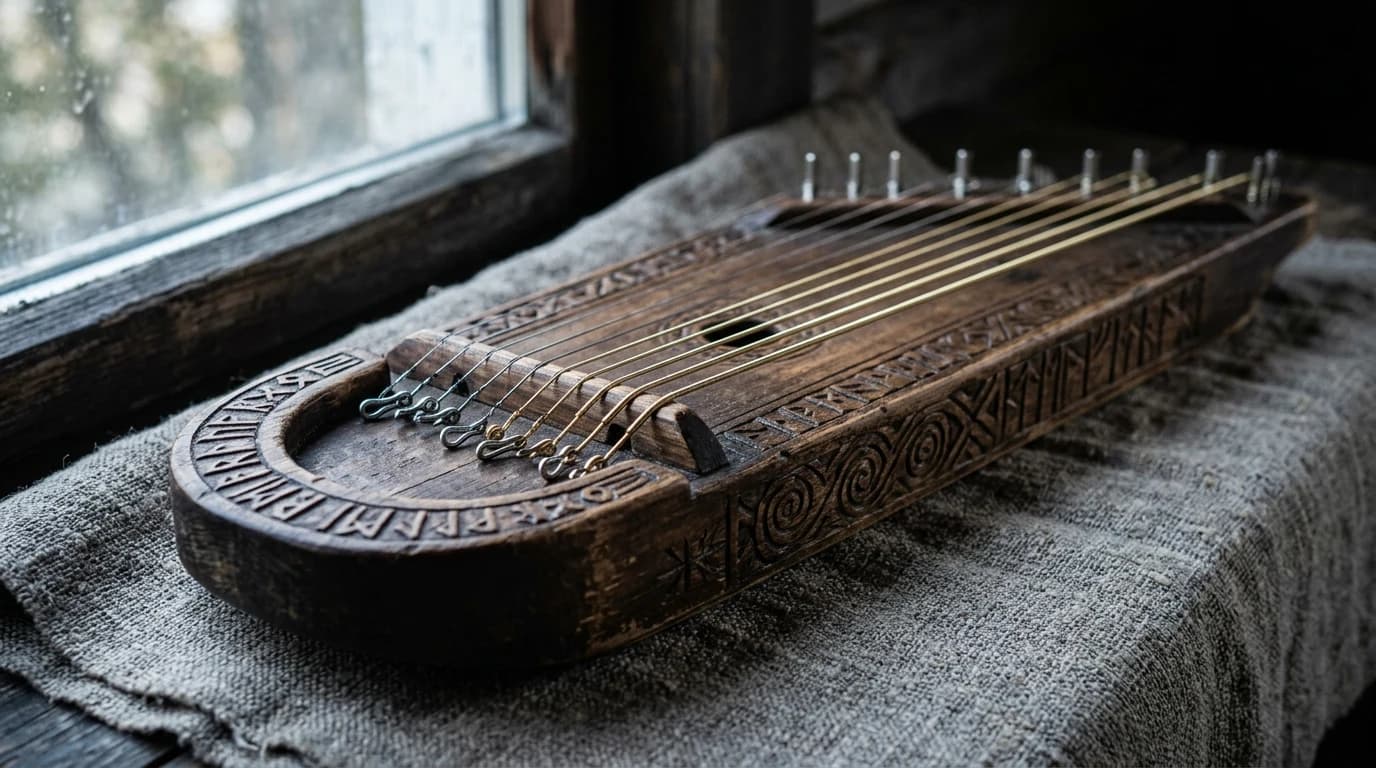
The kantele is a small trapezoidal Finno-Karelian plucked zither, traditionally strung with five horsehair or metal strings (concert versions today carry up to forty). Its written history begins in the 12th century, but its mythological home is the Kalevala — the Finnish national epic — in which the hero Väinämöinen builds the first kantele from the jawbone of a giant pike, strings it with the hair of a maiden of the sea, and plays it so beautifully that every creature in the forest gathers to listen.
The instrument itself is small, light, and built for solitude. It was a household object before it was a concert object — kept by the door, played on dark afternoons, passed down through generations alongside the runo-songs whose melodic cells are the backbone of its traditional repertoire.
What it is not: loud, percussive, or restless. The kantele's tone is bell-like and decays slowly. Played quietly, in a small wooden room, it sounds as if the room itself is ringing.
02 · The piece
Calibrated for sleep, not for listening to.
This piece is paced at 45 BPM — slower than a resting heartbeat. Each plucked note rings for four to six seconds. The silences between notes last two to four seconds, and they are part of the music; the kantele's whole tradition rests on letting the previous note's resonance complete before the next one enters.
There are no fast arpeggios, no glissandi, no sudden gestures. The dynamic range stays pianissimo throughout. The piece is calibrated not to be listened to so much as to be present in the room — a slow ringing in the corner of the attention, gradually unhooking the mind from the day.
The recording is intentionally dry. No cathedral reverb, no synthesized ambience. The acoustics suggest a small wooden cabin in deep snow, where the silence outside is part of the music inside.

03 · The listening
Put it on, then let it go.
This piece is not designed to reward close attention. It is designed to be a presence in the background while you do something else — fall asleep being the canonical use, but it works equally for the slow hour before sleep when you do not want to be entertained.
Headphones are not required. A small speaker across the room is closer to the traditional context. Let the volume sit low enough that you can hear the silences as clearly as the notes.
If you find yourself listening for the next note, you are listening too hard. The kantele wants you to drift.

A listening guide
What to listen for
The decay. Each note rings for four to six seconds. Notice the entire arc of that decay before the next note arrives.
The silences. Two to four seconds between phrases. They are intentional. Resist filling them mentally.
The bell-tone. The kantele's metal strings produce a clear bell-like fundamental with a quiet shimmer of overtones above. The shimmer is the room itself responding.
The lack of climax. Nothing in this piece builds toward anything. It maintains, and gradually quiets.
The drift. Somewhere between minute eight and minute fifteen, the music stops feeling like an event and becomes part of the room. Stay there.
From the listener to the player
If the kantele pulled you in
The Finnish kantele is a quiet, plucked zither — and a hard one to find well-made outside the Nordics. Begin by listening closely.

To hear it
~$85
Philips SHP9500
The kantele is delicate and overtone-rich. Open-back headphones keep its faint, bell-like resonance intact instead of flattening it.
Buy on AmazonA Finnish kantele
A well-made 5- or 11-string kantele is best sourced from Nordic makers and specialist sellers. Reverb is the place to look.
Affiliate links
These are honest recommendations — the ones we’d point a friend toward. As an Amazon Associate, SlowHum earns from qualifying purchases; we may also earn from other links. It costs you nothing extra, and prices are approximate. Full disclosure.
Common questions
Questions people ask about the kantele
How many strings does a kantele have?
The traditional small kantele has five strings, and folk instruments commonly run to ten or fifteen. Modern concert kanteles are much larger, with dozens of strings and levers for changing key.
What is the kantele’s connection to the Kalevala?
In the Finnish national epic the first kantele is made by the sage Vainamoinen, and his playing is described as moving every creature that hears it. That story is why the instrument stands for Finnish identity rather than just Finnish folk music.
Why does kantele music sound so sparse?
A five-string instrument has few notes available, and the traditional playing style lets each one decay rather than filling the gap. The silence between notes is as much a part of the texture as the notes.
Listen to the kantele.
The full 30-minute piece lives on the channel. Subscribe to catch each new tradition as it arrives.
Subscribe on YouTubeFree · No email required
Continue the atlas
Other traditions
Duduk
Armenia
Shakuhachi
Japan
Quena
Peru & Bolivia
Celtic Harp
Ireland & Scotland
Kora
Mali & Senegal
Santur
Iran
Oud
Turkey & Syria
Sitar
India
Guzheng
China
Morin Khuur
Mongolia
Slack Key
Hawaii · soon
Mbira
Zimbabwe
Bansuri
India
Ney
Turkey
Tagelharpa
Norway · soon
Begena
Ethiopia · soon
Gayageum
Korea · soon
Ngoni
Mali · soon
Guqin
China
Erhu
China
Koto
Japan
Pipa
China
Setar
Iran
Sarod
India
Sarangi
India
Xiao
China
Kaval
Bulgaria
Dizi
China
Nyckelharpa
Sweden
Hurdy-gurdy
France
Saz
Turkey