Middle East · Iran
The
Santur
Seventy-two strings stretched over a walnut trapezoid. Struck with two light hammers, in the old listening rooms of Isfahan.
Quick answer
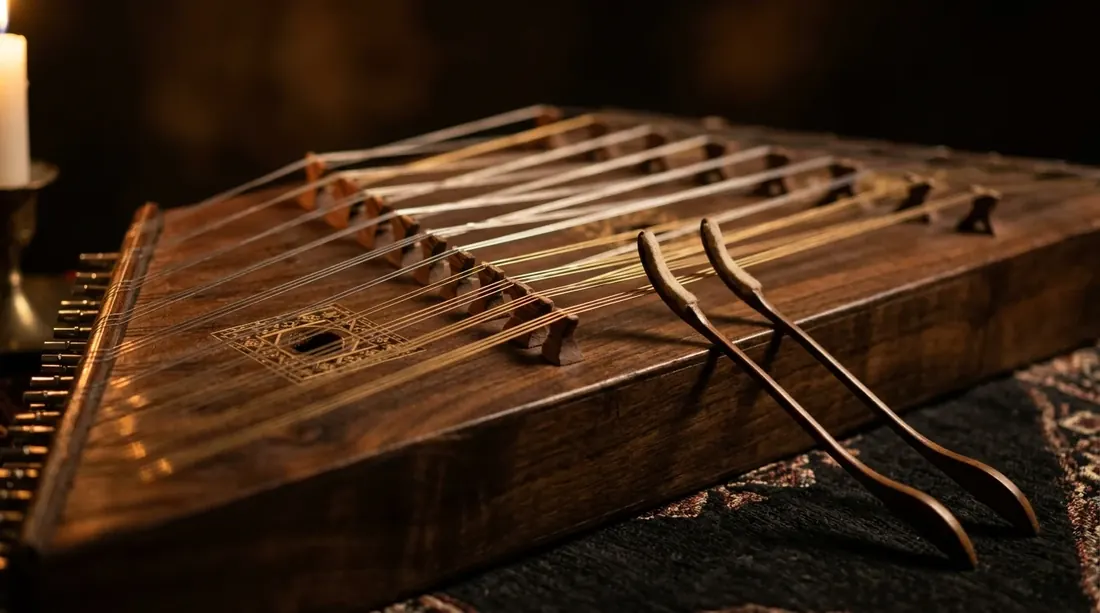
The santur is the Persian hammered dulcimer: a shallow trapezoidal box whose strings run in courses across two rows of bridges and are struck with a pair of light wooden mallets called mezrab. Every note rings on, so the instrument produces a cascade in which each phrase blurs slightly into the next. That overlapping shimmer is what makes it useful when the problem is a mind that will not stop circling — there is always a new note arriving to land on.
Listen now
01 · Origins
The instrument every hammered dulcimer descends from.
The santur is a trapezoidal walnut box strung with seventy-two strings of steel and bronze, arranged in courses of four and supported by small wooden bridges in two rows. The name comes through Persian from older Aramaic forms; references to it appear in Mesopotamian writing more than two thousand years old.
Its descendants spread along trade routes in every direction — eastward to the Chinese yangqin, westward to the Hungarian cimbalom and the Greek santouri, and across the Atlantic eventually to the Appalachian hammered dulcimer. All of them are children, by long lineage, of the Persian original.
The 10th-century philosopher al-Farabi, writing about the santur as already ancient in his time, called it “the quickest of all instruments” — a reference to the cascading speed possible when both hands strike independent lines across its strings.
02 · The mezrab and the dastgāh
Hammers like commas.
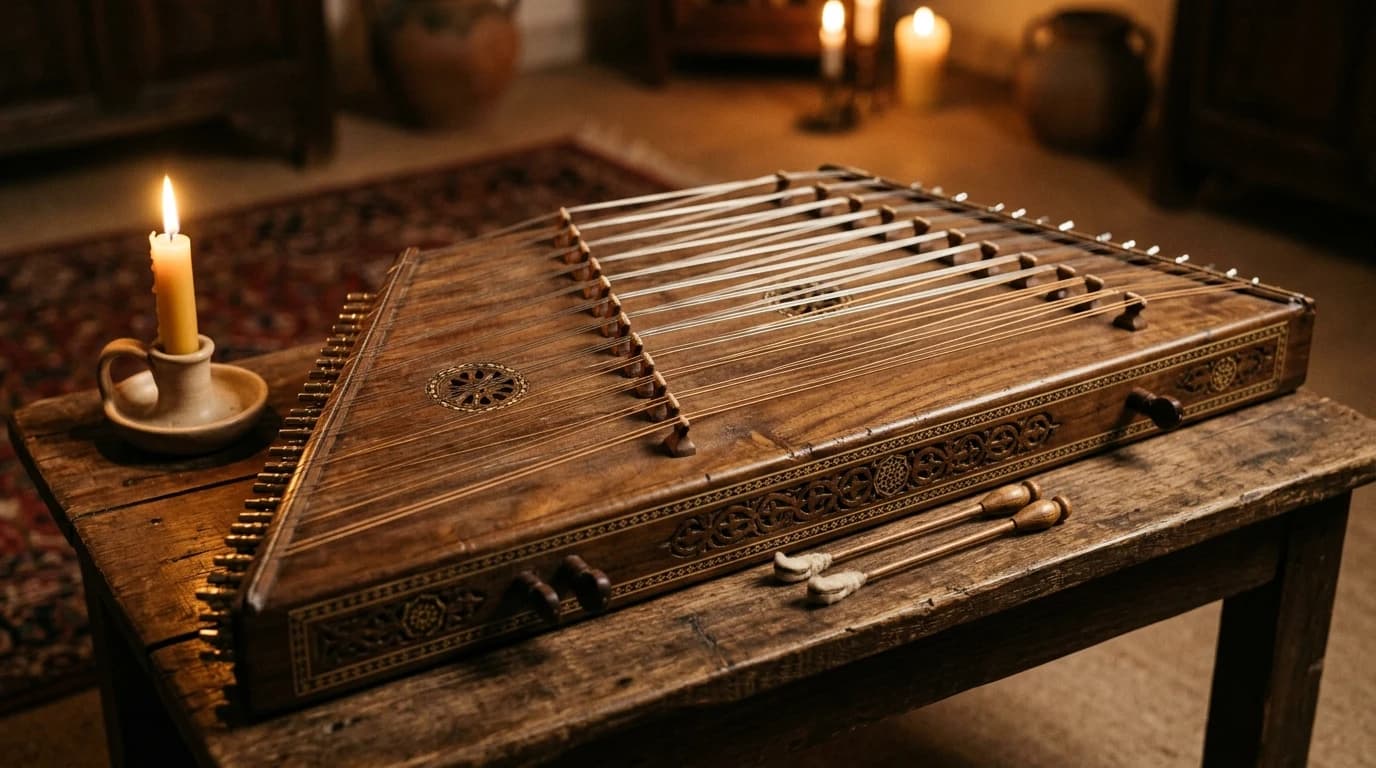
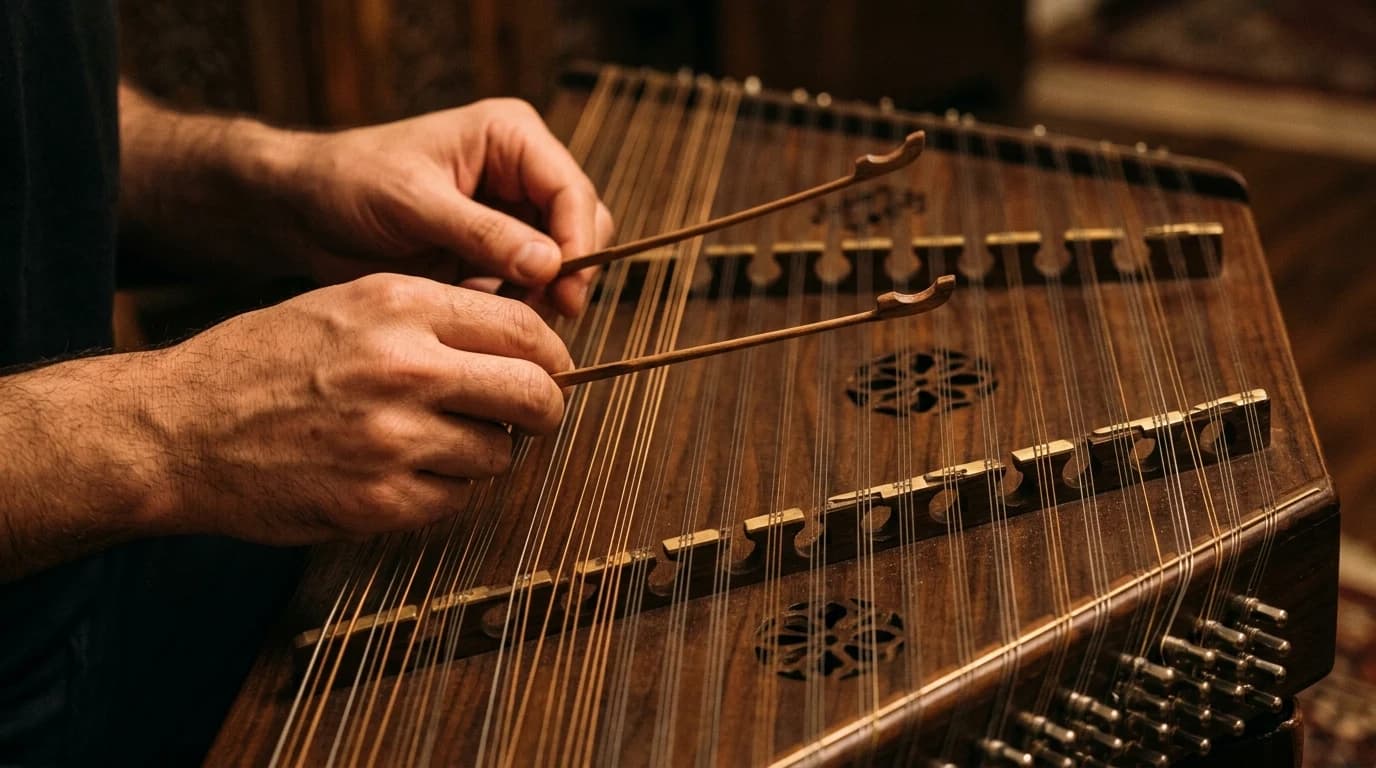
The mezrab are tiny wooden hammers, held between the index and middle fingers of each hand. They are light, almost weightless. Struck against the bronze strings, they produce a tone with a long, bell-like decay; a skilled player can draw three distinct dynamics from the same hammer with only the smallest difference in pressure and angle.
Persian classical music is organized around the dastgāh — twelve modal systems, each containing dozens of named melodic segments (gusheh) that the player threads through in a traditional sequence. A complete performance of a single dastgāh can last an hour or more.
This piece lives inside a slow dastgāh — drawn from the modes most associated with meditation and patience, paired intermittently with the ney, the long reed flute that has been the santur's traditional companion for at least a thousand years.
03 · The listening
A long unfolding.
The santur was, for most of its history, a chamber instrument — played in private gardens, in the listening rooms of Iranian aristocrats, in Sufi gatherings where music was understood as a path to attention rather than as entertainment. It was never meant for the concert hall.
It is not a percussive instrument despite being struck. The bronze strings ring long after the hammers leave them, and good players use that ring — placing each new note inside the still-decaying resonance of the previous one. The result is a continuous shimmer of sound that is technically discrete but feels seamless to the ear.
Stay with it. The first few minutes establish the mode. The middle stretches and varies. Somewhere past the twenty-minute mark, the piece stops feeling like it is going anywhere — and that is exactly where it wants you.
A listening guide
What to listen for
The bronze halo. After each strike, the string keeps ringing. Listen for the way the next note enters that ring rather than replacing it.
The mezrab attack. The hammers are wooden and light, but each strike still has a percussive shape. The dynamics are subtle and entirely intentional.
The dastgāh's slow turn. The mode does not modulate the way Western music does. It deepens. A new gusheh feels like a new room in the same house.
The ney. When the reed flute enters, it does so without ceremony — a long, breath-driven note rising out of the santur's cascade.
The lack of pulse. There is no fixed beat. The piece moves at the speed of the player's breathing, and your own willingness to slow down.
From the listener to the player
If the santur pulled you in
The santur is a hammered dulcimer with dozens of strings — a serious specialist instrument. Begin with deep listening.

To hear it
~$298
Sony WH-1000XM5 Headphones
The santur's shimmer is dozens of strings ringing at once. Headphones that hold that density keep it from collapsing into a blur.
Buy on AmazonA Persian santur
Santurs are specialist instruments best bought from makers and dedicated sellers. Browse Reverb when you're ready for the real thing.
Affiliate links
These are honest recommendations — the ones we’d point a friend toward. As an Amazon Associate, SlowHum earns from qualifying purchases; we may also earn from other links. It costs you nothing extra, and prices are approximate. Full disclosure.
Common questions
Questions people ask about the santur
What are the mallets called and why are they so light?
They are called mezrab, and they are thin and flexible so the strike is soft rather than percussive. A heavier stroke would give the santur a struck, piano-like attack instead of its characteristic shimmer.
What is a dastgah?
Dastgah is the modal system of Persian classical music: a set of scales and characteristic melodic phrases with their own moods and conventional order. A santur performance moves through the sections of a dastgah rather than through chord changes.
Is the santur related to the hammered dulcimers of other countries?
It belongs to the same broad family as the European hammered dulcimer, the Chinese yangqin and the Indian santoor, which share the struck-string design. Tuning, repertoire and playing technique are distinct to each tradition.
Listen to the santur.
The full 30-minute piece lives on the channel. Subscribe to catch each new tradition as it arrives.
Subscribe on YouTubeFree · No email required
Continue the atlas
Other traditions
Duduk
Armenia
Shakuhachi
Japan
Quena
Peru & Bolivia
Celtic Harp
Ireland & Scotland
Kora
Mali & Senegal
Oud
Turkey & Syria
Sitar
India
Guzheng
China
Morin Khuur
Mongolia
Kantele
Finland
Slack Key
Hawaii · soon
Mbira
Zimbabwe
Bansuri
India
Ney
Turkey
Tagelharpa
Norway · soon
Begena
Ethiopia · soon
Gayageum
Korea · soon
Ngoni
Mali · soon
Guqin
China
Erhu
China
Koto
Japan
Pipa
China
Setar
Iran
Sarod
India
Sarangi
India
Xiao
China
Kaval
Bulgaria
Dizi
China
Nyckelharpa
Sweden
Hurdy-gurdy
France
Saz
Turkey