East Asia · Korea· coming soon
The
Gayageum
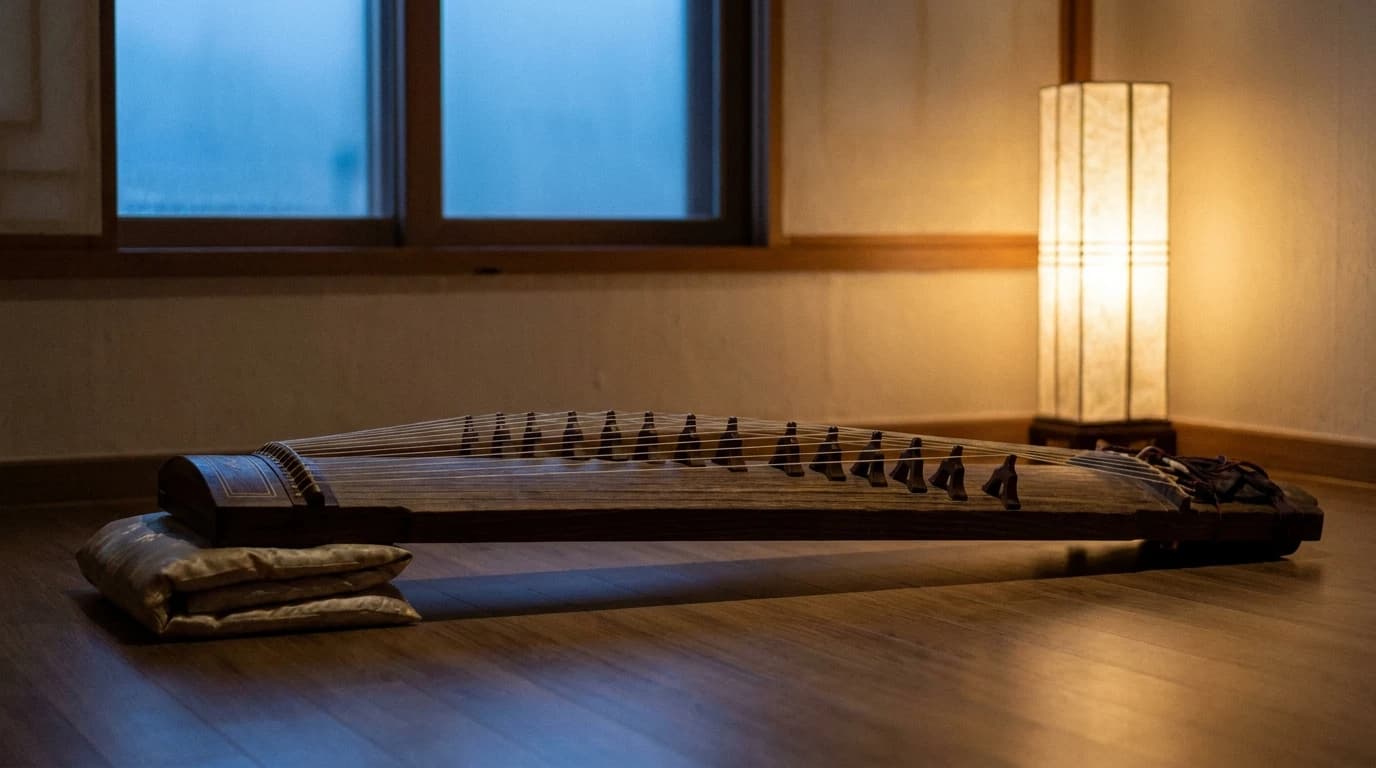
A Korean silk-stringed zither, twelve strings stretched across a board nearly two metres long. The most beloved instrument of the Korean classical tradition.
In preparation
Quick answer
The gayageum is the Korean zither: a long paulownia-wood body with twelve silk or synthetic strings, each raised on its own movable bridge. The right hand plucks bare-fingered while the left presses the string behind the bridge to bend, shake and release the pitch — the ornament Korean music calls nonghyeon. Its tone is silken rather than bright, and it suits the last hours of the evening.
The gayageum is a Korean zither with twelve silk strings (modern variants sometimes have eighteen or twenty-five), each supported by a movable wooden bridge in the shape of a wild goose. The instrument is long — nearly two metres — and is played sitting on the floor, with one end resting on the player’s knee. Its written history begins in the 6th century in the kingdom of Gaya, from which the instrument takes its name.
The gayageum sits at the centre of the Korean classical tradition called jeongak — the “correct music” of the royal court, characterized by slow tempos, long sustained phrases, and the subtle left-hand ornaments that bend and decorate each note after it has been plucked. The instrument’s silk strings give it a softer, less metallic tone than its Chinese cousin the guzheng — closer to a whisper than to a cascade. Our piece, when it arrives, will draw on the slow sanjo repertoire — improvised solo music in the modal style, paced for evening listening.
A new piece for this tradition is in preparation. Subscribe on YouTube to be notified when it releases.
Common questions
Questions people ask about the gayageum
How is the gayageum different from the Chinese guzheng or Japanese koto?
All three are bridged long zithers, but the gayageum is traditionally plucked with bare fingers rather than picks, has twelve strings in its classical form, and leans heavily on left-hand pitch-bending. The repertoires and tunings are entirely distinct.
What is sanjo?
Sanjo is a solo instrumental form that moves through a sequence of rhythmic cycles, starting slow and gradually accelerating. It is the best-known showcase for the gayageum and is usually accompanied by a janggu drum.
What is jeongak?
Jeongak is the older court and literati repertoire — restrained, slow and formal, as opposed to the folk-rooted expressiveness of sanjo. It is the quieter of the two traditions to listen to.
Be the first to hear the gayageum.
New traditions release on the SlowHum channel each week. Subscribe to catch this one when it drops.
Subscribe on YouTubeFree · No email required
Continue the atlas
Other traditions
Duduk
Armenia
Shakuhachi
Japan
Quena
Peru & Bolivia
Celtic Harp
Ireland & Scotland
Kora
Mali & Senegal
Santur
Iran
Oud
Turkey & Syria
Sitar
India
Guzheng
China
Morin Khuur
Mongolia
Kantele
Finland
Slack Key
Hawaii · soon
Mbira
Zimbabwe
Bansuri
India
Ney
Turkey
Tagelharpa
Norway · soon
Begena
Ethiopia · soon
Ngoni
Mali · soon
Guqin
China
Erhu
China
Koto
Japan
Pipa
China
Setar
Iran
Sarod
India
Sarangi
India
Xiao
China
Kaval
Bulgaria
Dizi
China
Nyckelharpa
Sweden
Hurdy-gurdy
France
Saz
Turkey