Southern Africa · Zimbabwe
The
Mbira
Twenty-two iron keys mounted on a wooden board, set inside a gourd that buzzes. A pattern that repeats every fifteen seconds, with the smallest variations across a half-hour.

Quick answer
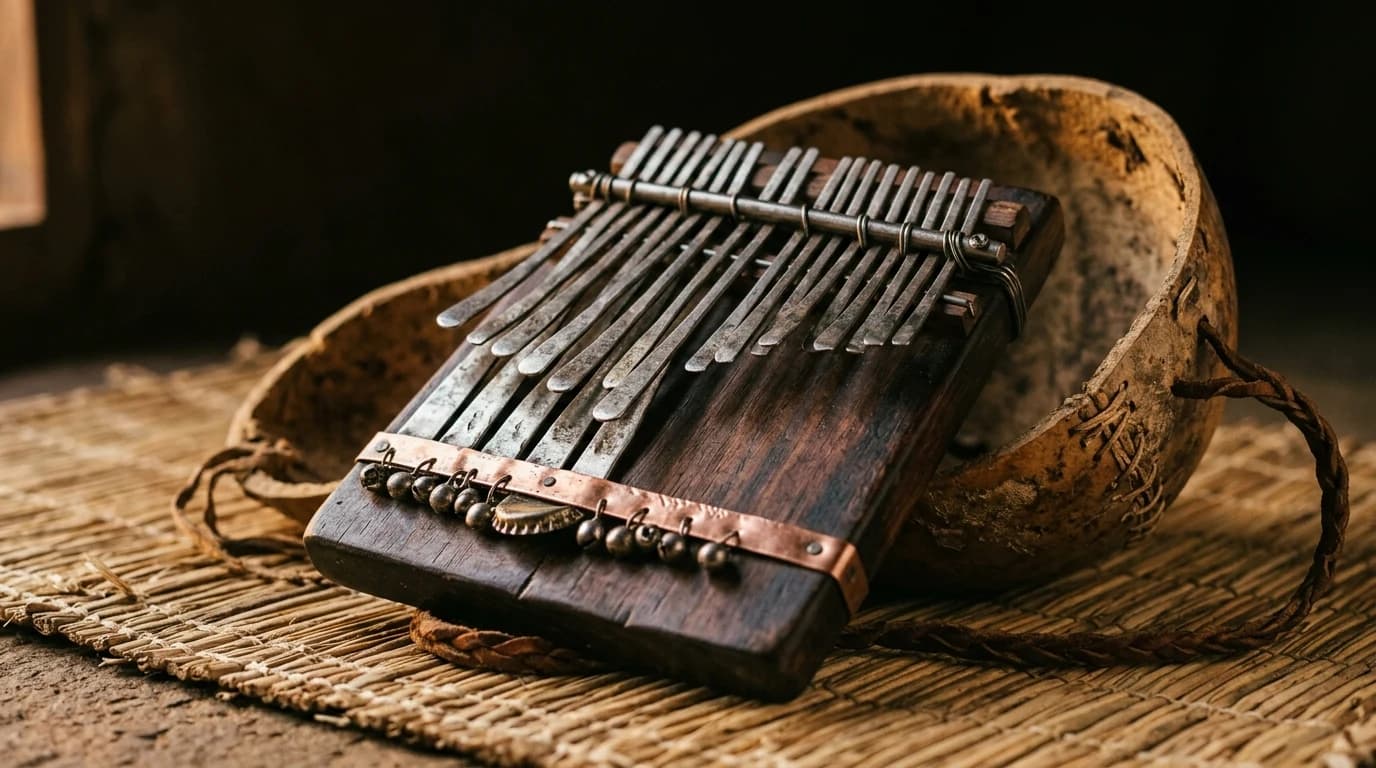
The mbira dzavadzimu is a Shona lamellophone from Zimbabwe: twenty-odd metal keys of different lengths mounted on a hardwood board and plucked with the thumbs and one forefinger. It is usually set inside a large gourd resonator, the deze, which amplifies it and adds a buzzing rattle from shells or bottle caps fixed around the rim. Its music is cyclical and interlocking, repeating a pattern that shifts slightly each time round — a texture that holds attention steady without ever resolving.
Listen now
01 · Origins
A thousand years of interlocking thumbs.
The mbira is an ancient Shona instrument from Zimbabwe and the surrounding region. Continuously played for at least a thousand years, it consists of a flat wooden soundboard set with between twenty-two and twenty-eight thin iron keys of graduated length, plucked with the thumbs. The instrument is typically placed inside a large gourd resonator — the deze — which both amplifies the sound and provides the characteristic buzzing halo that identifies it from across a room.
What distinguishes the mbira from most other instruments is that two thumbs play independent melodic lines simultaneously, in a hocketing pattern where high and low notes alternate to produce a continuous interlocking texture. The pattern repeats — but the small variations across cycles are where the music lives. A single pattern can sustain a half-hour piece.
In Shona culture the mbira has a ceremonial role in the bira ritual that belongs to the people who carry that tradition. This piece, like all SlowHum recordings, draws on the musical grammar of the instrument — the interlocking pattern, the gourd buzz, the long unfolding — without replicating ceremonial function.
02 · The piece
A pattern that repeats. A mind that returns.
This piece is paced at 50 BPM. A single interlocking pattern, approximately twelve to sixteen seconds long, repeats throughout. Across each cycle the variations are tiny: a key landed slightly harder, a phrase resolved into a different note, a brief departure that always returns home.
It is not designed to demand attention. The pattern's predictability is the point. For deep focus work — coding, writing, drawing — the mbira's steady cyclical motion gives the mind something steady to settle against, without requiring any of the listener's attention to track.
Underneath the keys, the natural buzz of the machachara shells attached to the soundboard provides a low, sustained shimmer. A faint distant cricket layer was preserved in the recording — barely audible, anchoring the listening environment outdoors at evening.

03 · The listening
The pattern is the room.
If you are using this piece for focused work, do not listen to it. Put it on at low volume, let the cycle establish, and then return to whatever you were doing. The mbira will hold the room steady while you go inward.
If you choose to listen — and the music rewards close listening too — notice how the pattern is never exactly the same twice. The variations are tiny, slow, almost subliminal. The piece is built like a meditation: the same breath returning, never identical.
Headphones reveal the keys' attack and the gourd's buzzing more clearly. Speakers across the room reveal the cyclical texture more clearly. Both are correct contexts.

Watch the tradition
Watch the mbira pattern lock in
Seeing the thumbs helps the ear understand why the music feels steady and alive at the same time.
Patience Munjeri, Irene Chigamba, and Musekiwa Chingodza
Mahororo / Nhemamusasa
A strong human reference for the interlocking pattern and the social texture around it.
Musekiwa Chingodza
Mbira performance, Murewa 1999
A close, direct look at thumb motion, repetition, and the small changes that keep the cycle alive.
A listening guide
What to listen for
The interlocking. Two thumbs, two melodic lines, hocketing — high and low alternate to produce one continuous moving texture.
The buzz. The machachara shells produce a soft sustained shimmer around every note. It is not noise; it is the signature timbre.
The cycle length. Approximately fifteen seconds. Once you find the loop, you can use it as a kind of metronome for your own thinking.
The variations. Every cycle is slightly different. The differences are subtle — a single key landed differently — but they are what keep the piece alive across thirty minutes.
The crickets. Very faint, very low. They are not background noise; they are part of the recording's environmental signature.
From the listener to the player
If the mbira moved you
Where to begin — if you want to feel this sound under your own thumbs, not only hear it.

To listen
~$298
Sony WH-1000XM5 Headphones
The honest upgrade for this music. The mbira's shimmer and a kora's overtones live in detail that laptop speakers throw away — a comfortable, quiet pair you'll actually keep on for the full thirty minutes.
Buy on Amazon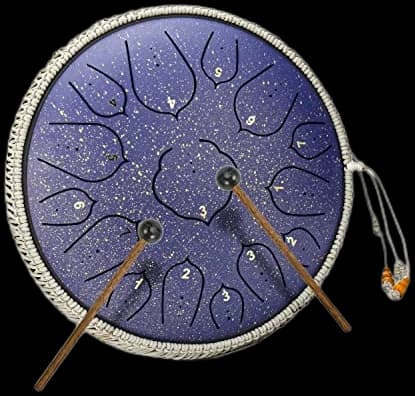
The instrument
~$80
Steel Tongue Drum (14″, 15 notes)
Not a true mbira — but the meditative instrument most people fall for and keep playing. Tuned so every note belongs: strike it anywhere and it sounds intentional. Like the kalimba, but fuller and more resonant.
Buy on Amazon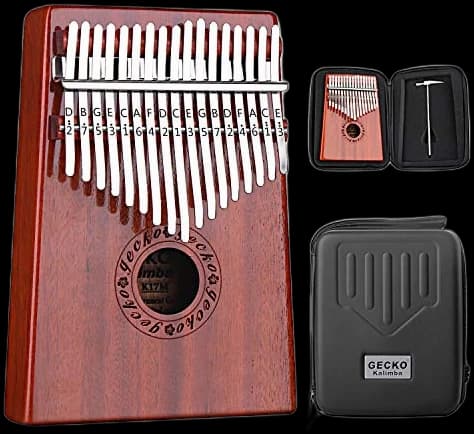
The instrument
~$32
GECKO 17-Key Kalimba
The mbira's accessible modern descendant. Arrives in tune, nearly impossible to play badly — the gentlest, cheapest way to put this sound under your own thumbs.
Buy on Amazon
To play
~$10
Kalimba Songbook: 50 Easy Classic Songs
If you start with a kalimba, this is day one — number-and-letter notation, no music reading required.
Buy on AmazonA hand-made Shona mbira
For the real thing — a traditional mbira dzavadzimu, new or used, direct from makers on Reverb.
Affiliate links
These are honest recommendations — the ones we’d point a friend toward. As an Amazon Associate, SlowHum earns from qualifying purchases; we may also earn from other links. It costs you nothing extra, and prices are approximate. Full disclosure.
Common questions
Questions people ask about the mbira
What does mbira dzavadzimu mean?
It translates as mbira of the ancestors. The instrument is played at bira ceremonies, where the music is understood to call ancestral spirits, so it belongs to a ritual context rather than a concert one.
Why is there a buzzing sound?
Shells, beads or bottle caps are attached to the soundboard and the gourd so they rattle with every note. The buzz is deliberate and valued — a clean tone would be considered incomplete in this tradition.
Why is mbira good for concentration?
The patterns are cyclical and dense, and two interlocking parts can produce melodies that neither player is literally playing. Your ear keeps finding new lines in an unchanging loop, which occupies the part of the mind that would otherwise wander.
Listen to the mbira.
The full 30-minute piece lives on the channel. Subscribe to catch each new tradition as it arrives.
Subscribe on YouTubeFree · No email required
Continue the atlas
Other traditions
Duduk
Armenia
Shakuhachi
Japan
Quena
Peru & Bolivia
Celtic Harp
Ireland & Scotland
Kora
Mali & Senegal
Santur
Iran
Oud
Turkey & Syria
Sitar
India
Guzheng
China
Morin Khuur
Mongolia
Kantele
Finland
Slack Key
Hawaii · soon
Bansuri
India
Ney
Turkey
Tagelharpa
Norway · soon
Begena
Ethiopia · soon
Gayageum
Korea · soon
Ngoni
Mali · soon
Guqin
China
Erhu
China
Koto
Japan
Pipa
China
Setar
Iran
Sarod
India
Sarangi
India
Xiao
China
Kaval
Bulgaria
Dizi
China
Nyckelharpa
Sweden
Hurdy-gurdy
France
Saz
Turkey