South Asia · India
The
Bansuri
A bamboo flute, raga Bhairav, and the hour just before sunrise in Vrindavan when the air is still cool and the temple bells have not yet started.
Quick answer
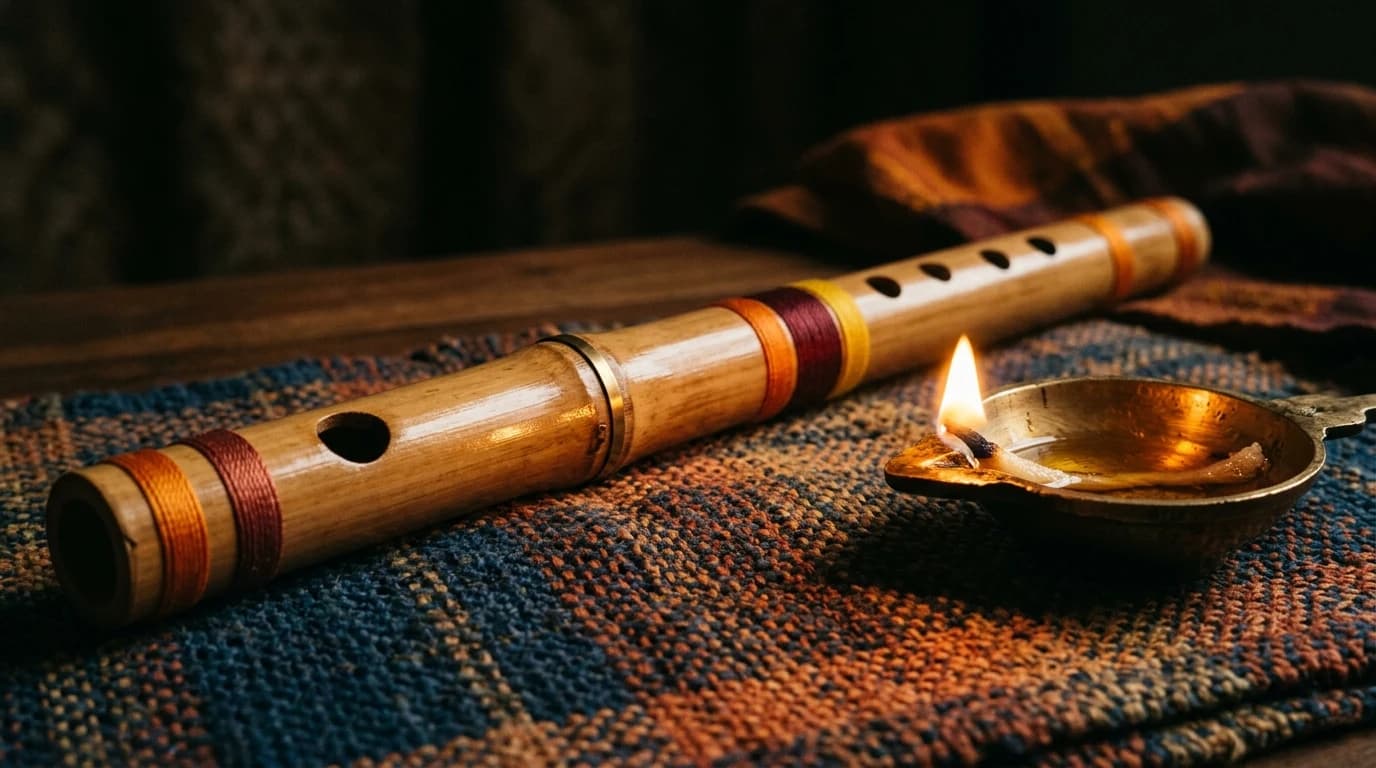
The bansuri is the North Indian transverse bamboo flute — a single length of cane with six or seven finger holes and no keys or mouthpiece. Because there are no mechanisms, pitch is shaped by partially covering the holes and by the angle of the breath, which lets the player glide continuously between notes in the manner of Hindustani vocal music. Played over a tanpura drone at a low volume it is among the most straightforwardly calming things in the atlas.
Listen now
01 · Origins
The instrument Krishna is always pictured holding.
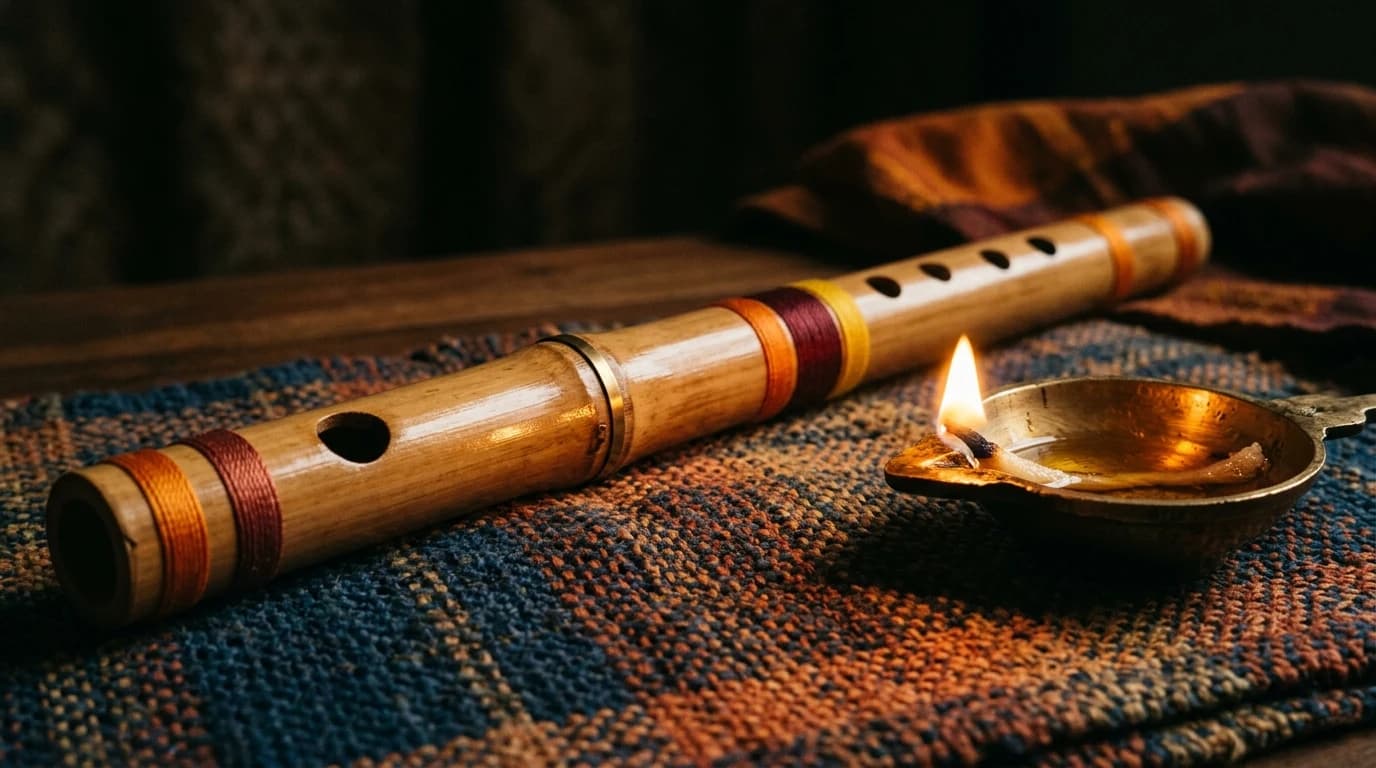
The bansuri is a transverse bamboo flute from the North Indian classical tradition. Six or seven open finger holes, no keys, no reeds — air across the embouchure and the bamboo's own resonance produce one of the oldest sustained tones in continuous use anywhere in the world.
Its mythological home is Vrindavan, the forest town on the Yamuna river where the young Krishna is said to have played his bansuri to call the gopis. Every bansuri player you will ever see pictured carries some echo of that image — a young figure under a tree, a flute held sideways, an attentive audience that may include cattle, monkeys, and one or two unrelated humans.
What gives the instrument its character is the simplicity of its acoustics combined with the depth of the system it is asked to express. Indian classical music — its ragas, its alaps, its microtonal slides — emerges from the bansuri's six open holes as if the instrument were built for nothing else.
02 · The piece
Bhairav, the morning raga, played at fifty-five beats per minute.
This piece is in raga Bhairav — the morning raga, traditionally performed at dawn or in the first hours after sunrise. Bhairav carries associations of awakening and devotion. Its scale features two flattened pitches (the second and sixth degrees) that give it a slightly austere, slightly tender quality, suited to the cool gravity of pre-sunrise air.
Under the bansuri, a continuous tanpura drone in C anchors the modal field. Long sustained notes from the bansuri with the traditional Hindustani meend — the gliding slide between pitches — and gentle gamak ornaments. No tabla, no percussion, no other melodic instruments. The pacing is unhurried at 55 BPM.
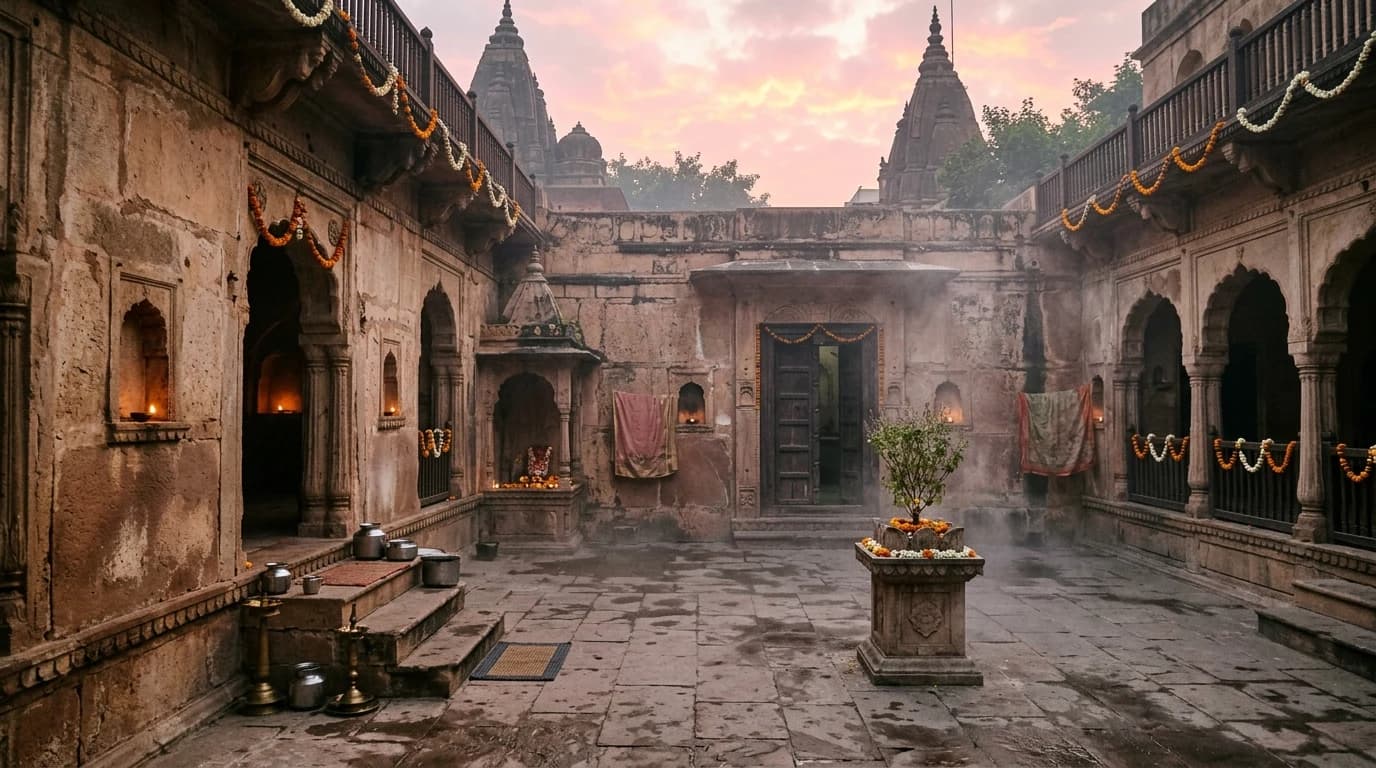
The recording space is rendered as an open Vrindavan courtyard at dawn — warm dry stone, very short natural reverb, the soft sense of an open sky overhead.
03 · The listening
Use it to begin the day.
This piece is positioned for the first hour after waking — the slow transition from sleep to attention, before the day's tasks have arrived. Bhairav's musical character is doing some of that work for you. The flattened scale degrees feel like the cool air before sunrise; the long held notes give the morning mind something steady to attach to.
It works just as well as standalone meditation music, or as a slow background for the first cup of tea. It does not work as deep-focus music — the meend slides have too much expressive motion to disappear into the background of cognitive work.
If you are not in a morning mood when this piece comes on, give it three minutes anyway. Bhairav has a way of recruiting the listener into its own clock.
A listening guide
What to listen for
The meend. The signature gliding slide between pitches, produced by partially covering finger holes. Notes do not jump; they arrive.
The flattened second. Bhairav's defining interval — a half-step above the tonic. It carries the raga's austere morning quality.
The tanpura. A soft, continuous four-note drone underneath, never changing pitch. The bansuri's reference and the listener's anchor.
The breath. Audible at the start of long phrases. Not a flaw — the bansuri tradition treats the breath as part of the music.
The lack of rhythm. No tabla, no fixed pulse. The piece moves at the speed of the bansuri's exhales.
From the listener to the player
If the bansuri pulled you in
A good single bansuri can be hard to keep in stock, so start with the breath and the theory — the flute is easy to add once you know the path.

Learn it
~$13
How to Play the Bansuri (Beginner Guide)
Hand position, breath, and the first notes of the bamboo flute — the part that actually decides whether a beginner sticks with it.
Buy on Amazon
To hear the breath
~$298
Sony WH-1000XM5 Headphones
The bansuri is breath shaped into pitch. Headphones that hold that airy detail change how much of the playing you can actually hear.
Buy on AmazonA concert bansuri
For a tuned, well-made bansuri in a specific key, Reverb's specialist sellers beat the unpredictable generic listings.
Affiliate links
These are honest recommendations — the ones we’d point a friend toward. As an Amazon Associate, SlowHum earns from qualifying purchases; we may also earn from other links. It costs you nothing extra, and prices are approximate. Full disclosure.
Common questions
Questions people ask about the bansuri
How does a keyless flute play every note?
The player half-covers and rolls off the finger holes and changes the breath angle, producing the pitches between the open-hole notes. That same technique produces the sliding meend that makes the bansuri sound like a singing voice.
What is the tanpura you hear underneath?
The tanpura is a long-necked drone instrument whose four strings are plucked in slow rotation. It never plays a melody — it holds the tonic and fifth of the raga so everything the flute does is heard against a fixed centre.
Which ragas suit morning listening?
Hindustani practice assigns ragas to times of day, and the morning ragas — Bhairav and Ahir Bhairav among them — are the traditional choice for early hours. It is a convention of the tradition rather than a rule about how you must listen.
Listen to the bansuri.
The full 30-minute piece lives on the channel. Subscribe to catch each new tradition as it arrives.
Subscribe on YouTubeFree · No email required
Continue the atlas
Other traditions
Duduk
Armenia
Shakuhachi
Japan
Quena
Peru & Bolivia
Celtic Harp
Ireland & Scotland
Kora
Mali & Senegal
Santur
Iran
Oud
Turkey & Syria
Sitar
India
Guzheng
China
Morin Khuur
Mongolia
Kantele
Finland
Slack Key
Hawaii · soon
Mbira
Zimbabwe
Ney
Turkey
Tagelharpa
Norway · soon
Begena
Ethiopia · soon
Gayageum
Korea · soon
Ngoni
Mali · soon
Guqin
China
Erhu
China
Koto
Japan
Pipa
China
Setar
Iran
Sarod
India
Sarangi
India
Xiao
China
Kaval
Bulgaria
Dizi
China
Nyckelharpa
Sweden
Hurdy-gurdy
France
Saz
Turkey