British Isles · Ireland & Scotland
The
Celtic harp · for reading
Slow Irish airs in G major, paced for the long afternoon read — never silent, never surprising, never asking the reader to look up.
Quick answer
This is the Celtic harp at its least demanding: slow airs and unhurried planxties, played without percussion, singing or dynamic swings. The harp’s notes decay quickly and the melodies are stepwise, so nothing in the texture snatches attention away from a page. It is background music in the good sense — present in the room, undemanding of you.
Listen now
01 · The mood
What reading music has to do, and what it has to avoid.
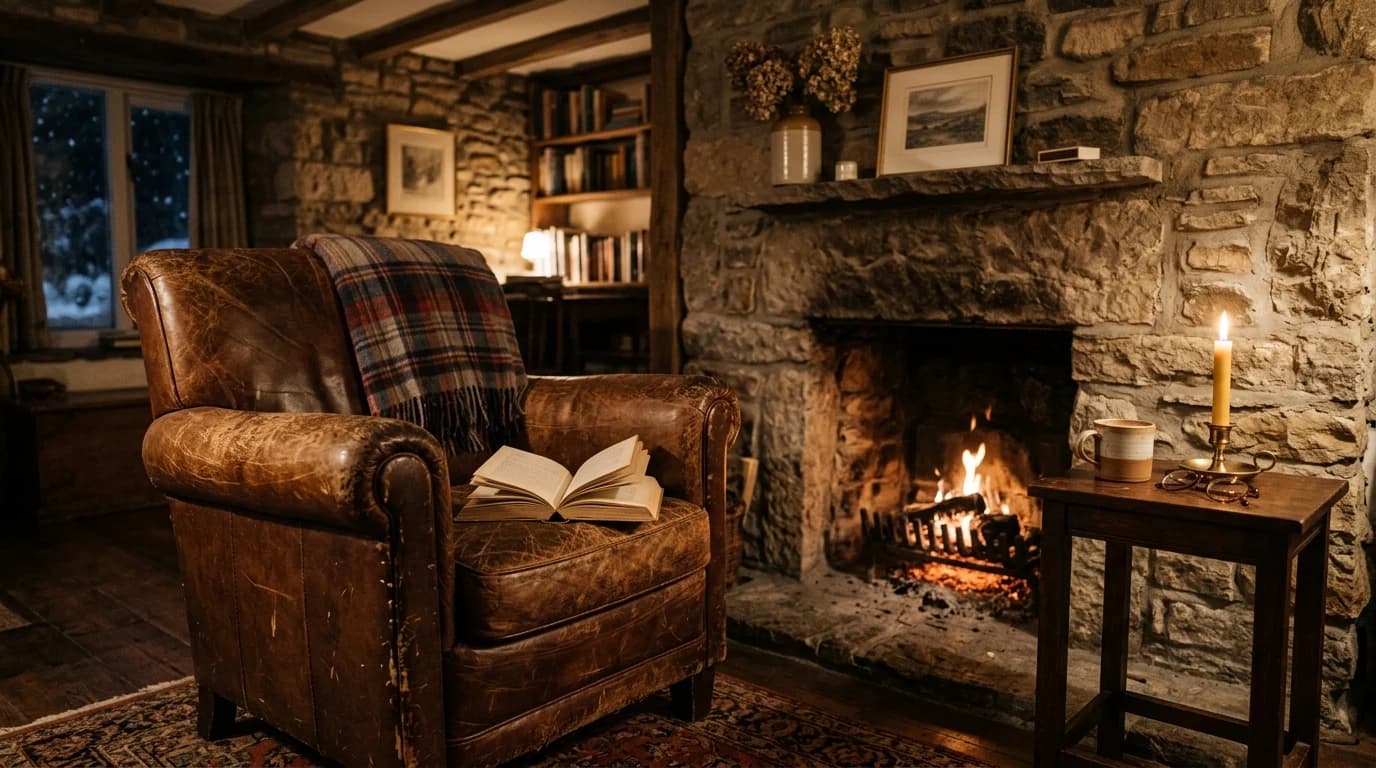
Music for reading is a stranger problem than music for sleep or focus, because the listener's attention is supposed to be elsewhere — on the text — but the music still has to do its job continuously, at a level where the reader never notices it but never quite forgets it either.
The constraints are sharp. No surprising key changes (the reader looks up). No sudden dynamics (the reader looks up). No long silences (the reader looks up). No vocals — even instrumental phrasing that resembles speech is a problem. The music has to flow.
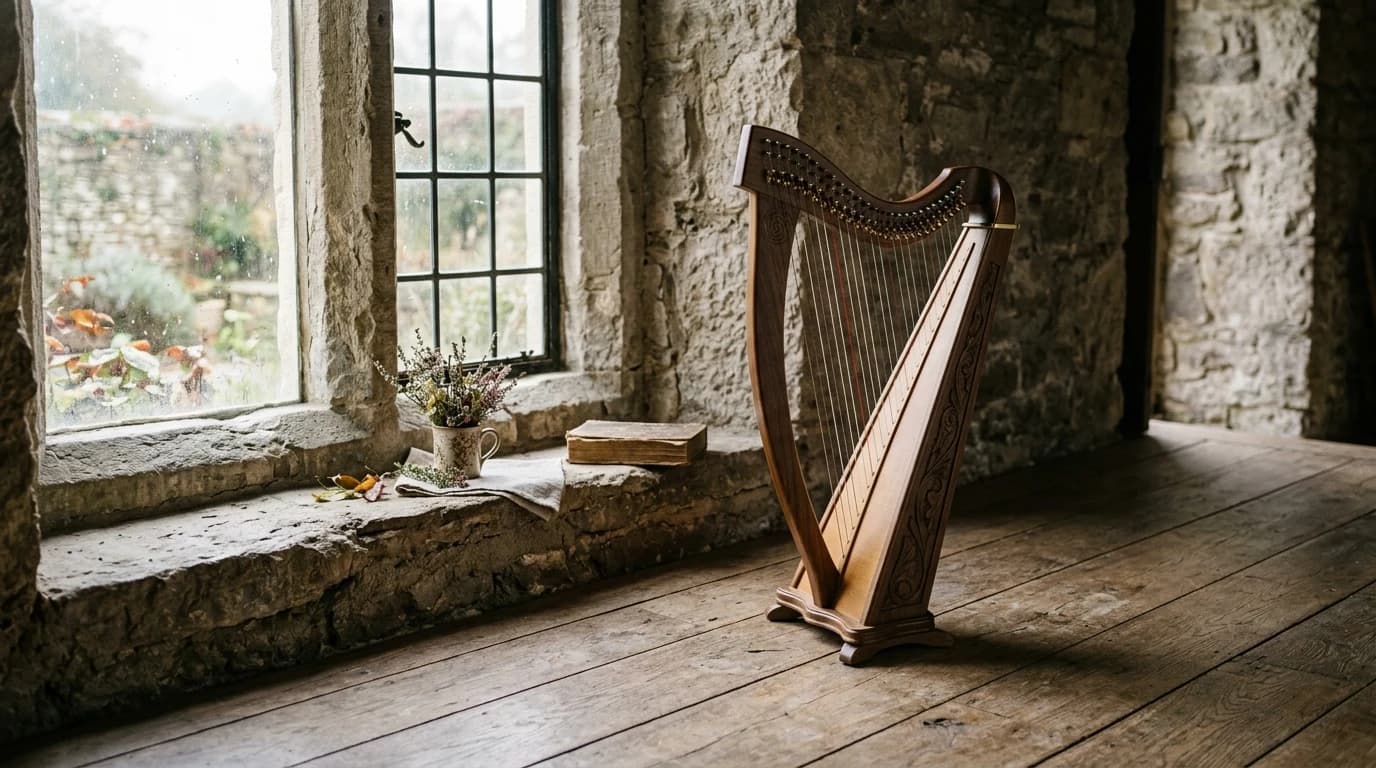
The Celtic harp is unusually well-suited for this. Its repertoire of slow airs, planxties, and traditional laments is built on continuous melodic motion in 3/4 or 6/8 time. The bass moves slower than the treble. The dynamic range is narrow. The harp's strings ring out with a clean bell-like sustain that fills the room without crowding it. The music never demands.
02 · The tradition
The cláirseach and a thousand years of slow airs.
The Celtic harp (the clàrsach in Scottish Gaelic, cláirseach in Irish) is the older of the two great harp traditions of Europe, with continuous documentary presence in Ireland and Scotland back to the 8th century. It is the national symbol of Ireland — the only country whose national symbol is a musical instrument.
Within the tradition, the slow air is a piece for solo harp played in free time, often based on the melody of an unaccompanied sean-nós song. Planxties are dedicatory pieces, written by harpers like Turlough O'Carolan for patrons who hosted them; their structure is melodically simple, harmonically warm, and built to be listened to over long afternoons.
This piece draws on that repertoire. Tempo at 60 BPM. G major. Continuous flow — the right hand never silent for more than two seconds, the left hand carrying a quiet repeated bass pattern underneath at half the melody's tempo.
03 · The listening
Set it, forget it, read.
Volume should be low. Low enough that you can hear the harp clearly but cannot single out individual notes from across the room. The piece is meant to be a tonal environment, not an object of attention.
Speakers work better than headphones for this use. The harp's resonance fills a room more naturally than it fills the inside of the head. If you are reading on a couch with a lamp, the speaker on the other side of the room is exactly right.
The piece will run for half an hour without ever asking you to look up. If at the end you cannot remember a single phrase you heard, the music did its job.
A listening guide
What to listen for
The continuous flow. Never silent for more than two seconds. This is structural — silences make readers look up.
The bass pattern. A quiet repeated four-note figure in the left hand, moving at half the speed of the melody. The reader's anchor.
The decay. Each plucked string rings for three to four seconds. The harp's signature sustain is what gives the room its warmth.
The lack of crescendo. The piece never gets louder. It never gets faster. It maintains.
The 3/4 time. The traditional time signature for Irish slow airs. A slow waltz, but barely.
Common questions
Questions people ask about the celtic harp · for reading
What makes music good to read to?
Predictability, mostly: no lyrics to decode, no sudden changes in volume, and a familiar shape so the ear stops checking what comes next. Slow harp airs meet all three without being featureless.
What is a slow air?
A slow air is an unmetered or loosely metered melody, often an instrumental setting of a song, played to bring out the tune rather than a dance rhythm. They sit at the quiet end of the Irish and Scottish repertoire.
Is the harp better than piano for reading?
Neither is better — they fail differently. A harp note decays faster than a piano note, so the texture stays thin and separated, which some readers find less intrusive than piano sustain.
Listen to the celtic harp · for reading.
The full 30-minute piece lives on the channel. Subscribe to catch each new tradition as it arrives.
Subscribe on YouTubeFree · No email required
More from this tradition
Other pieces for the celtic harp
Continue the atlas
Other traditions
Duduk
Armenia
Shakuhachi
Japan
Quena
Peru & Bolivia
Kora
Mali & Senegal
Santur
Iran
Oud
Turkey & Syria
Sitar
India
Guzheng
China
Morin Khuur
Mongolia
Kantele
Finland
Slack Key
Hawaii · soon
Mbira
Zimbabwe
Bansuri
India
Ney
Turkey
Tagelharpa
Norway · soon
Begena
Ethiopia · soon
Gayageum
Korea · soon
Ngoni
Mali · soon
Guqin
China
Erhu
China
Koto
Japan
Pipa
China
Setar
Iran
Sarod
India
Sarangi
India
Xiao
China
Kaval
Bulgaria
Dizi
China
Nyckelharpa
Sweden
Hurdy-gurdy
France
Saz
Turkey