The Best Studio Monitors for a Home Studio
The right studio monitor is the one sized to your room, not the one with the biggest number on the box.
Published September 15, 2026 · 6 min read
Quick answer
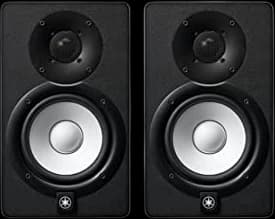
The Yamaha HS5 is the best all-around studio monitor for most home setups: a neutral, well-documented 5-inch nearfield that translates reliably to other systems.
Key takeaways
- Woofer size should match room size: 4-5 inch for small bedrooms, 6.5 inch for larger treated rooms.
- Placement in an equilateral triangle at ear height matters more than any single spec.
- Isolation pads decouple monitors from a desk and reduce muddy low-end resonance.
- Most monitors need a real audio interface with XLR or TRS outputs, not a headphone jack.
At a glance
| Pick | Best for | Price* | |
|---|---|---|---|
Best overall Yamaha HS5 Powered Studio Monitor (Pair) | Producers who want a neutral reference that translates | $299 | Buy on Amazon → |
 Best budget JBL 305P MkII Powered Studio Monitors (Pair) | First-time buyers on a tight budget | $319 | Buy on Amazon → |
 Best for larger rooms Kali Audio LP-6 V2 Studio Monitor | Rooms over roughly 150 square feet | $249 | Buy on Amazon → |
 | Mixers who want extended top-end clarity | $480 | Buy on Amazon → |
 Best for bass-heavy genres KRK Rokit 5 G5 Powered Studio Monitor | Hip-hop, trap, and electronic producers | $199 | Buy on Amazon → |
 Best compact budget pick PreSonus Eris 4.5BT 2nd Gen Media Reference Monitors★ 4.4 (220 Amazon ratings) | Tiny desks and dual-purpose music/production setups | $160 | Buy on Amazon → |
 Best for desks with no room to spare IK Multimedia iLoud Micro Monitor (Pair)★ 4.7 (2,217 Amazon ratings) | Laptop producers with a few inches of desk space | $300 | Buy on Amazon → |
* Prices are approximate and may vary. Please check the latest price on Amazon.
Most "best studio monitors" advice skips the one variable that decides whether a monitor works in your room: size. A 6.5-inch woofer that sounds great in a treated 300-square-foot room will overload a 10x10 bedroom with reflected bass. A tiny desktop monitor built for a laptop producer will feel thin in a larger space. The seven monitors below span that range, from a 3-inch desktop pair to a 6.5-inch nearfield, so the question isn't which is objectively "best" but which matches the room you actually have.
All seven are active (self-powered) monitors, which means each one needs its own power outlet and a signal from an audio interface rather than a receiver.
$299
Buy on Amazon01 · Best overall
Yamaha HS5 Powered Studio Monitor (Pair)
The most trusted small nearfield for hearing a mix as it actually is.
Yamaha lists a 54Hz-30kHz frequency response and a 70W bi-amp system (45W low, 25W high) on the HS5, with Room Control and High Trim switches to tame boundary bass. On r/musicproduction and similar threads, the recurring take is that the HS5 sounds cleaner and more neutral than bass-forward alternatives, though several posters note it rolls off low bass earlier than a 6.5-inch monitor. That tradeoff is exactly why it works: less flattering bass means fewer surprises when a mix moves to a phone speaker or a car.
Strengths
- + Neutral, well-documented reference sound
- + Room Control switch tames near-wall bass buildup
- + Widely used, so mixes translate to what others hear
Trade-offs
- − Light bass extension below ~65Hz on its own
- − No onboard DSP room correction
- Woofer
- 5 in cone
- Tweeter
- 1 in dome
- Frequency response
- 54Hz-30kHz (-10dB)
- Power
- 70W bi-amp (45W LF + 25W HF)
- Inputs
- XLR, TRS
- Controls
- Room Control, High Trim switches
$319
Buy on Amazon02 · Best budget
JBL 305P MkII Powered Studio Monitors (Pair)
A wide, forgiving sweet spot for the price, if you remember to buy two.
JBL's spec sheet puts the 305P MkII at 49Hz-20kHz (+/-3dB) with a 108dB peak SPL from an 82W bi-amp system, plus a boundary EQ switch for desks pushed against a wall. Reddit's beatmaking and budget-audiophile threads consistently point to it as the value pick, especially for hip-hop and electronic work where the wider stereo image and usable low end matter more than lab-flat accuracy.
Strengths
- + Wide stereo image and forgiving low end
- + Boundary EQ switch for wall-adjacent desks
- + Lowest price per monitor in this list
Trade-offs
- − Less accurate than the Yamaha or Kali for critical mixing
- − Pair listing is sold by a third-party seller
- Woofer
- 5 in (126mm)
- Tweeter
- 1 in (25mm) soft dome
- Frequency response
- 49Hz-20kHz (+/-3dB)
- Max SPL
- 108dB peak
- Power
- 82W bi-amp
- Inputs
- XLR, TRS
$249
Buy on Amazon03 · Best for larger rooms
Kali Audio LP-6 V2 Studio Monitor
A bigger, cleaner low end for producers who outgrew a 5-inch pair.
Kali's listing for the LP-6 V2 specifies a 45Hz-21kHz (+/-3dB) response and up to 115dB max SPL from an 80W bi-amped pair of drivers, with eight rear DIP switches for boundary, LF, and HF trim. The 6.5-inch woofer moves more air than the 5-inch monitors in this list, which is the honest reason to buy it: a bigger cone extends bass response before you need a subwoofer, and it's the model repeat Kali owners on r/studiomonitors reach for when a bedroom mix needs to hold up in a bigger room.
Strengths
- + Extended low end from the larger woofer
- + Extensive DIP-switch room correction
- + Strong price-to-accuracy ratio per independent reviews
Trade-offs
- − Larger cabinet needs more desk depth
- − Sold individually, budget for two
- Woofer
- 6.5 in
- Tweeter
- 1 in soft dome
- Frequency response
- 45Hz-21kHz (+/-3dB)
- Max SPL
- 115dB
- Power
- 80W bi-amp
- Inputs
- XLR, TRS, RCA
$480
Buy on Amazon04 · Best for high-frequency detail
Adam Audio T5V Studio Monitor (Pair)
The ribbon tweeter resolves cymbals and vocal sibilance other 5-inch monitors blur together.
Adam Audio's spec sheet lists a 45Hz-25kHz (-6dB) response, a 1.9-inch U-ART ribbon tweeter, and 106dB max SPL per pair from a 70W bi-amp system, with shelving EQ for both bass and treble. The ribbon tweeter is the differentiator: it extends well past what a dome tweeter reaches, and mixers who've moved up from dome-tweeter monitors often describe hearing more detail in high hi-hats and reverb tails. It asks for a treated room, since that same detail reveals room reflections just as readily.
Strengths
- + Ribbon tweeter extends detail past 20kHz
- + High and low shelf EQ built in
- + 5-year warranty from Adam Audio
Trade-offs
- − Reveals room reflections in untreated spaces
- − Pricier than the Yamaha or JBL
- Woofer
- 5 in polypropylene
- Tweeter
- 1.9 in U-ART ribbon
- Frequency response
- 45Hz-25kHz (-6dB)
- Max SPL
- 106dB per pair
- Power
- 70W bi-amp
- Inputs
- XLR, RCA
$199
Buy on Amazon05 · Best for bass-heavy genres
KRK Rokit 5 G5 Powered Studio Monitor
Punchier low end than most 5-inch monitors, with real DSP room correction.
KRK specifies a 54Hz-30kHz (+/-3dB) response and a 104dB max SPL from 130W of total power, plus onboard DSP offering three voicing modes and 25 room-tuning combinations. Reddit's mixed verdict is genuinely useful here: threads on r/edmproduction and r/TechnoProduction repeatedly describe the G5 as fuller and punchier in the low end than the Yamaha HS5, while others call that same low end less accurate for critical mixing. For bass-forward genres where that low end is the point, it's a reasonable tradeoff rather than a flaw.
Strengths
- + Fuller low end than most 5-inch competitors
- + Onboard DSP room tuning is genuinely adjustable
- + Kevlar woofer holds up to louder playback
Trade-offs
- − Bass emphasis can mask problems a flatter monitor reveals
- − Divisive reputation among mixing-focused users
- − Sold individually, so a stereo setup means buying two
- Woofer
- 5 in Kevlar composite
- Tweeter
- 1 in
- Frequency response
- 54Hz-30kHz (+/-3dB)
- Max SPL
- 104dB
- Power
- 130W total
- DSP
- 3 voicing modes, 25-setting room tuning
06 · Best compact budget pick
PreSonus Eris 4.5BT 2nd Gen Media Reference Monitors
The smallest, cheapest pair here that still behaves like a real monitor.
PreSonus specifies a 70Hz-20kHz response from 4.5-inch woven-composite woofers, 50W of Class AB power split across both speakers, Bluetooth 5.0, and +/-6dB shelving EQ at 100Hz and 10kHz. It's the only monitor in this list built around a front-panel aux input and Bluetooth streaming, which makes sense for a small desk doing double duty as a listening setup and a light production rig. It's not a replacement for a 5-inch or 6.5-inch monitor in a dedicated room, but for the smallest spaces it's an honest, capable starting point.
Strengths
- + Smallest footprint pair in this list
- + Bluetooth plus front-panel aux for casual listening
- + Lowest price per pair here
Trade-offs
- − Narrower frequency response than the 5-inch options
- − Class AB amps run warmer than the Class D designs above
- Woofer
- 4.5 in woven composite
- Tweeter
- 1 in silk dome
- Frequency response
- 70Hz-20kHz
- Max SPL
- 100dB peak
- Power
- 50W Class AB (25W/side)
- Bluetooth
- 5.0
4.4 out of 5 from 220 Amazon ratings
Amazon’s summary of its reviews: Customers find these speakers offer good value for money and perform flawlessly, with excellent size. The sound quality receives mixed feedback - while some find them crisp with balanced treble and bass, others report they're not as loud as advertised. Moreover, the Bluetooth connectivity and noise levels also get mixed reviews, with some reporting quick pairing and no issues, while others experience connection failures and buzzing noises.
What buyers praise
- price-performance ratio — 91% positive of 23 mentions
What buyers complain about
- noise — 65% negative of 17 mentions
07 · Best for desks with no room to spare
IK Multimedia iLoud Micro Monitor (Pair)
Genuinely usable monitoring in a footprint smaller than most bookshelf speakers.
IK Multimedia's spec sheet lists a 3-inch woofer and 3/4-inch silk dome tweeter reaching down to 55Hz (-3dB), a 56-bit onboard DSP, 50W of Class D power, and a built-in tilting isolation base. At 1.7kg each, these are the smallest monitors here by a wide margin, and the tilting base is a real fix for the common desk problem of monitors firing over your head rather than at your ears. They won't replace a 5-inch pair for serious mixing, but for a desk with genuinely no room, they beat listening on laptop speakers by a wide margin.
Strengths
- + Smallest footprint in this list by far
- + Built-in tilting isolation base aims sound at ear height
- + Bluetooth input for quick casual listening
Trade-offs
- − Limited low-end extension compared to any 5-inch monitor
- − Small sweet spot given the close driver spacing
- Woofer
- 3 in composite
- Tweeter
- 3/4 in silk dome
- Frequency response
- down to 55Hz (-3dB)
- Power
- 50W Class D bi-amp
- DSP
- 56-bit
- Weight
- 1.7kg each
4.7 out of 5 from 2,217 Amazon ratings
Amazon’s summary of its reviews: Customers praise these speakers for their sound quality, noting they're louder than older studio monitors and offer excellent soundstage for their size and price point. They are particularly well-suited for home studios and music production, with one customer highlighting their suitability for editing soundscapes. The Bluetooth connectivity receives positive feedback, with one customer mentioning they can stream anything without external connections. Performance and durability receive mixed reviews - while some say they do their job fine, others report units stopping working after two months or failing within two months. Additionally, several customers mention issues with high-pitched buzzing and audible noise.
What buyers praise
- sound quality — 83% positive of 364 mentions
- value for money — 85% positive of 99 mentions
- size — 95% positive of 73 mentions
- bluetooth connectivity — 76% positive of 33 mentions
What buyers complain about
- performance — 39% negative of 33 mentions
- durability — 38% negative of 24 mentions
Match woofer size to your room, not your budget
Woofer size roughly tracks the room size a monitor is built for. A 3-4.5 inch woofer suits a small bedroom or dorm where the listening position is a few feet away and low bass has nowhere to build up. A 5-inch woofer is the standard nearfield size for project studios in the 100-200 square foot range. A 6.5-inch woofer needs more room to breathe and can overwhelm a small, untreated space with boomy low end that a smaller monitor would never produce in the first place.
Bigger is not automatically better. A 6.5-inch monitor in a tiny bedroom often measures worse in-room than a well-matched 5-inch pair, because the extra bass energy has more room boundaries to reflect off before it reaches your ears.
Placement beats every EQ knob
Before touching any onboard EQ switch, get placement right: monitors and listening position should form an equilateral triangle, tweeters at ear height, angled slightly inward toward the listener. Pulling monitors away from walls and corners reduces the boundary bass buildup that most onboard "boundary EQ" or "room control" switches exist to compensate for in the first place.
Several monitors here include DSP or DIP-switch room correction, which helps, but it is a correction for a room problem, not a substitute for basic placement. Getting the triangle and wall distance right first means the room-correction switches have less work to do.
Isolation pads quiet the desk itself
A monitor sitting directly on a hard desk transmits vibration into the desk itself, which resonates and muddies the low-mids. Foam isolation pads (from established brands like Auralex or IsoAcoustics) decouple the cabinet from the desk and are one of the cheapest upgrades available for any monitor on this list. They matter more on a hard, hollow desk than on a solid, heavy one, but they rarely hurt.
You'll need an audio interface, not just a headphone jack
Every monitor here connects over XLR or TRS, not a 3.5mm headphone jack. That means a basic USB audio interface sits between your computer and the monitors, both to convert the digital signal and to give you independent volume control. It's an unavoidable extra purchase for anyone moving from computer speakers, and worth budgeting for alongside the monitors themselves.
How these seven differ
The Yamaha HS5 and JBL 305P MkII sit at opposite ends of the same 5-inch category: the Yamaha trades bass warmth for a flatter, more predictable response, while the JBL leans warmer and wider. The KRK Rokit 5 G5 splits the difference with a fuller low end and real DSP room tuning. The Kali LP-6 V2 is the only 6.5-inch option here, built for a bigger room than the others. The Adam T5V trades a bit of bass extension for a ribbon tweeter that resolves more high-frequency detail than any dome tweeter in this list. The PreSonus Eris 4.5BT and IK iLoud Micro Monitor are both built for the smallest desks, with the PreSonus prioritizing Bluetooth convenience and the iLoud prioritizing sheer footprint.
Questions people ask
Do I need studio monitors if I already have good headphones?
Headphones and monitors reveal different problems. Headphones remove room acoustics entirely and can exaggerate stereo width, while monitors let you hear how a mix behaves in actual air, including low-end buildup and how sounds translate to speakers most listeners will actually use. Most home producers eventually want both.
What size studio monitor is right for a small bedroom?
A 4-5 inch woofer is the general sweet spot for a small, untreated bedroom. A 6.5-inch monitor can work if the room is larger or has some acoustic treatment, but in a tight space it often produces more boomy low-end buildup than a smaller monitor would.
Do studio monitors need a subwoofer?
Not for most home studio work. A subwoofer helps if a room's monitors roll off too early to judge sub-bass, common with 3-4 inch woofers, but it adds a second thing to level-match and integrate correctly, which can introduce its own problems if done casually.
Can I use studio monitors for regular music listening?
Yes. Several picks here, including the PreSonus Eris 4.5BT and IK iLoud Micro Monitor, include Bluetooth specifically for that dual use. Flatter monitors like the Yamaha HS5 will sound less "exciting" than consumer speakers by design, since they're built to avoid flattering any particular frequency range.
How far apart should studio monitors be placed?
Far enough apart that the distance between them roughly equals the distance from each monitor to your listening position, forming an equilateral triangle. Too close narrows the stereo image; too far apart creates a hole in the middle of the mix.
Sources
- Yamaha HS Series (HS5/HS7/HS8/HS8S) full specifications
- Kali Audio Lone Pine (LP-6 V2) studio monitors — product page
- KRK Rokit 5 Generation Five product page
- ADAM Audio T5V product page and specifications
- PreSonus Eris 4.5BT 2nd Gen product page
- IK Multimedia iLoud Micro Monitor product page
- JBL 305P MkII product page and specifications
Keep reading
Listen first
As an Amazon Associate, SlowHum earns from qualifying purchases, at no extra cost to you. Full disclosure.