The Best Podcast Microphones
Dynamic microphones beat condensers in almost any untreated room, so every pick here starts from that and spreads out by price and connection type.
Published September 15, 2026 · 6 min read
Quick answer
The Shure MV7+ is the best all-around podcast microphone for most home setups: a dynamic capsule that rejects room noise, USB-C for simplicity, and XLR to grow into later.
Key takeaways
- Dynamic mics reject room noise; every mic on this list is dynamic, not condenser, for exactly that reason.
- Hybrid USB/XLR mics let you start simple now and add an audio interface later without buying a new mic.
- A boom arm and, for XLR-only mics, an interface with real clean gain matter as much as the mic itself.
- Budget dynamic mics get close to Shure SM7B sound for a fraction of the price and none of the gain hassle.
At a glance
| Pick | Best for | Price* | |
|---|---|---|---|
Best budget pick FIFINE K688 USB/XLR Dynamic Microphone | Beginners who want USB/XLR flexibility on a tight budget | $70 | Buy on Amazon → |
 | Buyers who want a full stand-and-cable kit in one box | $80 | Buy on Amazon → |
 | Buyers who want onboard DSP without a full interface | $183 | Buy on Amazon → |
 | Podcasters who want USB now and an XLR path later | $299 | Buy on Amazon → |
 Best for a treated, multi-mic setup Shure SM7B Cardioid Dynamic Microphone★ 4.8 (12,193 Amazon ratings) | Hosts who already own an interface with real clean gain | $429 | Buy on Amazon → |
* Prices are approximate and may vary. Please check the latest price on Amazon.
Most "best podcast microphone" arguments online skip the part that actually decides the recording: your room. A dynamic microphone in an untreated bedroom beats a condenser microphone in the same room almost every time, because dynamic capsules reject the reflections and background noise a condenser happily captures along with your voice. Every pick below starts from that, then spreads out by connection type and price so you can match a mic to your setup instead of the other way around.
01 · Best budget pick
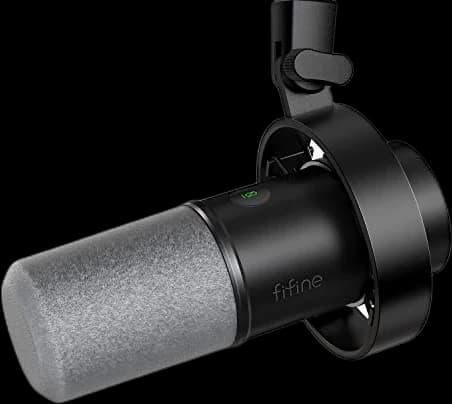
FIFINE K688 USB/XLR Dynamic Microphone
A cardioid dynamic mic with real onboard controls that undercuts every hybrid mic on this list.
FIFINE built the K688 around the same USB-plus-XLR-plus-headphone-jack formula as pricier hybrid mics, then priced it well below them. FIFINE's own listing puts the dynamic cardioid capsule's frequency response from 70Hz up, with a gain knob, touch-mute, and zero-latency monitoring built in — the same core feature set as mics costing twice as much. It also won a 2022 iF Design Award, which speaks to build quality more than sound. Skip it if you plan to run it through demanding music-production work; its USB side tops out at 16-bit/48kHz, which is fine for podcasts but tight for anything else.
Strengths
- + Gain knob and touch-mute on the mic body
- + Real XLR output for a future interface upgrade
- + Cheapest true hybrid mic with a metal body
Trade-offs
- − Frequency response starts higher than the pricier picks here
- − No onboard DSP or companion app
- Capsule
- Dynamic, cardioid
- Frequency response
- 70 Hz and up (FIFINE)
- Connectivity
- USB-C and XLR
- USB resolution
- 16-bit / 44.1–48kHz
- Weight
- ~331 g (mic only)
02 · Best budget kit
Samson Q2U USB/XLR Dynamic Microphone
The classic budget hybrid mic, dynamic and cardioid, and it ships with everything you need to start.
Samson's Q2U has been a default recommendation on r/podcasting and r/Twitch for years, and it still comes up unprompted in mic threads today. It's a dynamic cardioid capsule with both USB and XLR outputs, a 50Hz–15kHz frequency response per Samson's spec sheet, and a headphone jack for zero-latency monitoring. The box includes a mic clip, tripod stand, windscreen, and both cables, which is genuinely useful for a first setup. It won't match the detail of a condenser, and the included clip and stand feel basic, but it's a low-risk way to find out if podcasting sticks.
Strengths
- + Full accessory kit included in the box
- + Long-running default budget recommendation on Reddit
- + Headphone monitoring jack
Trade-offs
- − Included stand and clip feel basic
- − No gain knob — level is set in software
- Capsule
- Dynamic, cardioid
- Frequency response
- 50 Hz – 15 kHz
- Sensitivity
- -54 dBV/Pa
- Connectivity
- USB and XLR
- Included
- Stand, windscreen, USB and XLR cables
03 · Best value hybrid
Rode PodMic USB Dynamic Broadcast Microphone
Rode's dynamic broadcast capsule with a built-in preamp and DSP, so USB output sounds like a real chain.
The PodMic USB pairs Rode's dynamic broadcast capsule with an onboard Revolution Preamp and Aphex DSP, so its USB side gets clean gain and light processing without an external interface, which matters because dynamic mics like this one otherwise need a lot of clean gain to sound right. Rode's spec sheet lists a 20Hz–20kHz frequency response and 148dB max SPL. It has an internal pop filter and shockmount, all-metal construction, and a built-in headphone jack. It costs more than the budget hybrids above, but it's the clearest step up in build and sound before the Shure MV7+.
Strengths
- + Onboard preamp and DSP improve the USB sound
- + All-metal build with internal pop filter and shockmount
- + 5-year warranty from Rode
Trade-offs
- − Costs more than the Samson, Audio-Technica, and FIFINE hybrids
- − USB mode tops out at 48kHz, not 96kHz
- Capsule
- Dynamic, cardioid
- Frequency response
- 20 Hz – 20 kHz
- Max SPL
- 148 dB
- Connectivity
- USB-C and XLR
- USB resolution
- 24-bit / 48kHz
4.5 out of 5 from 137 Amazon ratings
Amazon’s summary of its reviews: Customers find the microphone's sound quality extraordinary and appreciate its appearance, with one noting it looks extremely premium on camera. Moreover, the microphone is super easy to set up. However, the connectivity receives mixed feedback, with several customers mentioning issues with the headphone port. Additionally, functionality and value for money also get mixed reviews, with some finding it an incredible value while others consider it slightly overpriced.
04 · Best overall
Shure MV7+ USB-C & XLR Podcast Dynamic Microphone
The mic reviewers and Reddit keep landing on for good reason: broadcast tone, real DSP, dual outputs.
The MV7+ keeps the warm, SM7-style tone Shure is known for, adds USB-C and XLR outputs, and layers on real-time denoising, auto-leveling, and a digital pop filter through Shure's MOTIV app, per Shure's product page. Its frequency response runs 50Hz–16kHz, and it records up to 48kHz/24-bit over USB. On Reddit, it's consistently the mic people recommend over the SM7B for anyone who doesn't already own an audio interface, since it sounds good straight out of the box. It costs more than the hybrids above, and its LED touch panel is a cosmetic extra some buyers would rather skip paying for.
Strengths
- + Warm broadcast tone without needing an external interface
- + Onboard DSP: denoiser, auto-level, digital pop filter
- + XLR output to grow into later
Trade-offs
- − Costs two to three times the budget hybrid picks
- − LED touch panel is a cosmetic extra, not a necessity
- Capsule
- Dynamic, cardioid
- Frequency response
- 50 Hz – 16 kHz
- Connectivity
- USB-C and XLR
- USB resolution
- 24-bit / 48kHz
- Extras
- Auto Level Mode, real-time denoiser, LED touch panel
4.6 out of 5 from 1,091 Amazon ratings
Amazon’s summary of its reviews: Customers find this microphone to be the best they've used, with crystal clear sound quality and effective noise cancellation. The microphone is easy to set up and use, with one customer noting it works flawlessly with USB hubs, and they appreciate the USB-C connection for daily use. While some customers find it worth the money, others consider it pricey, and the functionality receives mixed reviews with some reporting it stops working. The muting feature receives mixed feedback, with some praising the touch-to-mute feature while others find it too easy to accidentally activate.
What buyers praise
- quality — 91% positive of 125 mentions
- sound quality — 77% positive of 87 mentions
- ease of use — 94% positive of 31 mentions
- noise cancellation — 81% positive of 21 mentions
What buyers complain about
- value for money — 35% negative of 54 mentions
05 · Best for a treated, multi-mic setup
Shure SM7B Cardioid Dynamic Microphone
The industry-standard broadcast mic, but only once you've budgeted for the gain it demands.
The SM7B is a passive, XLR-only dynamic mic with a flat, wide-range frequency response designed for broadcast and studio use, per Shure's own materials. It has no USB output, and unlike the newer SM7dB, no built-in preamp — Reddit's Shure-focused communities and Shure's own SM7dB launch messaging agree it needs real clean gain, typically from a Cloudlifter or an interface built for low-output dynamic mics, to sound its best. That's an extra $100 or more most beginners haven't budgeted for. Buy it once you're already running an interface with gain to spare, want room to add more mics later, and don't need a USB output at all.
Strengths
- + Broadcast-standard warm tone
- + Detachable windscreen and internal shock isolation
- + Scales cleanly into a multi-mic XLR setup
Trade-offs
- − Needs a Cloudlifter or high-gain interface to sound right
- − No USB output at all
- Capsule
- Dynamic, cardioid
- Frequency response
- Wide-range, flat (per Shure)
- Connectivity
- XLR only
- Included
- A7WS detachable windscreen, RPM602 switch plate
- Preamp
- None — needs a Cloudlifter or high-gain interface
4.8 out of 5 from 12,193 Amazon ratings
Amazon’s summary of its reviews: Customers praise the microphone's sound quality, build with its all-metal construction, and its effectiveness in rejecting background noise. The microphone excels in capturing speech and singing with exceptional fidelity, and performs well in both live and studio settings. While some customers find it well worth the money, others feel it's overpriced at $400. The volume level receives mixed feedback, with some appreciating the perfect amount of gain while others note extremely low gain.
What buyers praise
- sound quality — 89% positive of 665 mentions
- performance — 74% positive of 116 mentions
- versatility — 98% positive of 92 mentions
- noise cancellation — 73% positive of 74 mentions
Dynamic vs. condenser for untreated rooms
Reddit's r/podcasting comes back to the same answer whenever someone asks about a small, untreated bedroom or office: get a dynamic mic. A dynamic capsule is less sensitive off-axis, so it picks up your voice close-up and rejects the HVAC hum, keyboard clicks, and echo that a condenser mic captures right along with it. That's why every mic on this list is dynamic rather than condenser — for spoken-word podcasting in a normal room, it's the safer default.
Condenser mics still have a place: they capture more detail and a wider frequency range, which is why they're common for music and voiceover work in treated spaces. If you've already added moving blankets, foam, or a proper vocal booth, a condenser can sound excellent. If you haven't, a dynamic mic will forgive you.
USB, XLR, or hybrid: picking a connection type
A USB microphone plugs straight into your computer and needs nothing else — the simplest way to start. An XLR microphone, like the classic Shure SM7B, needs an audio interface or mixer with phantom power or enough clean gain to work at all. A growing number of mics, including most of the picks below, are hybrid: they offer a USB-C output for day one and an XLR output for whenever you add an interface.
Buy hybrid if there's any chance you'll add co-hosts, a second mic, or an interface later — it costs little extra now and saves a second purchase down the line. Buy XLR-only, like the SM7B, only once you already own, or are budgeting for, an interface built to drive a low-output dynamic mic.
What else you need: interface, boom arm, pop filter
A microphone is one piece of a small chain. If you go XLR-only, you need an audio interface, and for a passive dynamic mic like the SM7B, one with real clean gain or a separate booster like a Cloudlifter, since Reddit's Shure-focused communities consistently flag the stock SM7B as a quiet mic that needs help. A boom arm keeps the mic close to your mouth without a desk stand eating your workspace, and most hybrid mics here don't ship with one. A pop filter or foam windscreen cuts plosives on hard consonants; a few picks below build one in, but an external filter helps on any mic. Budget roughly $30–60 for a boom arm if your mic doesn't include one.
How to choose between these picks
Start at the top of your budget and work down, not the other way around. The FIFINE K688 and Samson Q2U do the same basic job — dynamic, cardioid, hybrid — and differ mostly in build quality and included accessories. The Rode PodMic USB adds onboard processing that makes its USB output sound closer to a proper studio chain. The Shure MV7+ is the mic to buy if you want the best sound with the least extra gear. The Shure SM7B only makes sense once an interface with real gain is already part of your setup, or about to be.
What to skip
Skip Renewed or used listings for any of these — a dynamic capsule that's been dropped is hard to verify from a listing photo, and the price difference rarely justifies the risk. Skip buying an SM7B before you've priced out the gain it needs; several Reddit threads describe buyers who bought the mic first and only later discovered they needed a $100-plus Cloudlifter or interface upgrade to make it usable. And skip gaming-oriented condenser mics with RGB lighting for spoken-word podcasting in an untreated room — the party trick there is lighting, not noise rejection.
Questions people ask
Do I need an audio interface for a USB podcast microphone?
No. USB microphones connect directly to your computer and don't need an interface. If you buy a hybrid mic like several picks here, an interface only becomes necessary if you later switch to its XLR output, add a second XLR mic, or want more control over gain and monitoring than the USB side offers.
Is the Shure SM7B worth it for a beginner?
Usually not as a first mic. It's a passive, XLR-only dynamic microphone with no built-in preamp, and Reddit's Shure communities consistently note it needs a lot of clean gain, typically from a Cloudlifter or an interface built for low-output mics, to sound its best. That's an extra cost most beginners haven't budgeted for.
What's the difference between the Shure MV7+ and the Shure MV6?
Both are Shure USB microphones, but the MV7+ adds an XLR output and keeps the warm, SM7-style tone Shure built its reputation on, according to Shure's own comparison page. The MV6 is USB-only, with a brighter tone tuned for gaming and streaming rather than spoken-word podcasting.
Can I use a condenser microphone for podcasting?
Yes, but only comfortably in a treated or naturally quiet room. Condenser capsules are more sensitive than dynamic ones, so they pick up room echo, HVAC noise, and typing along with your voice, which is why dynamic mics are the more common recommendation for untreated home setups.
How close should I sit to a dynamic podcast mic?
A few inches. Most dynamic capsules are designed for close-mic use and lose warmth and volume quickly as you move away, unlike a condenser that can pick up a voice from across a desk. If your recordings sound thin, moving closer is usually the first fix to try.
USB or XLR: which should a beginner choose?
USB, or a hybrid mic with a USB option, for almost everyone starting out — it needs no extra gear and sounds good immediately. Move to XLR only once you're adding a second mic, want more control over gain, or are already buying an audio interface for another reason.
Sources
- MV7+ - Podcast Microphone (Shure product page)
- SM7B - Vocal Microphone (Shure product page)
- MV6 or MV7+ - Which mic is right for you? (Shure)
- Rode PodMic USB product page
- FIFINE AmpliTank K688 product page
- The best podcasting microphones 2026 (SoundGuys)
- Best Podcast Microphones In 2026 For Great Audio (Podcast Insights)
As an Amazon Associate, SlowHum earns from qualifying purchases, at no extra cost to you. Full disclosure.