The Best USB Microphones
USB microphones plug in and just work; these six condensers span a compact budget pick to studio-grade sound for singing and music.
Published September 15, 2026 · 6 min read
Quick answer
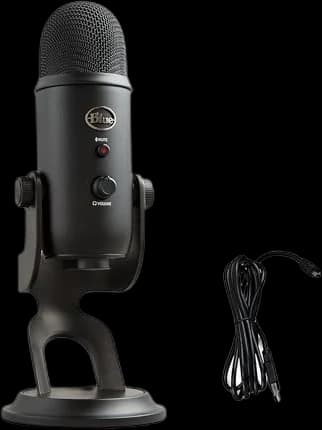
The Logitech Yeti (formerly Blue Yeti) is the best all-around USB microphone for most people, thanks to four switchable polar patterns that cover solo recording, interviews, and calls with one mic.
Key takeaways
- Nearly every good USB microphone is a condenser, which is why USB mics reward a reasonably quiet room more than dynamic podcast mics do.
- Extra polar patterns (omni, bidirectional, stereo) are worth paying for only if more than one voice will use the same mic.
- Onboard DSP, on the Rode NT-USB+ and Elgato Wave:3 MK.2, moves processing onto the mic instead of your computer.
- Blue Microphones is gone as a brand name; Logitech now sells the same lineage simply as the Logitech Yeti.
At a glance
| Pick | Best for | Price* | |
|---|---|---|---|
Best overall / most versatile Logitech Yeti USB Microphone | Anyone who needs one mic for solo, interviews, and calls | $99 | Buy on Amazon → |
 Best for streaming and plug-and-play setup Elgato Wave:3 MK.2 USB Condenser Microphone | Streamers who want onboard processing without extra software | $145 | Buy on Amazon → |
 Best for creators who want gaming-forward controls HyperX QuadCast 2 USB Microphone★ 4.6 (894 Amazon ratings) | Gamers and streamers who want a mute tap and 4 patterns | $120 | Buy on Amazon → |
 Best sound quality for vocals and music Rode NT-USB+ USB Condenser Microphone★ 4.4 (1,405 Amazon ratings) | Musicians and singers who want studio-grade USB sound | $169 | Buy on Amazon → |
 Best reliable mid-range workhorse Audio-Technica AT2020USB-X Cardioid Condenser USB Microphone | Buyers who want AT2020 sound with none of the fuss | $186 | Buy on Amazon → |
 | Desks with no room for a full-size microphone | $123 | Buy on Amazon → |
* Prices are approximate and may vary. Please check the latest price on Amazon.
A USB microphone plugs into your computer and just works: no interface, no phantom power, no XLR cable to buy. That convenience makes USB mics the default choice for streaming, voice chat, and casual music recording, and most of the best ones are condenser microphones, more detailed and more sensitive than the dynamic mics that dominate spoken-word podcasting. The six picks below span a $99 all-rounder to a $186 studio-grade condenser, with one gaming-forward pick and two that process audio onboard.
01 · Best overall / most versatile
Logitech Yeti USB Microphone
Four polar patterns in one mic mean it adapts to almost any recording situation you're in.
Logitech folded Blue Microphones into its own brand in 2023–2024, and this multi-pattern condenser, sold today as the Logitech Yeti with "Blue" now used only as a technology name per Logitech's own announcement, is the direct descendant of the original Blue Yeti. It uses three condenser capsules to offer cardioid, omnidirectional, bidirectional, and stereo pickup, a 48kHz/16-bit sample rate, and onboard gain, mute, and headphone controls, per Logitech's product page. It's the mic Reddit's streaming and podcasting threads recommend most often for buyers who aren't sure yet exactly what they'll record. It's still a condenser, so a quiet-ish room helps.
Strengths
- + Four polar patterns cover solo, interview, and conference use
- + Onboard gain, mute, and headphone monitoring
- + Widely stocked with easy-to-find accessories
Trade-offs
- − Condenser capsule picks up more room noise than a dynamic mic
- − 16-bit resolution is behind newer USB condensers
- Capsule
- 3x condenser, multi-pattern
- Polar patterns
- Cardioid, omnidirectional, bidirectional, stereo
- Sample rate
- 48kHz / 16-bit
- Frequency response
- 20 Hz – 20 kHz
- Connectivity
- USB
$145
Buy on Amazon02 · Best for streaming and plug-and-play setup
Elgato Wave:3 MK.2 USB Condenser Microphone
A quieter-room condenser with real-time processing built into the mic instead of your CPU.
Elgato's Wave:3 MK.2, released in 2026, moves audio processing onto the mic itself: a Wave FX Processor runs a low-cut filter, expander, compressor, EQ, and voice tuning with no added latency or CPU load, per Elgato's own comparison page for the two Wave:3 generations. It replaces the original Wave:3, which handled effects in software instead. Clipguard 2.0 raises max SPL to 130dB, up from 120dB on the original. It's still a condenser, so it rewards a reasonably quiet room, and full control leans on Elgato's Wave Link software, which some buyers find fiddly at first.
Strengths
- + Onboard DSP runs with zero added latency
- + Clipguard 2.0 makes distortion hard to trigger
- + Multifunction dial for quick adjustments
Trade-offs
- − Condenser capsule still favors a quieter room
- − Full control needs Elgato's Wave Link app
- Capsule
- 16mm condenser, cardioid
- Sample rate
- 48kHz
- Max SPL
- 130 dB (Clipguard 2.0)
- Connectivity
- USB-C
- Onboard DSP
- Low-cut filter, expander, compressor, EQ, voice tune
03 · Best for creators who want gaming-forward controls
HyperX QuadCast 2 USB Microphone
A four-pattern condenser built around one multifunction knob and a tap-to-mute sensor.
The QuadCast 2 records at 24-bit/96kHz and switches between cardioid, omnidirectional, bidirectional, and stereo pickup with the same knob that handles gain, playback, and monitoring volume, according to HyperX's product page. A tap-to-mute sensor on top and a detachable shock mount round out a design aimed squarely at streamers rather than podcasters. It's a step up in resolution from the original QuadCast, and HyperX also sells a QuadCast 2 S variant with RGB lighting and 32-bit/192kHz recording for more money. As a condenser, it's more sensitive to room noise than the dynamic mics in our podcast microphone guide.
Strengths
- + One knob controls gain, volume, and polar pattern
- + Tap-to-mute sensor on top of the mic
- + Detachable shock mount, no extra hardware needed
Trade-offs
- − Condenser sensitivity means room noise still matters
- − RGB, higher-resolution QuadCast 2 S variant costs more
- Capsule
- Condenser, multi-pattern
- Polar patterns
- Cardioid, omnidirectional, bidirectional, stereo
- Resolution
- 24-bit / 96kHz
- Connectivity
- USB-C
- Mounting
- 3/8" and 5/8" threading
4.6 out of 5 from 894 Amazon ratings
Amazon’s summary of its reviews: Customers praise the microphone's sound quality, describing it as studio quality, and appreciate its sleek appearance, easy setup, and plug-and-play connectivity. They like the lighting features, with one customer highlighting the instant status indicator, and the tap-to-mute functionality, with one noting its quick and responsive operation. While the microphone generally works well, some customers report that it randomly turns off.
What buyers praise
- sound quality — 94% positive of 51 mentions
- value for money — 81% positive of 16 mentions
- ease of use — 93% positive of 15 mentions
04 · Best sound quality for vocals and music
Rode NT-USB+ USB Condenser Microphone
Rode's Revolution Preamp and onboard DSP make this the clearest-sounding mic on this list.
The NT-USB+ pairs a half-inch studio condenser capsule with Rode's Revolution Preamp and Aphex-powered onboard DSP, a compressor, noise gate, high-pass filter, and two Aphex processing modes, all controllable without an app, per Rode's product page. It's class-compliant USB-C, so it works without drivers on a computer or a USB-C phone or tablet. It is among the pricier picks here, and its detail comes at the cost of room forgiveness: like any condenser, it rewards a quiet, ideally lightly treated space more than a noisy one.
Strengths
- + Onboard DSP and preamp rival a small interface
- + Works without drivers on PC, Mac, and USB-C mobile
- + Built-in pop filter and desktop stand included
Trade-offs
- − Most expensive pick on this list
- − Condenser sensitivity needs a reasonably quiet room
- Capsule
- 1/2" studio condenser, cardioid
- Preamp
- Rode Revolution Preamp
- Onboard DSP
- Compressor, noise gate, high-pass filter, Aphex FX
- Connectivity
- USB-C, class-compliant
- Resolution
- 24-bit / 48kHz
4.4 out of 5 from 1,405 Amazon ratings
Amazon’s summary of its reviews: Customers find the microphone's quality amazing and appreciate its ease of use with plug-and-play functionality. The sound quality is positive, with one customer noting it captures even the smallest details, and they like the adjustable volume controls and sound shaping options. While some customers find it totally compatible, others report connectivity issues, and while some consider it worth the investment, others warn against purchasing it. The noise cancellation receives mixed feedback, with some reporting zero background noise while others complain about excessive background noise.
What buyers praise
- quality — 79% positive of 77 mentions
- ease of use — 85% positive of 27 mentions
What buyers complain about
- functionality — 37% negative of 30 mentions
- value for money — 42% negative of 24 mentions
- connectivity — 45% negative of 22 mentions
$186
Buy on Amazon05 · Best reliable mid-range workhorse
Audio-Technica AT2020USB-X Cardioid Condenser USB Microphone
A USB-C update to a long-trusted condenser, with a mute button and monitoring built in.
The AT2020USB-X updates Audio-Technica's widely used AT2020 condenser capsule with USB-C plug-and-play operation, a 24-bit/96kHz converter, and a headphone jack with volume control for direct monitoring, per Audio-Technica's product page. A soft-touch capacitive mute button and an LED ring that turns red when muted round out the controls. It ships with a custom desk stand and both USB-C and USB-A cables. It's a straightforward condenser with no onboard DSP or polar-pattern switching, which is either a limitation or an advantage depending on whether you want simplicity.
Strengths
- + Well-known AT2020 capsule sound
- + Mute button and headphone monitoring built in
- + Ships with both USB-C and USB-A cables
Trade-offs
- − Single cardioid pattern only, no switching
- − No onboard DSP or app control
- Capsule
- Cardioid condenser
- Resolution
- 24-bit / 96kHz
- Connectivity
- USB-C (USB-A adapter included)
- Weight
- 373 g
- Controls
- Capacitive mute button, headphone volume
$123
Buy on Amazon06 · Best budget condenser
Rode NT-USB Mini USB Condenser Microphone
A compact condenser that gives up little sound quality for a much smaller footprint.
The NT-USB Mini fits a cardioid condenser capsule, a magnetic detachable desk stand, and USB-C connectivity into a footprint a fraction the size of Rode's own NT-USB+, with a 20Hz–20kHz frequency response, 48kHz/24-bit resolution, and 121dB SPL handling per Rode's spec sheet. It's class-compliant, so there's nothing to install. Reviewers consistently describe it as close to the bigger NT-USB+ in sound for meaningfully less money. It's still a condenser, so it's not the pick for a noisy shared room, and it lacks the onboard DSP of the pricier Rode mic above.
Strengths
- + Small desk footprint with a magnetic detachable stand
- + Sound quality close to the pricier NT-USB+
- + Simple class-compliant USB-C, no drivers
Trade-offs
- − No onboard DSP or gain knob
- − Still a condenser — favors a quieter room
- Capsule
- Cardioid condenser
- Frequency response
- 20 Hz – 20 kHz
- Resolution
- 24-bit / 48kHz
- Max SPL
- 121 dB
- Weight
- 585 g (mic and stand)
Condenser vs. dynamic for a USB mic
Every mic on this list is a condenser, and that's not an accident: condensers capture more detail and a wider frequency range than dynamic mics, which is exactly what streaming, singing, and instrument recording benefit from. The tradeoff is sensitivity — a condenser also picks up room echo, fan noise, and keyboard clicks more readily. If you're recording spoken-word podcasts in an untreated room, a dynamic microphone is usually the better starting point.
None of that rules condensers out for casual use. A reasonably quiet home office or bedroom is enough for every mic on this list to sound good.
What these mics are actually good for
USB condensers are the default pick for three overlapping uses: live streaming, where low latency and a simple setup matter more than studio polish; voice chat and video calls, where almost any mic here outperforms a laptop microphone; and casual music or vocal recording, where the wider frequency range of a condenser earns its keep. If your main use is a daily podcast recorded in a spare room, weigh a dynamic mic instead, since the tradeoffs run the other way.
Polar patterns, explained
Most mics on this list use a single cardioid pattern, which picks up sound from directly in front and rejects sound from the sides and rear, the right choice for one person talking into one mic. The Logitech Yeti and HyperX QuadCast 2 add omnidirectional (picks up everything around the mic, good for a roundtable), bidirectional (front and back, good for a face-to-face interview), and stereo (good for ambient or musical recording) patterns on top of cardioid.
Extra patterns are worth paying for if you'll record more than one voice on the same mic. If it's always going to be just you, a simpler cardioid-only condenser does the job for less.
How to choose between these picks
The Rode NT-USB Mini is the easiest entry point: small, simple, and close in sound to Rode's own step-up model. The Audio-Technica AT2020USB-X and HyperX QuadCast 2 sit in the middle, AT2020USB-X for a known-quantity sound with no distractions, QuadCast 2 if you want extra polar patterns and a gaming-forward look. The Logitech Yeti is the most flexible all-rounder for anyone who isn't sure yet what they'll record. Reach for the Elgato Wave:3 MK.2 if you want processing handled on the mic instead of in software, and the Rode NT-USB+ if sound quality for singing or music matters more than price.
What to skip
Skip Renewed or used condenser mics: a condenser capsule that's taken a drop can develop noise or distortion that's hard to catch from a listing photo. Skip an ultra-cheap unbranded USB condenser bundled with a cheap boom arm and pop filter; the mic itself is usually the weak link in those kits, and none of the brands here need bundled accessories to justify their price. And skip buying a four-pattern mic like the Yeti or QuadCast 2 if you'll only ever record solo, since a simpler cardioid-only condenser gets you the same core sound for less.
Questions people ask
Is Blue Yeti still a thing, or is it called something else now?
Logitech absorbed the Blue Microphones brand in 2023–2024 and now sells the mic simply as the Logitech Yeti, with "Blue" used only to describe the underlying audio technology, per Logitech's own announcement. The microphone itself carries on the same lineage as the original Blue Yeti.
Do I need an audio interface for a USB microphone?
No. USB microphones convert audio to digital inside the mic and send it straight to your computer over a USB cable, with no interface, mixer, or phantom power required. An interface only becomes useful if you later add an XLR microphone.
Can I use a USB microphone for singing or music?
Yes. Condenser USB mics like the Rode NT-USB+ and AT2020USB-X are built for exactly that, capturing more detail and a wider frequency range than the dynamic mics common in podcasting. For serious multi-track recording, most musicians eventually move to an XLR mic and an audio interface instead.
Why do some USB mics have four polar patterns and others only one?
Extra patterns add cost and complexity in exchange for flexibility, useful if you'll ever record more than one person on the same mic, for a roundtable or an in-person interview. If it's always going to be one voice, a single cardioid pattern does the job for less.
Is a USB microphone good enough for professional streaming?
For most streamers, yes. The gap between a good USB condenser and an XLR setup with an interface is smaller than it used to be, and several picks here add onboard processing that used to require extra hardware. The XLR route still wins for people who want to add mixers or multiple mics.
What's the difference between the Rode NT-USB+ and NT-USB Mini?
The NT-USB+ uses a larger studio condenser capsule with an onboard preamp and DSP, aimed at musicians and singers who want the best sound. The NT-USB Mini is smaller, simpler, and roughly $45 cheaper, with reviewers describing its sound as close to its bigger sibling.
Sources
- Logitech retires the Blue microphone brand (Engadget)
- Logitech Yeti Multi-Pattern USB Microphone product page
- Wave:3 vs Wave:3 MK.2: What's the difference (Elgato)
- HyperX QuadCast 2 - USB Microphone product page
- Audio-Technica AT2020USB-X product page
- Rode NT-USB Mini datasheet
- Best USB microphones 2026 (MusicRadar)
As an Amazon Associate, SlowHum earns from qualifying purchases, at no extra cost to you. Full disclosure.