The Best Microphones for Vocals
The best microphone for vocals depends more on your room than your budget — here are seven XLR picks that account for both.
Published September 15, 2026 · 7 min read
Quick answer
The Rode NT1 5th Generation is the best all-around microphone for singing at home: an ultra-quiet large-diaphragm condenser with both XLR and USB output, suited to a beginner without a treated room.
Key takeaways
- A dynamic mic like the Shure SM58 rejects room noise better than any condenser, which matters more than diaphragm size in an untreated bedroom.
- Large-diaphragm condensers (NT1 5th Gen, AT2020, TLM 102) capture more detail but also more of the room — pair them with blankets or a reflection filter.
- Every condenser here needs 48V phantom power from an audio interface or mixer; the SM58 does not.
- Pads and low-cut filters (AT2035, sE X1 S, AKG C214) protect against loud singers and plosives — skip them and a big note can clip.
At a glance
| Pick | Best for | Price* | |
|---|---|---|---|
Best for untreated rooms Shure SM58 Dynamic Vocal Microphone | Beginners recording without a treated room | $109 | Buy on Amazon → |
 Best budget condenser Audio-Technica AT2020 Cardioid Condenser Microphone★ 4.7 (15,091 Amazon ratings) | A first condenser mic on a tight budget | $118 | Buy on Amazon → |
 Best step-up condenser Audio-Technica AT2035 Cardioid Condenser Microphone | Singers who need headroom for loud passages | $159 | Buy on Amazon → |
 Best for pad and filter flexibility sE Electronics X1 S Large-Diaphragm Condenser Microphone | Recording both quiet and loud sources with one mic | $189 | Buy on Amazon → |
 | Most home singers who want one do-everything mic | $213 | Buy on Amazon → |
 Best for loud singers and dynamic range AKG C214 Large-Diaphragm Condenser Microphone | Belters and singers who record close to the mic | $387 | Buy on Amazon → |
 | Singers who want a Neumann sound at the lowest Neumann price | $799 | Buy on Amazon → |
* Prices are approximate and may vary. Please check the latest price on Amazon.
The right vocal microphone depends less on the mic and more on the room it's recording in. A large-diaphragm condenser sounds glorious in a treated booth and murky in a bedroom with hard walls; a dynamic mic makes the opposite trade, giving up some sparkle for a tighter pickup pattern that ignores the room around it. The seven mics below cover both approaches, from a $109 dynamic that has outlasted five decades of newer mics to a Neumann condenser that costs roughly seven times as much.
All are XLR microphones built for a proper audio interface or mixer with 48V phantom power (the SM58 is the one exception). This guide sticks to singing-first mics; USB-only microphones and broadcast-style podcast mics get separate coverage.
$109
Buy on Amazon01 · Best for untreated rooms
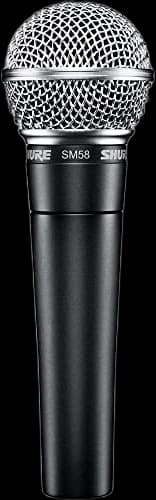
Shure SM58 Dynamic Vocal Microphone
The industry-standard dynamic mic that stays clean in almost any room, at the cost of studio sparkle.
Shure has sold the SM58 largely unchanged since 1966, and it remains the mic most singers learn on. Its dynamic capsule needs no phantom power, and its tight cardioid pattern rejects sound from the sides and rear, so it stays usable in a bedroom or living room with no acoustic treatment. It handles loud, close-up singing without distortion and shrugs off handling noise. The tradeoff is detail: it captures less top-end air than a condenser, so a quiet, breathy vocal can sound duller. Skip it if you're recording delicate vocals in a genuinely treated space, where a condenser will reward the room.
Strengths
- + Rejects room noise better than any condenser here
- + Nearly indestructible build
- + No phantom power or pad needed
Trade-offs
- − Needs more preamp gain than a condenser
- − Less top-end detail on quiet vocals
- Type
- Dynamic
- Polar pattern
- Cardioid
- Frequency response
- 50 Hz–15 kHz
- Connector
- XLR
- Phantom power
- Not required
02 · Best budget condenser
Audio-Technica AT2020 Cardioid Condenser Microphone
A cardioid condenser that punches above its price and remains a default studio recommendation.
The AT2020 has been Audio-Technica's entry point into studio recording for close to two decades, and it still turns up as the mic reviewers point beginners toward. Its 16mm capsule delivers a flat, uncolored cardioid pickup across a 20 Hz–20 kHz range, useful for vocals, acoustic guitar, and voiceover alike. It requires 48V phantom power and picks up more of the room than a dynamic mic, so it rewards even minimal treatment, like a closet or blanket fort. It has no pad or filter switch, so singers who record loud or close to the capsule should look at the AT2035 instead.
Strengths
- + Flat, neutral sound for the price
- + Rugged build for a budget condenser
- + Widely recommended as a first upgrade from a USB mic
Trade-offs
- − No pad or filter switch
- − Picks up more room noise than a dynamic mic
- Type
- Condenser
- Polar pattern
- Cardioid
- Frequency response
- 20 Hz–20 kHz
- Max SPL
- 144 dB
- Phantom power
- 48V required
4.7 out of 5 from 15,091 Amazon ratings
Amazon’s summary of its reviews: Customers praise the microphone's sound quality, describing it as clear and comparable to more expensive models, while also appreciating its suitability for home studios and podcasting. The build quality is well-constructed, and customers find it offers excellent value for money. However, the included accessories receive mixed feedback - while some customers report it feels like it'll last for decades, others mention it stopped working after 8 days, and several customers note the lack of a cable. The noise level also receives mixed reviews, with some customers reporting little to no background noise while others complain about picking up a lot of noise.
What buyers praise
- quality — 91% positive of 755 mentions
- sound quality — 83% positive of 471 mentions
- value for money — 94% positive of 393 mentions
- suitability — 86% positive of 93 mentions
What buyers complain about
- durability — 40% negative of 67 mentions
$159
Buy on Amazon03 · Best step-up condenser
Audio-Technica AT2035 Cardioid Condenser Microphone
The AT2020's more capable sibling, with a pad and filter for singers who push levels hard.
The AT2035 shares the AT2020's cardioid pattern and studio-standard build but adds a larger capsule, a switchable 80 Hz high-pass filter, and a 10 dB pad that raises maximum SPL to 158 dB. In recording forums it's frequently the tie-breaker recommendation for singers weighing the AT2020 against the NT1 — the extra headroom matters if you belt or record close to the capsule. It ships with its own shock mount, which the AT2020 lacks. It's still a single cardioid pattern with no multi-pattern flexibility, so instrument recording is more limited than with a true multi-pattern mic.
Strengths
- + Pad and filter the AT2020 lacks
- + Includes a shock mount
- + Handles loud, close-up vocals cleanly
Trade-offs
- − Costs about a third more than the AT2020 for a similar core sound
- − Still single-pattern cardioid only
- Type
- Condenser
- Polar pattern
- Cardioid
- High-pass filter
- 80 Hz, 12 dB/octave
- Pad
- -10 dB
- Max SPL
- 158 dB (with pad)
$189
Buy on Amazon04 · Best for pad and filter flexibility
sE Electronics X1 S Large-Diaphragm Condenser Microphone
Two pads and two filters give this cardioid condenser more headroom options than mics twice its price.
The X1 S pairs a hand-finished, gold-sputtered 1-inch capsule with two switchable pads (-10 dB/-20 dB) and two low-cut filters (80 Hz/160 Hz), a combination sE reserves for pricier mics elsewhere in its range. That flexibility matters for a home vocalist who also records acoustic guitar or a loud amp on the same interface channel. Its all-metal capsule and body feel sturdier than the AT2020 at a similar weight class. It doesn't have the ultra-low self-noise of the Rode NT1 5th Gen, so quiet, breathy vocal takes show slightly more hiss when pushed in a mix.
Strengths
- + Two pads and two filters for real flexibility
- + Solid all-metal build
- + Handles loud sources as well as vocals
Trade-offs
- − Higher self-noise than the NT1 5th Gen
- − Bare mic doesn't include a shock mount
- Type
- Condenser
- Polar pattern
- Cardioid
- Pads
- -10 dB / -20 dB
- Filters
- 80 Hz / 160 Hz
- Max SPL
- 160 dB (with pad)
05 · Best overall
Rode NT1 5th Generation Condenser Microphone
Rode's flagship condenser adds USB output and class-leading self-noise to the mic it built its name on.
Rode rates the NT1 5th Generation's self-noise at 4 dBA, among the quietest studio condensers made, which shows up as a genuinely dark, hiss-free background behind a vocal. Its Dual Connect design runs XLR into an interface or USB-C straight into a computer, so it doubles as a starter mic and a long-term studio one. The 1-inch HF6 capsule gives a smooth, slightly forward midrange that recording forums consistently favor for solo vocals over the AT2020. It ships with a proper shock mount and pop filter, unlike most mics at this price. Skip it if you specifically want a bright, aggressive sound, since its tuning leans warm.
Strengths
- + Extremely low self-noise
- + XLR and USB-C in one mic
- + Includes shock mount and pop filter
Trade-offs
- − Warmer, less aggressive tone than some condensers
- − Costs more than a basic XLR-only condenser
- Type
- Condenser
- Polar pattern
- Cardioid
- Self-noise
- 4 dBA
- Connectors
- XLR and USB-C (Dual Connect)
- Max SPL
- 142 dB
4.6 out of 5 from 2,043 Amazon ratings
Amazon’s summary of its reviews: Customers find this microphone to be a top-tier product for its price, with clear and professional sound quality that picks up all voice nuances. They appreciate its easy setup and functionality, with one customer noting it works just like any other condenser XLR microphone, and another mentioning the USB interface completely bypasses the need for an interface. While some customers report low noise levels, others mention strong self-noise issues.
What buyers praise
- quality — 96% positive of 114 mentions
- sound quality — 83% positive of 83 mentions
- value for money — 92% positive of 51 mentions
- functionality — 70% positive of 37 mentions
$387
Buy on Amazon06 · Best for loud singers and dynamic range
AKG C214 Large-Diaphragm Condenser Microphone
A scaled-down version of AKG's flagship C414 capsule, with more headroom than most mics near this price.
The C214 borrows its capsule design from AKG's higher-end C414, giving it a wide 143 dB dynamic range and a 20 dB pad that lets it handle sound sources up to 156 dB SPL without distortion. That headroom is useful for singers who belt or record close to the capsule, where cheaper condensers can clip. Its built-in shock-mounted capsule reduces handling and stand noise without a separate shock mount purchase. It's a fixed-cardioid design, not the multi-pattern option the C414 offers, so it's built specifically for single-source recording like vocals rather than stereo or room miking.
Strengths
- + Wide dynamic range for loud vocals
- + Built-in shock mounting
- + Cost-effective alternative to the C414
Trade-offs
- − Fixed cardioid only, no pattern switching
- − Pricier than the NT1 5th Gen without USB output
- Type
- Condenser
- Polar pattern
- Cardioid (fixed)
- Pad
- -20 dB
- Max SPL
- 156 dB (with pad)
- Self-noise
- 13 dBA
07 · Best splurge
Neumann TLM 102 Large-Diaphragm Condenser Microphone
Neumann's entry point into its own catalog, with a signature treble lift for silky, present vocals.
Neumann built the TLM 102 as its most affordable large-diaphragm microphone, made in Germany with the brand's transformerless circuitry rather than a stripped-down capsule. It adds a gentle 8–12 kHz treble boost that Neumann tunes for vocals, giving a silky top end without sounding harsh. Its 144 dB max SPL and 132 dB dynamic range mean it handles both whispered and belted takes cleanly. It costs nearly four times the Rode NT1 5th Gen for a similar cardioid-only feature set, so it's a pick for a singer who has outgrown a budget condenser and wants the Neumann name and voicing specifically, not a mic most beginners need first.
Strengths
- + Signature Neumann treble lift flatters vocals
- + Very low noise floor
- + Made in Germany, transformerless circuit
Trade-offs
- − Nearly four times the price of the NT1 5th Gen
- − Cardioid only, no pad switch
- Type
- Condenser
- Polar pattern
- Cardioid
- Frequency response
- 20 Hz–20 kHz
- Max SPL
- 144 dB
- Dynamic range
- 132 dB
4.7 out of 5 from 195 Amazon ratings
Amazon’s summary of its reviews: Customers praise the microphone's professional sound quality and find it affordable for its high-end performance. They appreciate its versatility, with one customer noting it works well with various instruments, and another highlighting its effectiveness with vocals, delivering warmth and clarity. The size receives positive feedback, with one mentioning it's large enough to capture every sound, while opinions on noise level are mixed, with several customers reporting humming issues.
What buyers praise
- sound quality — 86% positive of 28 mentions
Dynamic vs. condenser: what actually matters in a bedroom studio
A dynamic microphone like the Shure SM58 uses a simple moving-coil design that's inherently less sensitive. That's a feature indoors: it picks up mostly what's directly in front of it and rejects reflections bouncing off bare walls, so it can sound cleaner in an untreated room than a condenser costing three times as much.
A condenser microphone is more sensitive across the frequency range, which is why studios use them — they capture detail a dynamic mic misses. That sensitivity also means they capture more of the room. On recording forums, the recurring advice for someone singing without any acoustic treatment is to start with a dynamic mic, or to treat the space — even blankets and a closet — before buying a nicer condenser.
Polar pattern, pad, and low-cut filter, explained
Every mic here uses a cardioid polar pattern, meaning it picks up sound mostly from the front and rejects it from the rear — the standard choice for a single vocalist in an untreated room. A few mics (the AT2035, sE X1 S, and AKG C214) add a pad, which reduces the signal reaching the capsule so louder singers don't distort it, and a low-cut filter, which rolls off rumble and breath noise below roughly 80 Hz.
None of that matters if you're a quiet, controlled singer recording at a normal level — the pad and filter switches just sit unused. They matter more for belters, loud rooms, or anyone recording close to the capsule.
Why every condenser here needs phantom power
Condenser capsules need an external voltage to charge their internal plates, supplied as 48V phantom power from an audio interface or mixer. Every condenser on this list — the AT2020, AT2035, X1 S, NT1 5th Gen, C214, and TLM 102 — needs it to work at all. The SM58 is the outlier: as a dynamic mic, it generates its own signal and needs no external power, part of why it survives being plugged into almost anything.
If you don't already own an audio interface to provide phantom power, budget for one alongside the mic; most beginner interfaces include it as standard.
USB vs. XLR, and why this guide sticks to XLR
Rode's NT1 5th Gen and a few competing condensers now offer both XLR and USB-C output, letting you skip an interface entirely for a first recording. But XLR into a dedicated interface still gives more control over gain, generally cleaner preamps at a given price, and room to add more mics later. This guide focuses on XLR-first singing mics; a USB-only microphone or a broadcast-style dynamic built for spoken word and podcasting gets separate coverage elsewhere.
How the picks differ, and how to choose
If you have no treated space at all, start with the Shure SM58 — it's the mic most forgiving of a bad room, and it doubles as a live vocal mic later. If you have even minimal treatment (a closet, heavy curtains, or a duvet fort), the Audio-Technica AT2020 or Rode NT1 5th Gen will capture more detail for a modest step up in price. Singers who record loud, close, or push their voice hard should look at mics with a pad — the AT2035, sE X1 S, or AKG C214. The Neumann TLM 102 is for a singer who has already outgrown a budget condenser and wants the specific Neumann voicing, not a starting point.
What to skip
Skip mics with no listed polar pattern or SPL rating, and skip unbranded condensers bundled with a flimsy boom arm and pop filter for under $50 — reviewers and recording forums alike treat these as disposable. Skip Amazon listings labeled Renewed or Refurbished for any mic on this list; a used capsule is one of the few components in a home studio worth buying new.
Questions people ask
Do I need a condenser microphone to record good vocals at home?
No. A dynamic microphone like the Shure SM58 can sound better than a condenser in an untreated room, because it rejects reflections a condenser would pick up. Condensers capture more detail and are the studio standard, but only pay off once the room itself is reasonably quiet and treated.
What's the difference between the Rode NT1 5th Gen and the older NT1-A?
The NT1-A is Rode's previous-generation condenser. The NT1 5th Generation replaces it with lower self-noise, USB-C output alongside XLR, and 32-bit float recording. Some retailers still carry earlier NT1 variants, but the 5th Generation is the current model and the one this guide recommends.
Can I use a vocal microphone for acoustic guitar or podcasting too?
Yes, cardioid condensers like the AT2020 or NT1 5th Gen work well on acoustic instruments too. For dedicated podcasting or spoken-word work, a broadcast-style dynamic mic built for close-talking speech, like the Shure SM7B or SM7dB, is usually a better fit than a vocal-first condenser.
How much does an audio interface add to the cost?
Budget interfaces with the phantom power a condenser needs start around $100 to $200. The Shure SM58 is the one mic here that works without phantom power, though you'll still need an interface or mixer to get any XLR mic into a computer at a usable level.
Is a pad switch necessary for singing?
Only if you sing loudly or record very close to the microphone. A pad reduces the signal before it can overload the capsule. Quiet or moderate singers at a normal mic distance rarely need one, which is why budget mics like the AT2020 skip it entirely.
What's the single best upgrade from a USB microphone?
An XLR condenser like the Audio-Technica AT2020 paired with a basic audio interface, rather than a pricier USB mic. It costs about the same as a good USB mic but leaves room to add more inputs, better preamps, or a second microphone later.
Sources
- SM58 - Vocal Microphone, Shure USA
- Cardioid Condenser Microphone | AT2020, Audio-Technica
- Cardioid Condenser Microphone | AT2035, Audio-Technica
- X1 S product page, sE Electronics
- NT1 5th Generation | Studio Condenser Microphone, RODE
- AKG C214 Microphone, AKG
- TLM 102 Studio Set - Microphones, Neumann
- Shure SM7dB review, MusicRadar
As an Amazon Associate, SlowHum earns from qualifying purchases, at no extra cost to you. Full disclosure.