The Best MIDI Keyboards
A MIDI keyboard is a dumb terminal for your software instruments — the right one just needs to get out of the way.
Published September 15, 2026 · 7 min read
Quick answer
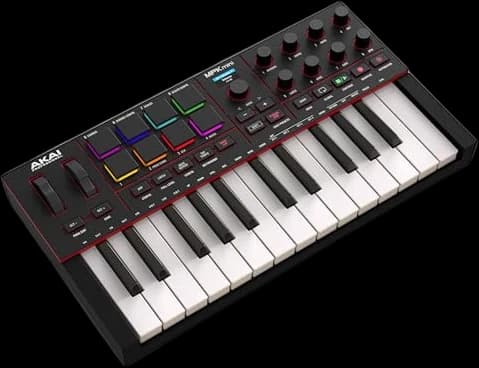
The Akai MPK Mini IV is the best all-around MIDI keyboard for most beginners: 25 mini keys, 8 pads, and a real software bundle for around $100. Producers who want a better keybed, more keys, or a specific DAW's native mapping should look at the step-up picks below.
Key takeaways
- 25-key mini controllers cover beat-making and chord sketching; step up to 49 or 61 keys once you're playing real basslines and melodies.
- Pads and knobs matter as much as the keys — check pad count and whether the encoders are endless or turn-limited before buying.
- Every pick here ships with a DAW (usually Ableton Live Lite) and a slice of the maker's own instrument library, so weigh that into the price.
- Producer forums split the same way over and over: Arturia for keybed feel, Akai for pad feel. Try both in person if you can.
At a glance
| Pick | Best for | Price* | |
|---|---|---|---|
Best overall Akai Professional MPK Mini MK4 | A first controller that covers beats and basic keys | $99 | Buy on Amazon → |
 Best keybed at this size Arturia MiniLab 3 | Buyers who prioritize how the keys feel over pad count | $119 | Buy on Amazon → |
 Best for Ableton Live Novation Launchkey 49 MK4 | Ableton Live users who want hands-on clip and mixer control | $280 | Buy on Amazon → |
 Best all-around studio controller Arturia KeyLab Essential mk3 61 | Producers who want one keyboard for years, not just months | $299 | Buy on Amazon → |
 Best for the Kontakt/Komplete ecosystem Native Instruments Komplete Kontrol M32 | Producers already bought into Native Instruments plugins | $139 | Buy on Amazon → |
 Best budget 61-key Nektar Impact GX61 | Full-size keys without paying for a screen or faders | $130 | Buy on Amazon → |
* Prices are approximate and may vary. Please check the latest price on Amazon.
Most MIDI keyboards do the same basic job: turn key presses into note data your software instruments can use. What actually separates them is how the keys feel, how many pads and knobs you get for beats and sound tweaking, and how directly the hardware talks to your DAW. None of the keyboards below make a sound on their own — they're controllers, not synthesizers with their own speakers.
The picks here run from a $99 mini controller to a $299 61-key studio rig, chosen to cover the decision most beginners actually face: how many keys, how much control surface, and which software bundle tips the value in your favor.
01 · Best overall
Akai Professional MPK Mini MK4
The default beginner pick: small, cheap, and genuinely useful past the first month.
Akai lists 25 velocity-sensitive mini keys, 8 backlit MPC-style pads, 8 assignable 360-degree knobs, and a small color display, all over USB-C. The MK4 revision dropped the old 4-way joystick for a proper pitch/mod strip, which reviewers and Reddit's producer forums both flag as a real usability fix over the MK3. It comes with Akai's Studio Instrument Collection plus Ableton Live Lite 12 and over 1,000 presets. Skip it if you already know you want full-size or semi-weighted keys — the mini keybed is a compromise for portability, not a piano substitute.
Strengths
- + Cheapest way into real production
- + Chord and scale modes help non-keyboardists
- + Pad feel is a step above most mini controllers
Trade-offs
- − Mini keys aren't a substitute for full-size ones
- − No faders
- Keys
- 25, velocity-sensitive mini keys
- Pads
- 8 backlit, MPC-style
- Knobs
- 8 assignable, 360-degree
- Connectivity
- USB-C, 5-pin MIDI out
- Software included
- Studio Instrument Collection, Ableton Live Lite 12
$119
Buy on Amazon02 · Best keybed at this size
Arturia MiniLab 3
Same footprint as the MPK Mini, better-regarded keybed, more software in the box.
Arturia's own spec sheet lists 25 slim keys, 8 pads across two banks (16 total), 8 knobs, 4 faders, and two capacitive touch strips for pitch and mod — faders are the feature that separates it from most keyboards this size. On Reddit's r/synthesizers and r/musicproduction threads, the recurring split is that the MiniLab's keybed and build quality edge out the MPK Mini, while Akai's pads edge out Arturia's. It ships with Analog Lab Intro (500 presets) and Ableton Live Lite. Skip it if finger-drumming is your main use case; the pads are smaller than dedicated pad controllers.
Strengths
- + Faders are rare at this price and size
- + Widely reported as the better keybed of the two mini rivals
- + 5-year warranty from Arturia
Trade-offs
- − Pads are smaller and less sensitive than Akai's
- − No MIDI in, only out
- Keys
- 25, slim velocity-sensitive keys
- Pads
- 8, two banks (16 total)
- Controls
- 8 knobs, 4 faders, 2 touch strips
- Connectivity
- USB-C, 5-pin MIDI out, 1/4" pedal input
- Software included
- Analog Lab Intro, Ableton Live Lite
$280
Buy on Amazon03 · Best for Ableton Live
Novation Launchkey 49 MK4
The closest thing to a native Ableton controller that isn't Ableton's own hardware.
Novation's listing puts the MK4 at 49 semi-weighted, waterfall-style keys, 16 velocity-sensitive RGB pads, 8 continuous encoders, and 9 faders, with an OLED display for feedback. In Ableton Live it maps directly to Session View, Drum Rack, and the mixer with no setup, and it also carries custom integrations for Logic, FL Studio, Cubase, Reason, Reaper, and Ardour. The box includes Ableton Live Lite, Cubase LE, and Novation's own Play instrument library. Skip it if you don't use one of its named DAWs — you'll still get generic MIDI, but you lose the whole point of the controller.
Strengths
- + Zero-setup mapping for Ableton, Logic, FL Studio and more
- + Faders plus encoders, unusual at this price
- + Four storable custom modes
Trade-offs
- − 49 keys and a control surface make it bulkier to travel with
- − Overkill if you only sketch chords
- Keys
- 49, semi-weighted, synth-action
- Pads
- 16, velocity-sensitive RGB
- Controls
- 8 encoders, 9 faders, OLED display
- Connectivity
- USB-C, 5-pin MIDI out
- Software included
- Ableton Live Lite, Cubase LE, Novation Play
$299
Buy on Amazon04 · Best all-around studio controller
Arturia KeyLab Essential mk3 61
The most complete package here: real key count, a screen, and a software bundle worth more than the hardware.
Arturia specs the Essential mk3 61-key at a semi-weighted, velocity-sensitive keybed with a 2.5-inch display, 8 touch-and-pressure pads across two banks, 9 faders, and 9 rotary encoders plus a main encoder. It bundles Analog Lab V (2,000-plus presets), Ableton Live Lite, Native Instruments' Komplete Select, and UVI's Model D piano — a software stack that alone approaches the keyboard's price. It works as a generic DAW controller with any major software. Skip it if 61 keys and a full control surface won't fit your desk; the smaller Essential mk3 25/49 share the same feature set in less space.
Strengths
- + Software bundle alone is worth hundreds of dollars
- + Display makes editing presets far less guesswork
- + Available in 25/49/61/88-key sizes with the same layout
Trade-offs
- − Priciest pick here
- − Semi-weighted action still isn't a piano feel
- Keys
- 61, semi-weighted, velocity-sensitive
- Pads
- 8, touch- and pressure-sensitive, 2 banks
- Controls
- 9 faders, 9 encoders + main encoder, 2.5" display
- Connectivity
- USB-C, 5-pin MIDI out, pedal input
- Software included
- Analog Lab V, Ableton Live Lite, NI Komplete Select, UVI Model D
$139
Buy on Amazon05 · Best for the Kontakt/Komplete ecosystem
Native Instruments Komplete Kontrol M32
A narrow but genuinely useful pick if Komplete or Kontakt is your main instrument library.
NI specs the M32 at 32 compact, synth-action keys with two touch strips and full Native Kontrol Standard (NKS) support, which auto-maps knobs and browsing to any NKS-ready plugin — hundreds exist beyond NI's own. It includes the Komplete Kontrol software, a Komplete 15 Select edition (Beats, Band, or Electronic, chosen after registration), and Ableton Live Lite. It lacks the full-color Light Guide of NI's larger S-series keyboards. Skip it if you don't already use Komplete or Kontakt instruments; the NKS integration is the entire reason to choose this over a cheaper generic controller.
Strengths
- + NKS auto-mapping works across hundreds of third-party plugins
- + Compact enough for a laptop bag
- + Komplete Select bundle has real production value
Trade-offs
- − No pads at all
- − The NKS advantage disappears if you don't use NKS instruments
- Keys
- 32, synth-action, custom NI keybed
- Controls
- 2 touch strips
- Integration
- Full NKS (Native Kontrol Standard) mapping
- Connectivity
- USB 2.0 bus-powered, 1 pedal input
- Software included
- Komplete Kontrol, Komplete 15 Select, Ableton Live Lite
$130
Buy on Amazon06 · Best budget 61-key
Nektar Impact GX61
The cheapest way to get 61 full-size keys and real DAW mapping, with no frills attached.
Nektar's spec sheet lists 61 full-size, synth-action keys, pitch and mod wheels, and eight buttons dedicated to DAW transport and mixer control, with pre-built integration for Cubase, Logic Pro, Reason, Reaper, Studio One, Bitwig, GarageBand, and more. It ships with Bitwig 8-Track, a scaled-down DAW with over fifty instruments and effects. It has no pads, no faders, and no display — this is a keys-first controller. Skip it if pads or hands-on mixing controls matter to you; those are the whole reason the pricier picks above cost more.
Strengths
- + Full-size keys at a mini-controller price
- + Broad, genuine DAW integration list
- + Bus-powered, nothing extra to plug in
Trade-offs
- − No pads or faders
- − No display for feedback
- Keys
- 61, full-size, synth-action
- Wheels
- Pitch bend and modulation
- DAW buttons
- 8, with transport control
- Connectivity
- USB bus-powered, no external PSU needed
- Software included
- Bitwig 8-Track
25, 49, or 61 keys: how much do you actually need
A 25-key mini controller (two octaves) is enough for programming beats, triggering samples, and sketching chords one hand at a time — most hip-hop and electronic producers never outgrow one. A 49-key controller gives you two full hands of range for basslines played against a melody, which matters once you're writing anything with real harmonic movement. A 61-key board is the point where you can play most piano parts without constantly shifting octaves.
The honest advice on r/musicproduction and r/synthesizers is consistent: buy the size that matches what you already play, not what you think you'll grow into. A 25-key controller that fits next to your laptop gets used; a 61-key board that lives on a stand in the corner often doesn't.
Key action: mini, synth-action, and semi-weighted
"Mini" keys (as on the MPK Mini and MiniLab 3) are narrower than piano keys, built for portability rather than playing technique. "Synth-action" full-size keys, like the Nektar GX61's, are full width but spring back quickly with no simulated hammer weight — standard on cheaper keyboard synths since the 1980s. "Semi-weighted" keys, used on the Launchkey MK4 and KeyLab Essential mk3, add resistance that approximates (without fully replicating) a piano's feel.
None of these are a substitute for a fully-weighted hammer-action digital piano if your main instrument is piano. They're built for producers layering parts in a DAW, not for practicing classical repertoire.
Pads and knobs: beat-making vs. sound design
Pads matter if you finger-drum or trigger samples; Akai's MPC-style pads have the strongest reputation for that specifically, a point that comes up unprompted in almost every Reddit thread comparing it to Arturia's controllers. Knobs and faders matter for real-time sound tweaking and mixing — the KeyLab Essential mk3 and Launchkey MK4 both add faders that the smaller mini controllers skip entirely for space.
If your main use is triggering drum samples, weight your decision toward pad quality. If it's sculpting synth patches or riding levels while you record, weight it toward faders and encoder count instead.
DAW integration: what "plug and play" actually means
Every keyboard here works as generic MIDI input in any DAW. The difference is whether the hardware also maps its knobs, faders, and transport buttons to your specific software without manual assignment. Novation's Launchkey line builds this specifically for Ableton Live (with secondary support for Logic, FL Studio, Cubase, and more), Nektar builds broad multi-DAW mapping into all its Impact keyboards, and NI's NKS standard on the Komplete Kontrol M32 auto-maps to compatible plugins rather than to a DAW's mixer.
Check that your DAW is on the specific integration list before assuming a "DAW integration" feature will actually do anything for you.
The software bundle is part of the price
Every pick here ships with a DAW (usually a Lite or LE edition) and at least one virtual instrument or preset library. On the KeyLab Essential mk3, that bundle (Analog Lab V, Komplete Select, UVI Model D) has real resale and production value on its own. Factor that in before comparing keyboards on hardware specs alone — a slightly pricier controller with a genuinely useful software bundle can be the better deal.
How the picks differ
Start with the Akai MPK Mini MK4 if you want the cheapest reasonable entry point and don't yet know your workflow. Choose the Arturia MiniLab 3 over it if keybed feel and faders matter more to you than pad feel. Move up to the Novation Launchkey 49 MK4 specifically if you produce in Ableton Live and want hands-on clip control. The Arturia KeyLab Essential mk3 is the pick for someone buying one keyboard to keep for years. Choose the Native Instruments Komplete Kontrol M32 only if you're already invested in NI's plugin ecosystem. And the Nektar Impact GX61 is for anyone who wants real piano-length keys and doesn't care about pads, faders, or a screen.
Questions people ask
Do I need a MIDI keyboard to make music, or can I use my computer keyboard?
You can program notes with a mouse or your computer's QWERTY keys in most DAWs, and plenty of producers start that way. A MIDI keyboard is faster for playing chords and melodic ideas in real time and adds velocity sensitivity, which a computer keyboard can't replicate. It becomes worth buying once typing in notes starts slowing you down.
Does a MIDI keyboard make sound by itself?
No. Every keyboard on this list sends MIDI data to software instruments running on your computer, or to a synthesizer if you connect one via 5-pin MIDI. Without a DAW, a virtual instrument, or an external synth on the other end, pressing a key does nothing.
Is 25 keys really enough to get started?
For beat-making, chord sketches, and most electronic production, yes — it's the size most producers on Reddit's production forums recommend for a first controller. If you already play piano and write parts that span more than about two octaves at once, size up to 49 or 61 keys instead.
What's the difference between a MIDI keyboard and a synthesizer?
A MIDI keyboard, sometimes called a controller, has no sound engine of its own — it only sends performance data. A synthesizer generates its own sound and can be played standalone. Several controllers here (KeyLab Essential, Launchkey) can also control external synths over 5-pin MIDI, but they still don't make sound on their own.
Do I need to buy the same brand as my DAW?
No DAW requires a matching-brand controller. But some keyboards, like Novation's Launchkey line, are built around deeper integration with specific software, so check whether your DAW is on the manufacturer's supported list before assuming you'll get one-touch mixer and clip control.
Sources
- MPK Mini IV | Akai Professional (product specifications)
- MiniLab 3 | Arturia (product overview and specifications)
- KeyLab Essential mk3 | Arturia (product overview and specifications)
- Komplete Kontrol M32 | Native Instruments (product specifications)
- Launchkey 49 MK4 | Novation (product page)
- Keyboard Krush: best MIDI keyboard controllers roundup
- Nektar Impact GX61 product listing | GB Music & Sound
As an Amazon Associate, SlowHum earns from qualifying purchases, at no extra cost to you. Full disclosure.