The Best Synthesizers for Beginners
A good first synthesizer puts every important control on a knob you can see and turn, not buried in a menu.
Published September 16, 2026 · 6 min read
Quick answer

The Korg Minilogue XD is the best all-around first synthesizer for most beginners: four-voice polyphony, a real step sequencer, and a knob-per-function layout that teaches subtractive synthesis directly. Buyers on a tighter budget should start with the Behringer Crave instead.
Key takeaways
- Subtractive synthesis (oscillator, filter, envelope) is the easiest style to learn on, and every pick here uses it as its foundation.
- A knob-per-function layout, where each control has one dedicated job, is worth prioritizing over deeper synths that hide parameters in menus.
- Polyphony ranges from 1 note (Bass Station II) to 4 notes (Minilogue XD) among these six — check it matches the chords you want to play.
- None of these synths need a computer to make sound, but several connect over USB or MIDI if you want to record them into a DAW.
At a glance
| Pick | Best for | Price* | |
|---|---|---|---|
Best budget semi-modular Behringer Crave | Learning synthesis by patching cables, not just knobs | $189 | Buy on Amazon → |
 Best for sound-design depth Arturia MicroFreak | Room to grow into experimental sound design | $349 | Buy on Amazon → |
 Best classic monosynth with real keys Novation Bass Station II | Learning subtractive synthesis on a full-size keyboard | $581 | Buy on Amazon → |
 Best all-around step-up Korg Minilogue XD | Real chords on a synth that won't be outgrown fast | $680 | Buy on Amazon → |
 Best full-featured Roland GAIA 2 | A long-term synth for a serious beginner | $825 | Buy on Amazon → |
* Prices are approximate and may vary. Please check the latest price on Amazon.
Subtractive synthesis — start with a raw waveform, then carve it down with a filter and shape it over time with an envelope — is how nearly every beginner synth on this list works, and it's the easiest style to learn on because you can hear what each control does immediately. The picks below all put those controls on physical knobs rather than in a touchscreen menu, which is the single biggest factor in whether a first synth actually teaches you anything.
They range from a $189 semi-modular box with no keys worth mentioning to an $825 hybrid synth with a real sequencer and effects — chosen to match different starting budgets and different reasons for wanting a first synthesizer.
$189
Buy on Amazon01 · Best budget semi-modular
Behringer Crave
The cheapest real way into patch-cable synthesis, with a caveat: it won't save your sounds.
Behringer's spec sheet lists a discrete 3340 analog oscillator, a classic 24dB Moog-style ladder filter, 47 real-time controls, and an 18x14 patch bay for connecting to Eurorack modular gear. Its 32-step sequencer stores up to 64 patterns across 8 banks, and it can poly-chain with up to 16 voices alongside other Crave units. The touch-plate keys are not full-size or velocity-sensitive. Skip it if you want to save and recall your own sounds; Reddit users and manufacturer specs agree it has no patch/preset memory for sound settings, only for sequencer patterns.
Strengths
- + Real patch-cable modular experience at a low price
- + Poly-chains with other Crave/Behringer semi-modular units
- + Classic ladder filter sound
Trade-offs
- − No memory for sound patches, only sequencer patterns
- − Touch keys aren't a substitute for a real keybed
- Oscillator
- 1x discrete 3340 analog VCO
- Filter
- 24dB Moog-style ladder filter
- Sequencer
- 32 steps, 64 patterns, 8 banks
- Patch bay
- 18x14 real-time patch matrix, 47 controls
- Keyboard
- 13-note capacitive touch plate, not velocity-sensitive
$349
Buy on Amazon02 · Best for sound-design depth
Arturia MicroFreak
The deepest oscillator section here, paired with one real limitation worth knowing before you buy.
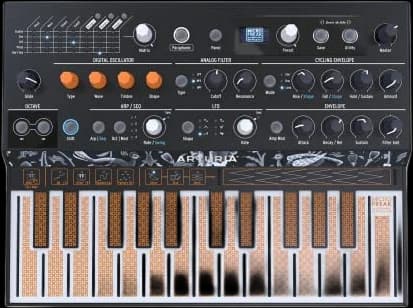
Arturia's listing specs a 25-key capacitive touch keybed with polyphonic aftertouch, an analog filter paired with 11-plus digital oscillator modes (including the open-source Plaits engine) ranging from wavetable to physical modeling, and paraphonic operation up to 4 voices. It includes an arpeggiator, sequencer, and CV/gate output for controlling external analog gear. Arturia has kept it current with free firmware updates since its 2019 release, and it remains a separate, cheaper line from the newer 6-voice MiniFreak. Skip it if you want built-in effects — reviewers consistently note its output is completely dry, with no onboard reverb or delay.
Strengths
- + Widest range of oscillator/synthesis types in this guide
- + CV/gate out for connecting to modular or other analog gear
- + Continues to receive free firmware updates
Trade-offs
- − No built-in effects, output is completely dry
- − Touch keybed isn't velocity-sensitive in the traditional sense
- Keybed
- 25-key capacitive touch, polyphonic aftertouch
- Oscillator
- 11+ digital modes (wavetable, physical modeling, and more)
- Filter
- 1 analog filter
- Polyphony
- Paraphonic, up to 4 voices
- Extras
- Arpeggiator, sequencer, CV/gate out
$581
Buy on Amazon03 · Best classic monosynth with real keys
Novation Bass Station II
A one-note-at-a-time analog synth built around full-size keys and a straightforward, learnable layout.
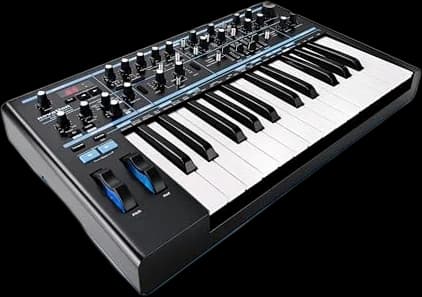
Novation's listing specs 25 full-size keys with aftertouch, two analog oscillators plus a sub-oscillator, two selectable filter types, an analog overdrive circuit, and a built-in arpeggiator. It also has a paraphonic mode for basic chords despite being fundamentally monophonic. It's USB-MIDI class-compliant and stores patches, unlike the Crave. Skip it if polyphony matters to you for chords and pads; this is a lead- and bass-focused instrument by design, not a keyboard-pad synth.
Strengths
- + Full-size keys with aftertouch, rare at this price for a hardware synth
- + Patch memory, unlike several cheaper picks here
- + Straightforward two-oscillator layout is easy to learn on
Trade-offs
- − Monophonic (one note at a time) with only basic paraphonic mode
- − No built-in sequencer beyond the arpeggiator
- Keys
- 25, full-size, with aftertouch
- Oscillators
- 2 analog + 1 sub-oscillator
- Filters
- 2 selectable filter types
- Extras
- Analog overdrive, arpeggiator, patch memory
- Connectivity
- USB (class-compliant MIDI)
$680
Buy on Amazon04 · Best all-around step-up
Korg Minilogue XD
Four-voice polyphony, a real sequencer, and a knob for nearly everything that matters.
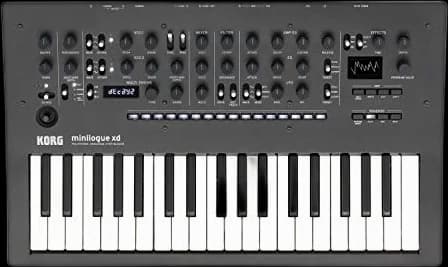
Korg specs the Minilogue XD with a 37-key keybed, 4-voice polyphonic analog synthesis, a digital multi-engine third oscillator (adding wavetable and noise options on top of the analog voices), built-in stereo digital effects, and a 16-step sequencer with an OLED oscilloscope for visual feedback. It builds directly on the original Minilogue's knob-per-function layout, adding depth without hiding it in menus. Skip it if 4-voice polyphony feels limiting for the chords you want to play, or if the price is a stretch for a first instrument — the Behringer Crave teaches the same fundamentals for a fraction of the cost.
Strengths
- + Real polyphony for chords, not just single notes
- + Knob-per-function layout despite the added digital engine
- + Built-in effects and sequencer reduce the need for extra gear
Trade-offs
- − Priciest pick that isn't the Gaia 2
- − Keys aren't velocity-sensitive
- Keys
- 37, standard-size, non-weighted
- Polyphony
- 4-voice analog + digital multi-engine
- Sequencer
- 16-step, with motion recording
- Effects
- Built-in stereo digital effects (delay, reverb, chorus, etc.)
- Display
- OLED oscilloscope
$825
Buy on Amazon05 · Best full-featured
Roland GAIA 2
A hybrid engine and full-size keys aimed at a buyer who's serious about learning sound design, not just trying it out.
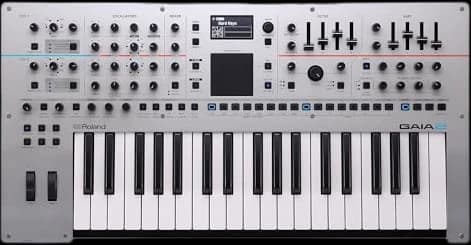
Roland's listing specs a hybrid wavetable and virtual analog sound engine, an SH-101 model expansion, 256 onboard presets, a 2-axis "Motional Pad" for real-time performance control, 53 multi-effects, and a built-in step sequencer and arpeggiator, over 37 full-size keys. It connects via 5-pin MIDI and USB-C. This is the priciest and most feature-dense pick here, successor to the original GAIA SH-01. Skip it as a first synth if you'd rather learn on fewer parameters; its depth rewards someone who already knows they want to stick with hardware synthesis.
Strengths
- + Widest effects and preset library in this guide
- + Full-size keys plus a genuinely playable performance pad
- + USB-C and 5-pin MIDI for both modern and legacy setups
Trade-offs
- − Most expensive pick here
- − More menu-diving than the fully analog options for deep editing
- Keys
- 37, full-size, non-weighted
- Sound engine
- Hybrid wavetable + virtual analog, SH-101 model expansion
- Presets
- 256 onboard
- Effects
- 53 multi-FX types
- Extras
- 2-axis Motional Pad, step sequencer, arpeggiator
What subtractive synthesis actually means
Every synth here starts with an oscillator generating a raw waveform (a sawtooth or square wave, usually), runs it through a filter that removes frequencies to shape the tone, and uses an envelope to control how the volume or filter changes over the length of a note. Turning the filter's cutoff knob while a note plays is the fastest way to understand what a filter does — which is exactly why a knob-per-function layout, not a menu, is worth prioritizing on a first synth.
Knob-per-function vs. menu diving
Every pick here favors direct control: one knob does one thing, always. Some competing synths in this price range hide most parameters behind a single encoder and a small screen, which can genuinely slow down learning because you can't see the whole instrument's state at once. The Roland GAIA 2 has the deepest menu system of these six, simply because it has the most features to organize — still knob-accessible for the basics, with menus reserved for the deeper wavetable and effects editing.
Keys, touch plates, and desktop modules
The Behringer Crave has no keybed at all, built for sequencing and knob-tweaking rather than expressive playing. The Arturia MicroFreak's capacitive keybed adds polyphonic aftertouch but still isn't a traditional keybed. The Novation Bass Station II, Korg Minilogue XD, and Roland GAIA 2 all use full-size keys, which matters if you want to actually perform melodies rather than mostly program patterns.
Polyphony: how many notes you can play at once
The Bass Station II is monophonic — one note at a time, with a basic paraphonic mode for simple chord shapes. The MicroFreak is paraphonic, meaning multiple notes share the same filter and envelope rather than getting fully independent voices. The Minilogue XD is the only pick here with true 4-voice polyphony, where each note gets its own full signal path. If playing chords matters to you, that difference is worth weighing more heavily than any other spec on this list.
Built-in effects and sequencers
The MicroFreak and Bass Station II both ship with completely dry, effects-free output — you'll want a pedal, audio interface, or DAW plugin for reverb and delay. The Minilogue XD and GAIA 2 include their own digital effects. Sequencers vary in the same way: the Crave and Minilogue XD both include a step sequencer for programming patterns without a keyboard at all, while the Bass Station II and GAIA 2 rely on an arpeggiator instead of a full sequencer for that kind of hands-free repetition.
How the picks differ
Choose the Behringer Crave instead if you want to learn patch-cable synthesis and might expand into modular gear later. Move to the Arturia MicroFreak for the widest range of oscillator types and CV connectivity. The Novation Bass Station II is the pick for learning subtractive synthesis on genuine full-size keys. Choose the Korg Minilogue XD if playing real chords matters and the price fits your budget. And the Roland GAIA 2 is for a beginner who already knows they want the deepest, most complete instrument on this list.
Questions people ask
What's the difference between analog and digital synthesis?
Analog synths (the Crave and Bass Station II) generate sound with physical electronic circuits, which tends to produce a warmer, slightly less stable tone prized for bass and pads. Digital and hybrid synths (the MicroFreak, Minilogue XD's digital engine, GAIA 2) generate or shape sound with software running on a chip, which usually adds more waveform variety and built-in effects.
Do I need a keyboard synth, or is a knob-only desktop module fine to start?
Either works for learning synthesis fundamentals. A keyboard format like the Bass Station II or Minilogue XD is better if you want to perform melodies directly. A desktop or semi-modular unit like the Crave is fine, and often cheaper, if you plan to play it from a separate MIDI keyboard or sequence it by hand.
What does "monophonic" and "polyphonic" mean?
Monophonic means the synth can only play one note at a time, even if you hold down several keys — common on classic bass and lead synths like the Bass Station II. Polyphonic means it can play multiple notes simultaneously as a full chord. Paraphonic is a middle ground where multiple notes sound together but share some components, like a single filter.
Is a semi-modular synth like the Crave too complicated for a first synth?
It has a steeper first hour than a synth with everything pre-wired, since you sometimes need patch cables just to hear sound at all. Reddit's synthesizer community generally still recommends it to beginners specifically because the patch bay makes the signal path visible and easy to reason about once you understand the basics.
Do these synths need to be plugged into a computer to work?
No. Every synth in this guide runs standalone with its own sound output. Most also connect via USB or MIDI if you want to record them into a DAW or control them from a MIDI keyboard, but none require a computer to make sound.
Sources
- CRAVE | Behringer (official product page)
- Specifications | volca keys - Analogue loop Synth | KORG (USA)
- Arturia - MicroFreak - Specifications & Features | Arturia
- Novation Bass Station II Monophonic Analog Synthesizer product listing | B&H Photo Video
- minilogue xd | Korg (US) product page
- GAIA 2 | Roland (US) product page
- Best Synthesizers for Beginners in 2026 | Sweetwater InSync
As an Amazon Associate, SlowHum earns from qualifying purchases, at no extra cost to you. Full disclosure.