The Best Drum Machines
A drum machine is a sequencer with opinions about rhythm baked in — the right one matches how you actually want to program a beat.
Published September 16, 2026 · 6 min read
Quick answer
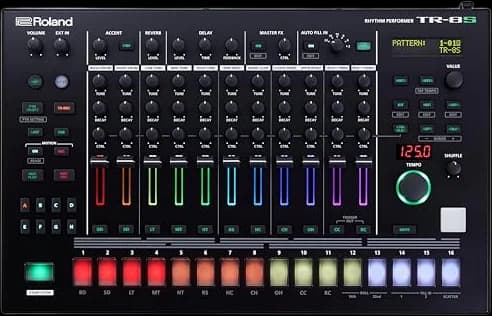
The Roland TR-8S is the best all-around drum machine for most people moving past a phone app: modeled classic drum sounds, sample import, and a real step sequencer in one standalone box. Budget-first buyers should start with the Korg Volca Beats or Teenage Engineering PO-12 instead.
Key takeaways
- Sampling machines play back audio you load in; synthesis machines generate drum sounds electronically and let you shape them with knobs.
- Standalone machines like these run without a computer; that's the whole appeal over a plugin, but it also means learning a new hands-on workflow.
- Battery power and a built-in speaker (Volca Beats, TR-6S, PO-12) matter more than spec sheets if you actually want to use the thing away from a desk.
- Reddit's synth forums consistently flag the Volca Beats' snare as its weak point — a real trade-off for its price, not a dealbreaker.
At a glance
| Pick | Best for | Price* | |
|---|---|---|---|
Best overall Roland TR-8S Rhythm Performer | Producers who want one drum machine to grow into for years | $900 | Buy on Amazon → |
 Best portable Roland TR-6S Rhythm Performer | Buyers who want TR-series sounds in a battery-powered box | $470 | Buy on Amazon → |
 Best analog / most hands-on Arturia DrumBrute Impact | Buyers who want every parameter on a physical knob, no menus | $299 | Buy on Amazon → |
 Best ultra-budget Korg Volca Beats | A first drum machine to learn sequencing basics cheaply | $120 | Buy on Amazon → |
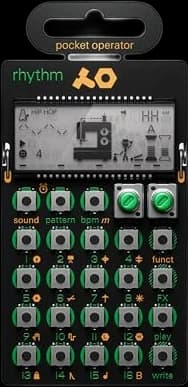 Best pocket-sized Teenage Engineering Pocket Operator PO-12 Rhythm | An impulse-buy price that still teaches real sequencing | $59 | Buy on Amazon → |
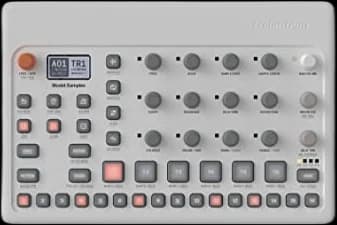 Best step-up for sample-based workflows Elektron Model:Samples | Sequencing your own samples, not just presets | $349 | Buy on Amazon → |
* Prices are approximate and may vary. Please check the latest price on Amazon.
A drum machine does two things: it generates or plays back drum sounds, and it sequences them into a pattern you can loop, tweak, and perform live. Some, like the Arturia DrumBrute Impact and Korg Volca Beats, synthesize their sounds electronically from scratch. Others, like the Elektron Model:Samples, play back audio you load in yourself. Most beginners don't need to decide that up front — the picks below are ordered by price and workflow, not by which technology is "better."
Every machine here runs standalone, without a laptop, which is the main reason to buy hardware over a drum plugin in the first place.
$900
Buy on Amazon01 · Best overall
Roland TR-8S Rhythm Performer
The most complete standalone drum machine here, at a price that reflects it.
Roland's spec sheet lists 11 instrument parts plus a dedicated trigger track, a 16-step TR-REC sequencer with 8 variations per pattern, and ACB (Advanced Circuit Behavior) modeling of the 808, 909, 707, 727, 606, and CR-78. It also holds 72 FM tones and 300-plus samples, with room to import your own via SD card. Eight individual analog outputs make it mixer-friendly in a real studio. Skip it if you just want to sketch beats casually — the depth here is wasted on a first drum machine bought to noodle with occasionally.
Strengths
- + Deepest sound engine of any pick here
- + Individual outs make it a real studio tool
- + Sample import means it isn't locked to factory sounds
Trade-offs
- − Most expensive pick by a wide margin
- − No AC-free portable power option
- Tracks
- 11 instrument parts + 1 trigger track
- Sequencer
- 16 steps per variation, 8 variations (A-H) per pattern
- Sound sources
- ACB modeling (808/909/707/727/606/CR-78), 72 FM tones, 300+ samples
- Sample import
- WAV/AIFF via SD card, ~600 seconds total
- Outputs
- 8 individual 1/4" TRS outs
$470
Buy on Amazon02 · Best portable
Roland TR-6S Rhythm Performer
The TR-8S's sound engine shrunk to fit a bag and run on AA batteries.
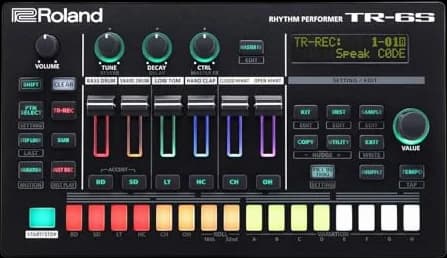
Roland's specs list 6 instrument tracks with the same 16-step, 8-variation TR-REC sequencer as the TR-8S, plus 2 fill-in patterns, running the same ACB modeling, 72 FM tones, and 300-plus samples in a 705-gram body. It runs on 4 AA batteries (about 4.5 hours on alkaline) or USB bus power, and doubles as a USB audio/MIDI interface. Skip it if you need more than 6 simultaneous instrument tracks — that's the real trade-off against the larger TR-8S, not sound quality.
Strengths
- + Same core TR sound engine as the flagship TR-8S
- + Genuinely pocket/bag-portable and battery-run
- + Doubles as a USB audio interface
Trade-offs
- − Only 6 tracks vs. the TR-8S's 11
- − No individual outs
- Tracks
- 6 instrument tracks
- Sequencer
- 16 steps per variation, 8 variations + 2 fill-ins
- Sound sources
- Same ACB modeling, FM tones and sample library as TR-8S
- Power
- 4 AA batteries (~4.5 hrs) or USB bus power
- Weight
- 705g / 1 lb 9 oz
$299
Buy on Amazon03 · Best analog / most hands-on
Arturia DrumBrute Impact
Ten pure-analog drum voices with no menu diving anywhere in the workflow.
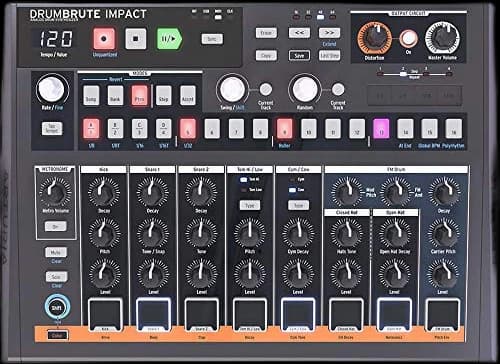
Arturia lists 10 analog drum voices (kick, two snares, hi and low toms, cowbell, cymbal, closed and open hi-hats, plus an FM voice), a sequencer holding up to 64 patterns at up to 64 steps each across 4 banks, and per-instrument "Color" controls that add overdrive and harmonic bite. Reddit's r/synthesizers regularly recommends it as one of the most hands-on machines available, with commenters specifically praising the polyrhythm-capable sequencer. The recurring complaint in the same threads is that knob positions aren't recalled when you switch patterns. Skip it if you want a computer-free sampler — this is pure synthesis, no sample import.
Strengths
- + Every control is a dedicated physical knob or button
- + Individual outs and deep sync options for a hardware setup
- + Polyrhythm sequencing that beginners can hear results from immediately
Trade-offs
- − Knob positions aren't saved with patterns
- − No sample playback, analog synthesis only
- Voices
- 10 pure analog (kick, 2 snares, hi/lo tom, cowbell, cymbal, 2 hats, FM)
- Sequencer
- Up to 64 patterns, up to 64 steps each, 4 banks
- Sound shaping
- Per-instrument "Color" overdrive/harmonic controls
- Connectivity
- USB MIDI, multiple sync options (MIDI, Clock, DIN24/48)
- Outputs
- Individual outs for kick, snares, hats, FM voice
$120
Buy on Amazon04 · Best ultra-budget
Korg Volca Beats
The cheapest real hardware drum machine worth owning, with one well-known weak spot.
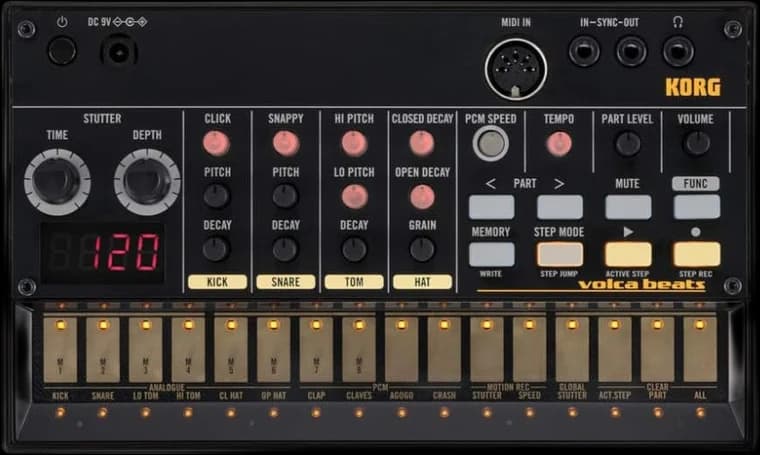
Korg's spec sheet lists 10 parts (6 analog: kick, snare, hi tom, lo tom, closed/open hi-hat; 4 PCM: clap, claves, agogo, crash) over a 16-step sequencer with 8 patterns of onboard memory and a Stutter effect for glitch-style fills. It runs on batteries with a built-in speaker, so it needs nothing else to make sound. On Reddit, the Volca Beats' snare comes up repeatedly and specifically as thin and limited compared to the rest of the kit — a known trade-off at this price, not a rumor. Skip it if a convincing snare sound matters to your genre; consider the DrumBrute Impact instead.
Strengths
- + Lowest price for genuine hardware synthesis
- + Built-in speaker and battery power for anywhere use
- + Simple enough to learn a step sequencer on in an afternoon
Trade-offs
- − Snare sound is a widely-noted weak point
- − No MIDI out, no sample import
- Parts
- 10 (6 analog, 4 PCM)
- Sequencer
- 16-step, 8 pattern memory slots
- Power
- Battery-powered with built-in speaker
- Connectivity
- MIDI in, Sync in/out
- Special feature
- Stutter effect, Active Step function
05 · Best pocket-sized
Teenage Engineering Pocket Operator PO-12 Rhythm
Genuinely tiny, genuinely cheap, and still a real step sequencer underneath the toy-like shell.
Teenage Engineering's specs list 16 tweakable synthesized drum sounds, a 16-step sequencer with 16 chainable patterns, 16 punch-in effects, and parameter locks for per-step sound tweaks. It runs on 2 AAA batteries for about a month of regular use and syncs to other Pocket Operators or gear over a 3.5mm audio cable. It has no MIDI, no USB, and a tiny LCD that some buyers find hard to read. Skip it if you need MIDI sync with a DAW or other modern gear; its sync method is audio-based and specific to the Pocket Operator ecosystem.
Strengths
- + Cheapest real drum machine in this guide by a wide margin
- + Pocket-sized and genuinely durable for its price
- + Parameter locks add real depth per step
Trade-offs
- − No MIDI or USB, sync is audio-jack only
- − Tiny display and buttons take some getting used to
- Sounds
- 16 tweakable synthesized drum sounds
- Sequencer
- 16-step, 16 chainable patterns
- Effects
- 16 punch-in effects, parameter locks
- Power
- 2 AAA batteries, ~1 month active life
- Sync
- 3.5mm audio jam sync (no MIDI/USB)
$349
Buy on Amazon06 · Best step-up for sample-based workflows
Elektron Model:Samples
Elektron's sequencing depth in the company's smallest, cheapest box.
Elektron's spec sheet lists 6 sample-playback tracks (doubling as 6 MIDI tracks), a sequencer running up to 64 steps with per-track length and scale settings, 64MB of sample RAM and 1GB of storage, and a resonant filter plus assignable LFO on every track. It stores 96 projects with 96 patterns each. It ships with a starter sample set but is built around loading your own. This is the pick for someone who has outgrown a synthesis-only machine like the Volca Beats and wants Elektron's parameter-lock sequencing without the price of the larger Digitakt. Skip it if you want built-in drum synthesis rather than sample playback.
Strengths
- + Elektron's parameter-lock sequencing at the company's lowest price point
- + Load your own samples instead of being limited to presets
- + Small footprint, real depth
Trade-offs
- − Sample-based only, no built-in drum synthesis engine
- − MIDI via TRS jacks needs the right cables, not standard 5-pin
- Tracks
- 6 sample-playback tracks (also usable as 6 MIDI tracks)
- Sequencer
- Up to 64 steps, per-track length/scale, parameter locks
- Sample memory
- 64MB RAM, 1GB storage
- Per-track
- 1 filter, 1 assignable LFO
- Connectivity
- USB 2.0, MIDI in/out via 3.5mm TRS
Sampling vs. synthesis: two different ways to make a kick drum
A synthesis-based machine like the DrumBrute Impact or Volca Beats builds each drum sound from oscillators, filters, and envelopes, the same building blocks as a synthesizer. You get a fixed set of drum types (kick, snare, hats, and so on) but can reshape each one with knobs. A sample-based machine like the Model:Samples instead plays back short audio recordings, so it can trigger literally any sound you load onto it — but it can't synthesize a new tone from scratch.
Roland's TR-series machines (the TR-8S and TR-6S) do both: modeled versions of classic drum circuits, plus the ability to import your own samples for the sounds those circuits can't cover.
Sequencer workflow: steps, patterns, and variations
Nearly every machine here uses some version of a step sequencer, where you place hits on a numbered grid (typically 16 steps per bar). What differs is how patterns chain together: the TR-8S and TR-6S use Roland's variation system (A through H) to build longer arrangements from one pattern, while the DrumBrute Impact and Model:Samples support full pattern banks you can switch between live. The PO-12's 16 chainable patterns are the simplest version of the same idea, built for spontaneous jamming rather than structured song arrangement.
Standalone vs. needs-a-computer
Every machine in this guide is standalone — it runs on its own power (AC, USB, or batteries) and doesn't need a DAW to make sound. That's the entire appeal over a drum plugin: you're forced into a hands-on workflow with physical knobs instead of a mouse and screen. The trade-off is that saving, backing up, and deeply editing patterns is usually slower than in software. If you already produce entirely inside a DAW, weigh whether you actually want a second, separate workflow before buying hardware.
Portability and power
The TR-6S, Volca Beats, and PO-12 all run on batteries, with the Volca Beats adding a built-in speaker so it needs nothing else to be heard. The TR-8S and DrumBrute Impact are AC/USB-powered desktop units built for a studio setup rather than a backpack. If you want something to bring to a friend's place or use away from an outlet, start with the battery-powered options.
What to skip
Skip anything marketed as a "drum machine app" bundled with a cheap MIDI controller — those are software instruments wearing a drum machine's branding, not standalone hardware. Also be wary of used analog drum machines from the 1980s and 1990s sold as investment pieces; parts and repairs for genuinely vintage units (as opposed to the modern reissues and clones covered here) can be expensive and hard to source.
How the picks differ
Start with the Teenage Engineering PO-12 or Korg Volca Beats if your budget is under $200 and you just want to learn step sequencing. Move to the Arturia DrumBrute Impact for a bigger step up in analog sound quality and knob-per-function control. Choose the Roland TR-6S if you want Roland's classic drum sounds in a genuinely portable, battery-powered box, or the Roland TR-8S if you want the full-featured version for a permanent studio setup. Pick the Elektron Model:Samples specifically if you want to sequence your own samples rather than built-in synthesized sounds.
Questions people ask
Do I need a drum machine if I already produce in a DAW?
No — every drum machine here can be replicated in software with enough plugins. People choose hardware for the hands-on workflow: physical knobs, no screen, and the constraints that come from not being able to infinitely undo. It's a workflow preference, not a capability gap.
What's the difference between a drum machine and a groovebox?
The terms overlap heavily. A drum machine is generally built around percussion sounds and a step sequencer. A groovebox (a term Elektron and others use) usually adds melodic or bass sequencing tracks alongside drums, aiming to be a more complete standalone production tool rather than drums only.
Can a drum machine sync with my computer or DAW?
Most can, but the connection method varies. The TR-8S, TR-6S, and DrumBrute Impact all support USB and/or MIDI sync with a DAW. The Volca Beats and Model:Samples use MIDI without direct USB audio routing. The PO-12 has no MIDI at all — it syncs only with other Pocket Operators and compatible gear over an audio cable.
Is analog or digital better for a first drum machine?
Neither is objectively better; they sound and behave differently. Analog machines like the DrumBrute Impact and Volca Beats tend to have warmer, less precise sounds and simpler per-voice controls. Digital and sample-based machines like the Model:Samples or the TR-series' sample-import mode offer more flexibility and precision, at the cost of some of that analog character.
Is a cheap drum machine like the PO-12 worth it, or should I save for something bigger?
If you're not sure you'll stick with hardware sequencing, a $59 Pocket Operator is a low-risk way to find out. It teaches the same core step-sequencer concepts as pricier machines. Producers who know they want sample import, individual outs, or a bigger sound palette are better served saving for the DrumBrute Impact or TR-6S instead.
Sources
- TR-8S | Roland (product specifications)
- TR-6S | Roland (product specifications)
- DrumBrute Impact | Arturia (product overview and specifications)
- Specifications | volca beats - Analogue Rhythm Machine | KORG (USA)
- Model:Samples | 6 Track Sample Based Groovebox | Elektron (product page)
- 5 Best Drum Machines for Beginners in 2026 | The Drum Ninja
As an Amazon Associate, SlowHum earns from qualifying purchases, at no extra cost to you. Full disclosure.