The Best Turntables for Beginners
A first turntable should have adjustable tracking force, a replaceable cartridge, and ideally a built-in preamp — and it should never be a suitcase player.
Published September 15, 2026 · 6 min read
Quick answer
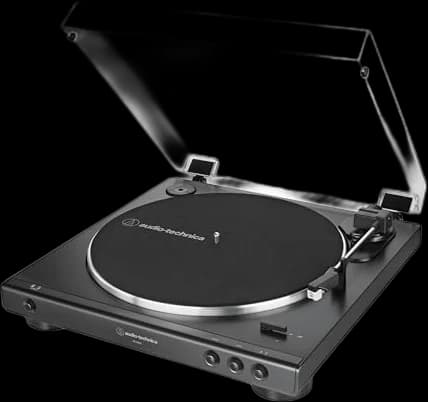
The Audio-Technica AT-LP60X is the easiest first turntable to own — automatic, a built-in preamp, a replaceable stylus — while the Fluance RT81+ is the better pick if you want to learn real tracking-force and anti-skate setup from day one.
Key takeaways
- Adjustable tracking force, anti-skate, and a replaceable cartridge matter more than the brand on the plinth.
- Suitcase and briefcase players are the most common beginner regret on vinyl forums — skip anything with a fixed, unadjustable tonearm.
- A built-in switchable phono preamp lets you skip buying a receiver just to get started.
- The AT-LP60X is the easiest first buy; the Fluance RT81+ teaches real setup for about $170 more.
At a glance
| Pick | Best for | Price* | |
|---|---|---|---|
Best overall starting point Audio-Technica AT-LP60X-BK Fully Automatic Belt-Drive Turntable | First-time buyers who want to press play, not tinker | $179 | Buy on Amazon → |
 Best for learning proper setup Fluance RT81+ Elite High Fidelity Vinyl Turntable | Beginners who want to learn tracking force and anti-skate | $350 | Buy on Amazon → |
 Best if you want DJ-style control from day one Audio-Technica AT-LP120XUSB-BK Direct-Drive Turntable | Beginners set on learning manual setup on sturdier hardware | $349 | Buy on Amazon → |
 Best made-to-order upgrade path U-Turn Audio Orbit Plus Turntable (Gen 2) | Buyers who want a hand-built turntable with room to grow | $399 | Buy on Amazon → |
 Best if you're ready to spend up for real hi-fi Pro-Ject Debut Carbon EVO Turntable | Beginners with a phono-input receiver and bigger budget | $649 | Buy on Amazon → |
* Prices are approximate and may vary. Please check the latest price on Amazon.
A good beginner turntable does three things well: it doesn't chew up your records, it makes noise without extra boxes, and it leaves room to get better later. That usually means a real counterweight instead of a fixed spring, a cartridge you can eventually replace, and, if you don't already own a receiver, a phono preamp built in. The Audio-Technica AT-LP60X covers all three for the least money and fuss, which is why it turns up in nearly every beginner recommendation thread. The five picks below cover that starting point and four ways to go further.
$179
Buy on Amazon01 · Best overall starting point
Audio-Technica AT-LP60X-BK Fully Automatic Belt-Drive Turntable
Simple, records-safe, and the default recommendation in nearly every beginner thread.
The AT-LP60X is fully automatic — it lowers and lifts the tonearm for you — and pairs a die-cast aluminum platter with a Dual Magnet cartridge whose stylus is replaceable (ATN3600LC), so wear is an eventual $30 part rather than a reason to buy a new turntable. Audio-Technica's own product page confirms the built-in phono preamp is switchable, so it connects to powered speakers, a receiver with a phono input, or a computer without extra gear. Skip it if you already know you want to swap cartridges — the headshell here isn't removable.
Strengths
- + Fully automatic — a safe first turntable to learn on
- + Built-in switchable phono preamp
- + Widely repeated as the default beginner pick on r/turntables
Trade-offs
- − Cartridge headshell isn't swappable
- − No adjustable tracking force or anti-skate to learn on
- Drive
- Belt, fully automatic
- Cartridge
- AT Dual Magnet, replaceable stylus
- Preamp
- Built-in, switchable
- Speeds
- 33-1/3, 45 RPM
- Platter
- Die-cast aluminum
$350
Buy on Amazon02 · Best for learning proper setup
Fluance RT81+ Elite High Fidelity Vinyl Turntable
A manual belt-drive deck with a swappable cartridge and real adjustments to learn on.
The RT81+ replaced the original RT81's cartridge with an Audio-Technica AT-VM95E, whose stylus and body both swap for upgrades later, per Fluance's own spec sheet. The S-shaped tonearm has an adjustable counterweight and an anti-skate dial, so a beginner sets tracking force by hand rather than trusting a fixed spring — genuinely useful groundwork for the hobby. The built-in preamp is switchable, and three adjustable feet help level the plinth on an uneven shelf. It's fully manual, so cueing the tonearm at the end of a side is on you.
Strengths
- + Swappable cartridge with several stylus upgrade options
- + Teaches real tracking-force and anti-skate setup
- + Three adjustable isolation feet
Trade-offs
- − Fully manual — you cue and lift the tonearm yourself
- − No Bluetooth
- Drive
- Belt, manual
- Cartridge
- Audio-Technica AT-VM95E, swappable
- Tracking force
- Adjustable via counterweight
- Anti-skate
- Adjustable dial
- Preamp
- Built-in, switchable
$349
Buy on Amazon03 · Best if you want DJ-style control from day one
Audio-Technica AT-LP120XUSB-BK Direct-Drive Turntable
A direct-drive, fully manual deck with real anti-skate and pitch control, priced like a beginner set but built like a step up.
The AT-LP120XUSB uses a direct-drive motor instead of a belt, with an S-shaped tonearm, an adjustable counterweight, and a front-panel anti-skate dial that Audio-Technica's own setup guidance says should match the tracking-force setting — 2.0 grams for the included AT-VM95E cartridge. Variable pitch control and quartz speed lock are extras a true beginner doesn't need yet, but the USB output for ripping records to a computer is genuinely useful. It's a bigger, heavier, more involved turntable than a first deck usually needs — buy it if you already know you want manual control.
Strengths
- + Direct drive, no belt to replace
- + Real adjustable anti-skate and counterweight
- + USB output for digitizing records
Trade-offs
- − More turntable than most first-time buyers need
- − Fully manual, no auto-return
- Drive
- Direct-drive, fully manual
- Cartridge
- AT-VM95E, swappable headshell
- Tracking force
- Adjustable, 2.0g recommended
- Anti-skate
- Adjustable, matches tracking force
- USB output
- Yes, for digitizing records
$399
Buy on Amazon04 · Best made-to-order upgrade path
U-Turn Audio Orbit Plus Turntable (Gen 2)
A U.S.-assembled belt-drive deck with a gimbal tonearm and a cartridge that's easy to trade up later.
U-Turn hand-assembles the Orbit Plus in Woburn, Massachusetts, and the Gen 2 version pairs an OA3 gimbal tonearm — adjustable counterweight, internal anti-skate — with a grooved acrylic platter that U-Turn's own product page says improves speed consistency over the entry Orbit's MDF platter. It ships with an Ortofon OM5E cartridge, one of five U-Turn offers, so upgrading later means swapping a stylus or cartridge rather than the whole turntable. One real caveat: the standard Amazon listing does not include U-Turn's optional Pluto 2 preamp, so budget for an external phono preamp or an amp with a phono input.
Strengths
- + Hand-assembled in the USA
- + Upgradeable cartridge line (five options)
- + Acrylic platter over the base model's MDF
Trade-offs
- − No built-in preamp on the Amazon configuration
- − Costs more than the AT-LP60X without its plug-and-play convenience
- Drive
- Belt
- Cartridge
- Ortofon OM5E, upgradeable
- Tonearm
- OA3 gimbal, adjustable counterweight
- Platter
- Grooved acrylic
- Preamp
- Not included on the Amazon listing
$649
Buy on Amazon05 · Best if you're ready to spend up for real hi-fi
Pro-Ject Debut Carbon EVO Turntable
A carbon-fiber-tonearm turntable from a company that's sold close to a million Debuts.
Pro-Ject's Debut Carbon EVO carries an 8.6-inch one-piece carbon fiber tonearm and ships with a Sumiko Rainier moving-magnet cartridge whose stylus upgrades to a Sumiko Olympia later. Height-adjustable metal feet handle leveling, and a rocker switch handles speed changes. It has no built-in phono preamp, so you need a receiver with a phono input or a separate phono stage — a real added cost most turntables on this list avoid. Pro-Ject has since released a pricier Debut EVO 2; the original Carbon EVO remains in production and is still the better beginner value of the two.
Strengths
- + Carbon fiber tonearm, rare outside pricier decks
- + Upgradeable Sumiko cartridge line
- + From a brand with a 20-plus-year, roughly a million-unit track record
Trade-offs
- − No built-in phono preamp — budget for one separately
- − Pricier than every other pick here
- Drive
- Belt
- Tonearm
- 8.6in one-piece carbon fiber
- Cartridge
- Sumiko Rainier, upgradeable stylus
- Speeds
- 33-1/3, 45, 78 RPM
- Preamp
- Not included
What a beginner turntable actually needs
Four things decide whether a turntable is worth buying, and none of them are the name on the plinth.
- Adjustable tracking force and anti-skate. The tonearm's downforce and the counterweight that offsets it determine how hard the stylus presses into the groove. Manufacturer guides — Audio-Technica's setup instructions for the AT-LP120XUSB are a clear example — walk through setting both, and a turntable that lets you adjust them is one you can keep tuned as the stylus wears.
- A replaceable, ideally swappable, cartridge. Every stylus wears out; a fixed cartridge means buying a new turntable when it does. A swappable cartridge, like the AT-VM95E on the Fluance RT81+, means buying a stylus instead.
- A phono preamp, built in or added. A turntable's signal is too quiet and tonally wrong for a normal aux input until it passes through a phono preamp, which most beginner decks build in and let you switch off if you already have one elsewhere.
- A moving-magnet cartridge, not ceramic. Ceramic cartridges, the kind that show up in briefcase and suitcase players, need much higher tracking force to work at all — that's the real source of record-wear complaints, not vinyl itself.
Skip the suitcase and briefcase players
Briefcase-style record players are the single most common regret in beginner threads on r/turntables. The recurring critique: a heavy, unadjustable tonearm paired with a ceramic cartridge and no anti-skate control, which together push the stylus into the groove with far more force than a properly balanced tonearm needs, and unevenly, since there's no way to counter the sideways pull toward the record's center. None of the picks above use a ceramic cartridge or a fixed arm.
The wear from one of these decks is gradual, not instant — a record played once or twice on a suitcase player isn't ruined. But a turntable you'll use for years is worth the extra cost over one built around records as a consumable part.
Automatic vs. manual, belt drive vs. direct drive
An automatic turntable like the AT-LP60X lowers and raises the tonearm for you, which matters most in the first few months, when cueing a tonearm by hand is the easiest way to scratch a record. Manual decks like the RT81+, AT-LP120XUSB, Orbit Plus, and Debut Carbon EVO ask you to do both yourself, but it isn't hard once you've done it a few times, and manual mechanisms have fewer parts to fail.
Belt drive, used by most of this list, isolates the platter from motor vibration through a rubber belt, which is what most affordable hi-fi turntables use. Direct drive, as on the AT-LP120XUSB, spins the platter straight off the motor — historically a DJ feature for fast start-up and pitch control, useful here mainly if you already know you want it.
The built-in preamp question
If you're starting from zero, no receiver, no powered speakers with a phono input, a built-in switchable preamp is the simplest path: plug the turntable into any aux input and you're done. The AT-LP60X, Fluance RT81+, and AT-LP120XUSB all include one. The U-Turn Orbit Plus and Pro-Ject Debut Carbon EVO don't, at least not on the standard Amazon listing, so budget an extra $50 to $150 for an external phono preamp, or plan to run either through a receiver that already has a phono input.
How these five differ
If you want to press play and stop thinking about it, the AT-LP60X, automatic, built-in preamp, no cartridge swapping, is the easiest ownership experience here. If you want to learn real turntable setup without much financial risk, the Fluance RT81+ is the manual, swappable-cartridge middle ground that vinyl forums keep landing on. The AT-LP120XUSB and U-Turn Orbit Plus assume you're ready for manual control and a longer upgrade runway; the Pro-Ject Debut Carbon EVO assumes you already own an amplifier with a phono input and want the best tonearm on this list.
Questions people ask
Do I need a separate phono preamp?
Only if your turntable doesn't have one built in, or you want better sound than a built-in preamp provides. Three of the five turntables above include a switchable built-in preamp, which is enough for a first setup. You can add an external preamp later without buying a new turntable.
Will a budget turntable damage my records?
A properly set up belt-drive turntable with a moving-magnet cartridge and correct tracking force won't. The record-damage stories concentrated in vinyl forums are almost entirely about briefcase and suitcase players, whose fixed high tracking force and ceramic cartridges are the actual problem, not affordable turntables in general.
Should I get an all-in-one with built-in speakers instead?
Most turntable-focused discussion, including recurring threads on r/turntables, advises against it: a stylus sitting inches from its own speaker cabinet can pick up vibration from the sound it's producing. A separate turntable and powered speakers, even budget ones, tend to sound noticeably clearer for similar money.
What speakers do I actually need?
Any powered (self-amplified) bookshelf speaker with an RCA or aux input works, since the turntable's built-in preamp already handles the signal conversion. You don't need a receiver or amplifier unless you're using passive (non-powered) speakers.
Is direct drive better than belt drive for a beginner?
Not meaningfully. Direct drive's advantages, faster start-up and easier pitch control, matter most for DJ use. For home listening, a well-built belt-drive turntable sounds just as good and typically isolates motor vibration slightly better.
Sources
- AT-LP60X product page — Audio-Technica
- AT-LP120XUSB product page — Audio-Technica
- RT81+ Elite High Fidelity Vinyl Turntable — Fluance
- Orbit Plus Turntable specifications — U-Turn Audio
- Pro-Ject Debut Carbon EVO Turntable — Amazon listing
- r/turntables — "help choosing the best beginner turntable/record player"
- r/turntables — "What is the best turntable for beginners?"
As an Amazon Associate, SlowHum earns from qualifying purchases, at no extra cost to you. Full disclosure.