The Best Powered Speakers for a Turntable
Quick answer
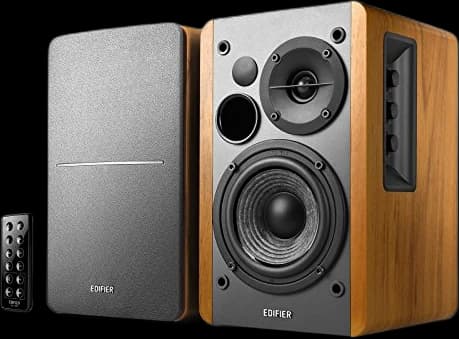
For most first vinyl setups, the Edifier R1280DB is the safest buy if your turntable has a built-in preamp, as most beginner turntables do: two RCA inputs, Bluetooth and optical in a pair that budget turntable communities keep recommending. If your turntable has no preamp, the Klipsch R-40PM and Kanto YU4 have one built in.
SlowHum may earn a commission when you buy through our links. Affiliate disclosure
Powered speakers can replace an entire amp and bookshelf-speaker setup - if you pick a pair built to take a turntable directly.
Updated October 22, 2026 · 6 min read
Key takeaways
- Not every powered speaker has a built-in phono preamp: the Edifier R1280DB, Audioengine A5+ Wired and Fluance Ai61 take line-level input only, so pair them with a turntable that has its own preamp or add an external one.
- Bigger rooms want bigger woofers and more RMS power; a 4-inch driver pair is built for a desk, not a living room.
- Never set a turntable directly on the same surface as its speakers - vibration feeds back into the cartridge as hum or muddiness.
- Klipsch has already replaced both the R-41PM and the original Fives with newer models (R-40PM and The Fives II) - check which generation a listing actually ships.
At a glance
Best overall / best budget
Edifier R1280DB Powered Bluetooth Bookshelf SpeakersA first vinyl setup on a desk or small shelf
- Drivers
- 4in mid-bass, 0.5in silk-dome tweeter
- Power
- Up to 42W RMS
Trade-off: No phono preamp; a turntable without one needs an external preamp
Best for bigger sound, if you add a preamp
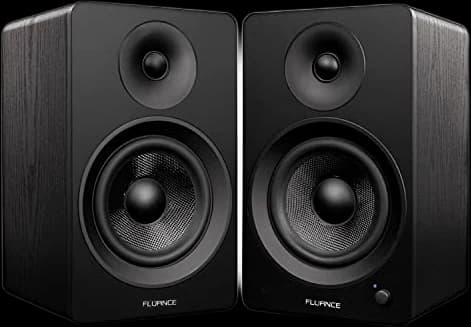
Fluance Ai61 Powered 6.5in Bookshelf SpeakersA medium room that wants more bass than a desktop pair can deliver
- Drivers
- 6.5in woofer, tweeter (2-way)
- Power
- 120W amplifier
Trade-off: No built-in phono preamp - budget for one separately
Best step-up with a phono switch
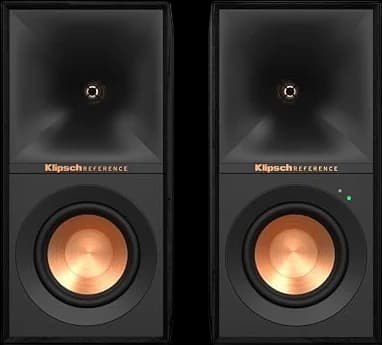
Klipsch Reference R-40PM Powered Bookshelf SpeakersA step up in output and horn-loaded clarity without going to a living-room system
- Drivers
- 4in copper-spun woofer, 1in aluminum tweeter
- Amplification
- Built-in, no receiver required
Trade-off: Bass rolls off around 60Hz - a small room's worth, not a large one
Best for a bigger room, wired setup
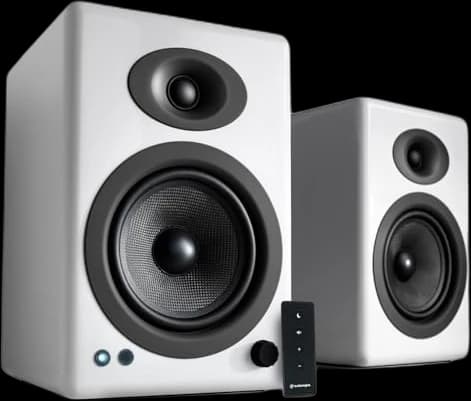
Audioengine A5+ Wired Bookshelf SpeakersA living room or larger bedroom, with a turntable that has its own preamp
- Drivers
- 5in woofer, 0.75in tweeter
- Power
- 50W RMS per channel, 75W peak
Trade-off: No phono preamp; needs a turntable with one built in, or an external preamp
Best for a compact desk with room to grow
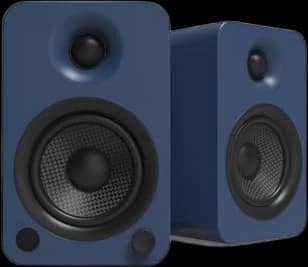
Kanto YU4 Powered Speakers with Built-in Phono PreampA desktop setup where sound quality matters more than shelf space
- Drivers
- 1in silk-dome tweeter, 4in Kevlar driver
- Power
- 140W peak, per the listing
Trade-off: Kanto has announced a 2nd Gen YU4; this listing is the earlier version
Best premium, whole-room system
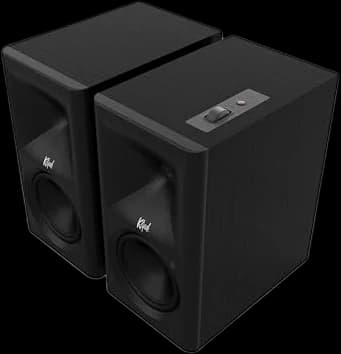
Klipsch The Fives II Dolby Atmos Powered SpeakersA living-room system meant to replace a TV soundbar and a stereo at once
- Drivers
- 5.25in Cerametallic woofer, 1in titanium tweeter (Tractrix horn)
- Frequency response
- 50Hz-25kHz (+/-3dB)
★ 4.8 (5 Amazon ratings)
Trade-off: Costs several times more than the stereo-only picks here
| Pick | Best for | Price* | |
|---|---|---|---|
Best overall / best budget Edifier R1280DB Powered Bluetooth Bookshelf Speakers★ 4.6 (4,808 Amazon ratings) | A first vinyl setup on a desk or small shelf Trade-off: No phono preamp; a turntable without one needs an external preamp | $154 | Buy on Amazon → |
Best for bigger sound, if you add a preamp Fluance Ai61 Powered 6.5in Bookshelf Speakers★ 4.3 (277 Amazon ratings) | A medium room that wants more bass than a desktop pair can deliver Trade-off: No built-in phono preamp - budget for one separately | $350 | Buy on Amazon → |
Best step-up with a phono switch Klipsch Reference R-40PM Powered Bookshelf Speakers★ 4.4 (231 Amazon ratings) | A step up in output and horn-loaded clarity without going to a living-room system Trade-off: Bass rolls off around 60Hz - a small room's worth, not a large one | $439 | Buy on Amazon → |
Best for a bigger room, wired setup Audioengine A5+ Wired Bookshelf Speakers★ 4.4 (1,278 Amazon ratings) | A living room or larger bedroom, with a turntable that has its own preamp Trade-off: No phono preamp; needs a turntable with one built in, or an external preamp | $399 | Buy on Amazon → |
Best for a compact desk with room to grow Kanto YU4 Powered Speakers with Built-in Phono Preamp★ 4.6 (434 Amazon ratings) | A desktop setup where sound quality matters more than shelf space Trade-off: Kanto has announced a 2nd Gen YU4; this listing is the earlier version | $300 | Buy on Amazon → |
Best premium, whole-room system Klipsch The Fives II Dolby Atmos Powered Speakers★ 4.8 (5 Amazon ratings) | A living-room system meant to replace a TV soundbar and a stereo at once Trade-off: Costs several times more than the stereo-only picks here | $1,400 | Buy on Amazon → |
* Prices are approximate and may vary. Please check the latest price on Amazon.
Powered speakers put the amplifier inside the cabinet, so a turntable can connect directly instead of running through a separate receiver. The catch is that not every powered speaker accepts a turntable the same way: some have a phono preamp built in, and some expect you to add one.
Check for a jack marked phono, not just a generic RCA input, before assuming a pair will work with your turntable out of the box.
01 · Best overall / best budget
Edifier R1280DB Powered Bluetooth Bookshelf Speakers
Two RCA inputs, Bluetooth and optical in one inexpensive, widely used pair, for a turntable that already has a preamp.
The R1280DB pairs a 4-inch mid-bass driver and a 0.5-inch silk-dome tweeter in each cabinet, rated at up to 42W RMS combined. Its two RCA inputs are line level, not phono: it has no built-in phono preamp, so it needs a turntable with a built-in preamp switched on, as most beginner turntables have, or an external phono preamp. It also takes Bluetooth 5.0 (SBC only, no aptX or AAC), optical and coaxial sources, so it can double as a desktop or TV speaker. It's one of the most repeated recommendations in budget-speaker discussions, generally described as the safe default rather than an exciting one. Skip it if you need to fill more than a small-to-medium room; its drivers are sized for near-field listening.
Strengths
- + Two RCA line inputs for a turntable with a built-in preamp
- + Bluetooth plus optical and coaxial digital inputs
- + Inexpensive and widely stocked
Trade-offs
- − No phono preamp; a turntable without one needs an external preamp
- − Bluetooth is SBC only, no aptX/AAC
- − 4-inch drivers won't fill a large room
- Drivers
- 4in mid-bass, 0.5in silk-dome tweeter
- Power
- Up to 42W RMS
- Phono input
- None; needs a turntable with a built-in preamp or an external one
- Bluetooth
- 5.0, SBC only
- Other inputs
- Optical, coaxial, dual RCA
02 · Best for bigger sound, if you add a preamp
Fluance Ai61 Powered 6.5in Bookshelf Speakers
Larger 6.5-inch drivers and 120W of power, but it needs an external phono preamp to accept a turntable.
The Ai61 steps up to 6.5-inch woofers in a ported wood cabinet, and Fluance's own spec sheet claims a 104dB signal-to-noise ratio and 32Hz-20kHz range - enough low end that it doesn't beg for a subwoofer in a normal living room. The important caveat: unlike most other picks here, the Ai61 has no built-in phono preamp. Fluance's own support documentation says a turntable without one needs an outboard preamp, and points to its own PA10 as a compatible option. That's about $100 more and one more cable, but it also means you aren't stuck with a fixed, non-upgradable phono stage. Skip it if you specifically want a single box with nothing extra to buy.
Strengths
- + Larger drivers than most desktop pairs at this price
- + Sub output for easy expansion
- + Bluetooth 5.0 plus optical and USB
Trade-offs
- − No built-in phono preamp - budget for one separately
- − Cabinet size needs real shelf space, not just a desk
- Drivers
- 6.5in woofer, tweeter (2-way)
- Power
- 120W amplifier
- Phono input
- None built-in - requires external preamp
- Bluetooth
- 5.0
- Other inputs
- RCA, optical, USB, sub out
03 · Best step-up with a phono switch
Klipsch Reference R-40PM Powered Bookshelf Speakers
Klipsch's current small powered pair, with a phono input, horn-loaded tweeter, and no need for the discontinued R-41PM.
The R-40PM is Klipsch's current-generation replacement for the R-41PM, which the company has discontinued - if a listing still shows the older R-41PM, it's outgoing stock, not the current model. The R-40PM keeps a familiar formula: a copper-spun 4-inch woofer paired with a 1-inch aluminum tweeter on Klipsch's Tractrix horn, built-in amplification so no receiver is needed, and a phono input with a ground-screw terminal for MM cartridges, per Klipsch's own product page. Klipsch lists the pair at $549.99; the Amazon listing linked here, from a third-party seller, was below that when checked. It also adds Bluetooth and a subwoofer output. Skip it if you specifically want the older R-41PM's exact tuning - Klipsch no longer sells it, so any "deal" is old stock, not a discount on a current product.
Strengths
- + Current-generation model - not the discontinued R-41PM
- + Horn-loaded tweeter for detailed highs
- + Built-in phono input with grounding terminal
Trade-offs
- − Bass rolls off around 60Hz - a small room's worth, not a large one
- − Exact wattage not published by Klipsch
- Drivers
- 4in copper-spun woofer, 1in aluminum tweeter
- Amplification
- Built-in, no receiver required
- Phono input
- Built-in MM phono with ground screw terminal
- Bass response
- Down to 60Hz
- Connectivity
- Bluetooth, phono/analog, digital, sub out
04 · Best for a bigger room, wired setup
Audioengine A5+ Wired Bookshelf Speakers
Audioengine's original wired A5+, at 50W RMS per channel, with line-level inputs and no Bluetooth.
Audioengine sells the A5+ in two versions, and this is the wired one (sometimes called the "Classic"), with no Bluetooth; make sure a listing says "Wired" or "Classic," not "Wireless." Its inputs are line level, so we don't list it as having a phono preamp: pair it with a turntable whose built-in preamp is switched on, or add an external phono preamp. The wired version is rated at 50W RMS per channel with a 5-inch woofer and 0.75-inch tweeter in each cabinet, enough to fill a living room at reasonable volumes, and includes a variable RCA subwoofer output. Skip it if you want Bluetooth streaming built in as well; that's the Wireless model's feature.
Strengths
- + 50W RMS per channel fills a bigger room
- + Variable subwoofer output
- + Hand-built wood cabinets, 3-year warranty
Trade-offs
- − No phono preamp; needs a turntable with one built in, or an external preamp
- − No Bluetooth on the Wired/Classic model; that's the separate Wireless version
- Drivers
- 5in woofer, 0.75in tweeter
- Power
- 50W RMS per channel, 75W peak
- Phono input
- None; line-level inputs
- Sub output
- Variable RCA
- Warranty
- 3 years
05 · Best for a compact desk with room to grow
Kanto YU4 Powered Speakers with Built-in Phono Preamp
A compact desktop pair with a built-in phono switch and Kevlar woofers, from a maker that has a second generation on the way.
The YU4 linked here is the version with a 1-inch silk-dome tweeter over a 4-inch Kevlar driver, rated at 140W peak, with a built-in phono preamp behind an RCA phono/line switch, per its Amazon listing from an authorized dealer. Kanto's own site now shows a YU4 2nd Gen, with abaca paper woofers and 110 W RMS, as coming soon at $449.99; it keeps the built-in phono preamp. Until that ships, this listing is the YU4 you can buy. If it is past your budget and your turntable already has a preamp, the Edifier R1280DB covers the same desk for less.
Strengths
- + Built-in phono preamp with a phono/line switch
- + Kevlar woofers in a compact cabinet
- + Compact enough for a desk
Trade-offs
- − Kanto has announced a 2nd Gen YU4; this listing is the earlier version
- − Pricier than the Edifier, which suits a turntable with its own preamp
- Drivers
- 1in silk-dome tweeter, 4in Kevlar driver
- Power
- 140W peak, per the listing
- Phono input
- Built-in MM preamp via RCA phono/line switch
- Bluetooth
- Yes
- Other
- USB charging port, subwoofer output
$1,400
Buy on Amazon06 · Best premium, whole-room system
Klipsch The Fives II Dolby Atmos Powered Speakers
Klipsch's current flagship compact system, with a built-in phono stage, HDMI 2.1 eARC, and Wi-Fi streaming - and by far the most expensive pick in this guide.
The Fives II is the current model, which Klipsch calls its next generation of powered speakers. Alongside a 1-inch titanium tweeter on a Tractrix horn and a 5.25-inch Cerametallic woofer, Klipsch's own product page confirms a dedicated analog input with a built-in phono stage for direct turntable connection, plus HDMI 2.1 with eARC, Wi-Fi streaming (AirPlay 2, Chromecast, Spotify Connect, Tidal Connect, Qobuz Connect), and Dolby Atmos processing. It is also by far the most expensive pick in this guide. Skip it unless you actually want the streaming and home-theater features; if you just want a phono input and good stereo sound, the R-40PM or Kanto YU4 do that job for a fraction of the cost.
Strengths
- + Built-in phono stage plus full home-theater connectivity
- + Horn-loaded tweeter and Cerametallic woofer for detailed sound
- + Wi-Fi streaming across major services
Trade-offs
- − Costs several times more than the stereo-only picks here
- − Overkill if you only want stereo vinyl playback, not a home-theater hub
- Drivers
- 5.25in Cerametallic woofer, 1in titanium tweeter (Tractrix horn)
- Frequency response
- 50Hz-25kHz (+/-3dB)
- Phono input
- Built-in phono stage, dedicated analog input
- Video
- HDMI 2.1 with eARC
- Streaming
- Wi-Fi: AirPlay 2, Chromecast, Spotify Connect, Tidal Connect, Qobuz Connect
What "built-in phono preamp" actually means here
A phono input on a powered speaker does the same job a standalone phono preamp does: it boosts the cartridge's signal and applies RIAA equalization before the internal amplifier drives the woofer and tweeter. On most of the speakers here, that input doubles as a regular line-level RCA input, switched between the two with a toggle on the back panel.
Some speakers, including the Edifier R1280DB, the Audioengine A5+ Wired and the Fluance Ai41 and Ai61, skip this circuit entirely and expect a turntable with its own preamp, or a separate outboard one. That's not a flaw, just a different design choice - it usually means a simpler, more upgradable signal path, at the cost of one more box to buy and cable to run.
Matching driver size and power to your room
A 4-inch driver pair rated around 40-70W, like the Edifier R1280DB or Kanto YU4, is built for near-field listening - a desk or a small bedroom, sitting a few feet from your ears. Step up to 5-6.5 inch woofers and 100W-plus, like the Audioengine A5+ or Fluance Ai61, and a pair can comfortably fill a living room at normal volumes. Bigger numbers don't always mean better sound, but undersized drivers in a big room will run out of headroom and start distorting well before they get loud enough.
Keep the turntable and the speakers physically separate
Powered speakers put a running motor next to their own amplifier, and a turntable is a mechanical device that's sensitive to vibration. Placing a turntable directly on the same shelf as a speaker cabinet - or between two speakers - can feed audible vibration back into the cartridge as hum, rumble, or a muddy low end, especially at higher volumes. Isolate the turntable on its own shelf or stand, ideally on a different surface than the speakers, and keep speaker cabinets a reasonable distance from the platter.
Bluetooth is a bonus, not the decision
Every pick here except the Audioengine A5+ Wired includes Bluetooth for streaming from a phone, and it's genuinely convenient for background listening. But it says nothing about how a pair handles a turntable - a phono input's gain, loading, and RIAA accuracy are separate design choices from wireless streaming, and a speaker's Bluetooth codec (SBC vs. aptX vs. aptX HD) only affects wireless audio quality, not the vinyl signal path.
How these six compare
Three picks here have a phono preamp built in: the Klipsch R-40PM, a horn-loaded pair with a phono switch; the Kanto YU4, a compact desktop pair; and the Klipsch Fives II, a living-room, do-everything system priced well above everything else. The other three take line-level input only. The Edifier R1280DB costs far less than any of them and suits a turntable with its own preamp, the Fluance Ai61 adds bigger 6.5-inch woofers for a medium room, and the Audioengine A5+ Wired fills a larger room if you can live without Bluetooth.
Questions people ask
Do all powered speakers work with a turntable?
No. A powered speaker needs either a dedicated phono input with a built-in preamp, or a line-level input paired with an external phono preamp and a turntable's own preamp switched on. Plugging an unamplified, non-preamp turntable signal into a plain line-level input will sound extremely quiet and thin.
Can I use these speakers with a receiver instead of directly with a turntable?
Powered speakers have their own built-in amplifier, so they're designed to skip a receiver entirely. Running them through a receiver or preamp isn't typical and can cause volume-matching issues; most owners connect sources (turntable, TV, computer) directly to the powered speaker's inputs.
How do I know if a listing is the current generation, not discontinued stock?
Check the exact model name against the brand's own current product page - Klipsch, for example, has replaced the R-41PM with the R-40PM and the original Fives with The Fives II. A retailer can still be clearing out the older model at a lower price, which isn't a problem as long as you know that's what you're buying.
Is Bluetooth sound quality good enough for vinyl-adjacent listening, like streaming a podcast?
For most casual listening, yes - Bluetooth quality mainly matters for critical, high-resolution playback. Codec support varies (SBC, aptX, aptX HD), and higher codecs sound closer to a wired connection, but none of it affects how a turntable's own phono signal sounds through the same speakers.
Do I still need a subwoofer with powered speakers?
Only if you want deeper bass than the speaker's own woofer provides - most pairs here, aside from the largest, roll off somewhere between 50-60Hz. Several of these speakers, including the Fluance Ai61 and Klipsch models, include a dedicated subwoofer output specifically for adding one later.
Sources
- Edifier R1280DB - official product page
- Fluance Ai61 Powered Bookshelf Speakers - product page
- Klipsch R-40PM Powered Speakers - product page
- Audioengine A5+ Classic Speakers - tech specs
- Kanto YU4 Powered Speakers - official product page
- Klipsch The Fives II Dolby Atmos Powered Speakers - product page
- r/turntables - powered speaker recommendation threads (community consensus)
As an Amazon Associate, SlowHum earns from qualifying purchases, at no extra cost to you. Full disclosure.