The Best Soundproof Curtains
Most "soundproof" curtains are heavy blackout curtains. They soften echo and some high-frequency noise. They do not soundproof a room, and here's why.
Published September 17, 2026 · 6 min read
Quick answer
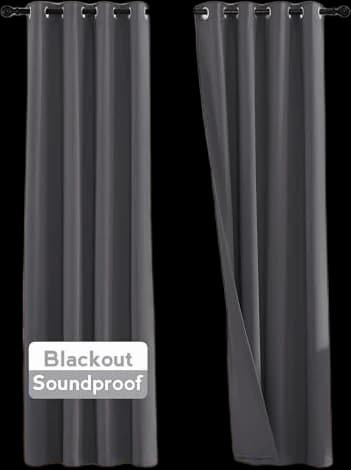
For most bedrooms, RYB HOME's three-layer curtain with a detachable felt liner is the best overall pick: real layered mass, no exaggerated soundproofing claim attached.
Key takeaways
- "Soundproof curtains" are heavy blackout curtains. They reduce echo and soften some high-frequency noise; they do not block sound from a wall or window.
- Only a couple of these picks publish an actual number (fabric weight or a lab-tested percentage). Most "noise reducing" labels carry no figure at all.
- Mass, fullness, and covering the whole window (or wall) matter more than brand name.
- For real noise blocking, a door sweep with full perimeter sealing or a window insert does far more than any curtain.
At a glance
| Pick | Best for | Price* | |
|---|---|---|---|
Best overall RYB HOME Soundproof Curtains | Bedrooms or living rooms wanting the heaviest widely available all-rounder | $80 | Buy on Amazon → |
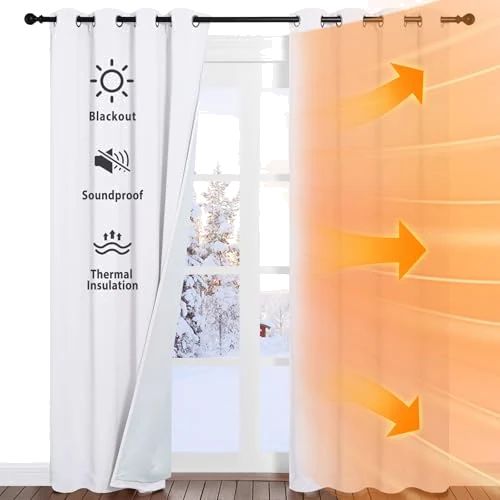 Best for a shared wall or room divider NICETOWN Sound Barrier Curtains | Floor-length use across a doorway, hallway, or thin shared wall, not just a window | $68 | Buy on Amazon → |
 Best with a maker-published noise number Sun Zero Halton Blackout Curtain | Buyers who want a specific tested figure instead of vague marketing language | $15 | Buy on Amazon → |
 Best for a published fabric weight StangH 300GSM Velvet Curtains | Buyers who want to compare curtains by an actual number, not a marketing label | $41 | Buy on Amazon → |
 Best budget pick, positioned candidly Deconovo Blackout Curtains | A tight budget where blackout and some softening of echo matter more than serious noise blocking | $12 | Buy on Amazon → |
* Prices are approximate and may vary. Please check the latest price on Amazon.
Almost everything sold as a "soundproof curtain" is, honestly, a heavy blackout curtain. That's not nothing: a thick, full curtain measurably softens echo inside a room and takes some edge off higher-frequency noise like voices, hiss, or a barking dog through a window. It will not soundproof anything. Sound moving through a wall or window is mostly a mass and air-gap problem, and a curtain, however heavy, is a thin fabric hanging an inch off the glass.
The six picks below were chosen for what's actually verifiable: a real layered construction, a published fabric weight, or, in one case, an actual lab-tested percentage from the maker. None were tested in-house — every spec is the manufacturer's own, cross-checked against the listing.
01 · Best overall
RYB HOME Soundproof Curtains
A three-layer blackout curtain with a dedicated felt liner, closer to a real layered approach than a single heavy fabric.
RYB HOME builds this as three distinct layers rather than one thick fabric: an outer decorative layer, a blackout layer, and a felt liner marketed specifically as the noise and draft barrier. That layered-mass approach is closer to what acousticians recommend than a single fabric, though RYB HOME does not publish an STC or dB figure, so no number should be attached to "how much quieter." Expect real echo reduction and some softening of high-frequency noise when fully drawn and overlapping the window generously, and expect little effect on low-frequency rumble like a passing truck.
Strengths
- + Dedicated felt liner, not fabric alone
- + Also functions as full blackout and thermal insulation
- + Liner detaches for washing
Trade-offs
- − No published dB or STC rating
- − Full benefit needs generous overlap past the window frame
- Layers
- 3 (decorative + blackout + felt liner)
- Liner
- Detachable felt
- Light blocking
- 100% (per maker)
- Panel size
- 52 x 84 in, 2 panels
- Care
- Liner detaches for machine wash
02 · Best for a shared wall or room divider
NICETOWN Sound Barrier Curtains
Sold explicitly as a divider curtain, with a felt liner NICETOWN's own listing says absorbs sound "2.5 times" better than a curtain without one.
NICETOWN sells this as a divider curtain as much as a window curtain, and that matters: hung floor-to-ceiling across a doorway or in front of a thin wall, the felt lining has more continuous fabric to work with than a curtain confined to a window frame. NICETOWN's listing states the felt liner makes it absorb sound "2.5 times" more than an ordinary curtain. That is the maker's own marketing language, not an independent lab test, so read it as a comparison to no liner at all, not a guarantee of a specific outcome in your room.
Strengths
- + Sold specifically for room-divider use, not just windows
- + Specific (maker-sourced) comparison claim, not vague marketing
- + Felt liner detaches for care
Trade-offs
- − The "2.5 times" figure is the maker's own claim, not an independent test
- − Heavy panels need a reinforced curtain rod
- Layers
- Triple-weave fabric + felt liner
- Liner
- Detachable
- Length options
- Up to 108 in for divider use
- Light blocking
- 100% (per maker)
- Use case
- Window or floor-length divider
03 · Best with a maker-published noise number
Sun Zero Halton Blackout Curtain
One of the few curtains in this category where the maker cites third-party lab testing behind its noise claim: up to 35% outside-noise reduction.
Most "soundproof curtain" marketing carries no number at all. Sun Zero is more specific: it states its Total Blackout fabric was third-party lab tested to reduce outside noise by up to 35% and cut window energy loss by a similar margin. That's still a manufacturer-commissioned test and a relative percentage, not an STC or dB rating, and "up to" describes a best case, not a guarantee. But it's a sourced claim rather than an unsupported "sound barrier" label, which makes it a fair pick for anyone who wants the closest thing to a documented figure here, at a lower price than the felt-lined options above.
Strengths
- + One of the only makers here citing a specific, tested noise figure
- + Full blackout and thermal benefit at a lower price
- + Standard grommet top fits most rods
Trade-offs
- − "Up to 35%" is a best-case, maker-commissioned figure, not STC/dB
- − No separate felt liner, lighter than the RYB HOME or NICETOWN picks
- Noise reduction
- Up to 35% (third-party lab tested, per maker)
- Light blocking
- 100% (per maker)
- Layers
- Single dense blackout weave
- Hanging
- Metal grommets, up to 1.5 in rod
- Energy loss reduction
- Up to 35-40% (per maker)
04 · Best for a published fabric weight
StangH 300GSM Velvet Curtains
A 300-gram-per-square-meter velvet StangH states outright, letting you compare mass against other curtains on a real spec.
Mass is the biggest factor in how much a fabric can absorb or block, which is why weight is more meaningful than an unquantified "noise reducing" label. StangH publishes its velvet at 300 grams per square meter (GSM), a real, comparable spec most blackout curtains never state. Velvet's dense pile also adds more depth to absorb higher frequencies than a flat woven poly fabric of similar weight, part of why velvet recurs as a recommendation in home-theater and podcasting forums for softening a room's slap echo, separate from any claim about blocking outside noise.
Strengths
- + Publishes an actual fabric-weight number (300 GSM)
- + Velvet pile adds real depth versus flat woven poly
- + Doubles as full blackout
Trade-offs
- − No separate acoustic liner, unlike RYB HOME or NICETOWN
- − No noise-reduction percentage or dB figure published
- Fabric weight
- 300 GSM (per maker)
- Material
- Velvet
- Layers
- Single dense weave, no separate liner
- Light blocking
- 100% (per maker)
- Hanging
- Grommet top
05 · Best budget pick, positioned candidly
Deconovo Blackout Curtains
A well-priced triple-weave blackout curtain. Deconovo calls it "noise reducing," but there's no dedicated liner behind that claim.
Deconovo's triple-weave polyester blocks close to all light and adds some thermal benefit, and its OEKO-TEX Standard 100 certification is a real, checkable credential, just not an acoustic one: it means the fabric was tested for harmful substances, not sound transmission. Unlike the RYB HOME and NICETOWN picks, this line has no separate felt or acoustic liner behind its "noise reducing" label, which on a single layer of polyester means, at best, a mild softening of hard echo and higher-frequency hiss. It's an honest budget choice if blackout and thermal benefit are the reason to buy, with any noise reduction treated as a bonus.
Strengths
- + Genuinely inexpensive for a full blackout curtain
- + OEKO-TEX certification is a real, checkable credential
- + Machine washable, fade-resistant
Trade-offs
- − No dedicated acoustic liner behind the "noise reducing" label
- − Lightest single-layer construction of the picks here
- Material
- 100% polyester, triple weave
- Certification
- OEKO-TEX Standard 100
- Liner
- None (single fabric layer)
- Light blocking
- Up to 99% (per maker)
- Care
- Machine washable
What "soundproof curtains" really means
On r/audioengineering, r/soundproof, and r/hometheater, people who've actually tried these curtains describe the same split result over and over: real help with echo and reverb inside the room, and "practically nothing" for isolating sound coming from outside. One recurring description is that curtains handle roughly the 1,000Hz-and-above range and do very little below it, which is exactly the range where street noise, bass, and voices through a wall tend to live.
That's not a flaw specific to any one brand. Absorption (softening reflections in a room) and isolation (stopping sound from crossing a boundary) are different jobs, and a fabric curtain is built for the first one. If a landlord's TV or a neighbor's bass is the problem, treat that as an isolation problem, not a curtain-shopping problem.
Mass is what actually does the work
Whatever softening a curtain provides comes almost entirely from mass and density, not marketing language. A dedicated felt liner, like the ones RYB HOME and NICETOWN build in, adds real weight and a different fiber structure than the outer decorative fabric alone. StangH's 300 GSM velvet is useful precisely because it's an actual number: heavier fabric per square meter generally absorbs more than lighter fabric, all else equal.
Most curtains marketed as "noise reducing" publish no weight and no test result at all, which is why this guide only attaches a specific figure to the two picks that state one — StangH's GSM and Sun Zero's lab-tested percentage. Everything else here is honestly a mass-and-layering argument, not a documented number.
Fullness and coverage matter more than the brand on the label
A curtain only absorbs what it physically covers, and gaps around the edges undo a lot of the benefit. Buying panels wide enough to overlap well past the window frame on both sides, hanging them floor-length, and mounting the rod several inches above and beyond the frame all matter more to the result than which of these six brands you choose. A curtain that just covers the glass, with light visible around the edges, is doing a fraction of the job a fuller one does.
This is also why NICETOWN's divider-length option matters: covering an entire doorway or wall floor-to-ceiling gives a curtain far more continuous material to work with than one confined to a single window.
Where curtains stop and real fixes start
Independent comparisons put real numbers on the gap. One soundproofing retailer's own comparison table rates heavy curtains at roughly 2-4 dB of reduction, against 10+ dB for a window insert that seals an airtight gap over the existing window — and states plainly that curtains "leave gaps and are usually not heavy enough to meaningfully block sound." Door sweeps show the same pattern: alone, they're rated at roughly 0-4 dB, useful mostly for drafts, and only become meaningful for noise once combined with sealing strips around the entire door frame, not the bottom alone.
None of that makes curtains pointless. It means treating them as a room-comfort upgrade — echo, privacy, a softer feel — and treating a genuinely noisy window or door as a separate, sealing-and-mass problem.
How to choose between these six
Choose RYB HOME as the default all-rounder: three real layers, a detachable felt liner, no overstated claim attached. Choose NICETOWN's Sound Barrier if you need floor-length coverage across a divider or shared wall rather than just a window. Choose Sun Zero's Halton line if you want the one pick here with an actual tested percentage behind it, at a lower price. Choose StangH if you want to shop by an actual fabric-weight number. Choose Deconovo if budget is the priority and you're buying mainly for blackout, with any noise softening as a bonus.
Questions people ask
Do soundproof curtains actually block outside noise?
Not in the way the name implies. They soften echo inside the room and take some edge off higher-frequency sounds, but independent comparisons put heavy curtains around 2-4 dB of reduction, versus 10+ dB for a proper window insert. For real noise blocking, look at sealing and mass, not fabric.
What's the real difference between blackout curtains and "soundproof" curtains?
Often very little. Most "soundproof" curtains are blackout curtains with an added felt liner or heavier fabric, marketed with a noise-reducing label that usually carries no test behind it. A few, like Sun Zero here, do cite an actual lab-tested figure; most don't.
Do heavier curtains work better?
Generally yes. Mass is the main variable behind whatever softening a curtain provides, which is why a published fabric weight (like StangH's 300 GSM) or a dedicated felt liner (like RYB HOME's or NICETOWN's) is more meaningful than a vague "noise reducing" label.
Does it matter if the curtain doesn't fully cover the window?
Yes, significantly. A curtain only absorbs what it physically covers, and gaps around the frame undo much of the benefit. Buy panels wide enough to overlap generously past the window, hang them floor-length, and mount the rod beyond the frame on both sides.
What actually stops noise coming through a window or door better than curtains?
A window insert that seals an airtight gap over the existing glass, or a door treated with sweeps and seals around the entire frame, not just the bottom. Both address the gaps and thin mass that curtains can't fix on their own.
Can I trust an STC or dB rating on a curtain listing?
Only if the maker states it directly and you can trace it to their own testing, as with Sun Zero's third-party lab-tested percentage here. Most curtain listings use "soundproof" or "noise reducing" with no number at all, which should be read as marketing language, not a spec.
Sources
- RYB HOME Soundproof Curtains, 3-Layer with Detachable Felt Liner — Amazon listing
- NICETOWN Sound Barrier 100% Blackout Divider Curtains — Amazon listing
- Sun Zero Halton Bright Vibes Total Blackout Curtain — Amazon listing
- StangH Blackout Velvet Curtains, 300GSM — Amazon listing
- Deconovo Blackout Curtains, Noise Reducing, OEKO-TEX Certified — Amazon listing
- Second Skin Audio — How to Soundproof Windows (curtains vs. window inserts comparison)
- Second Skin Audio — The Truth About "Soundproof Door Sweeps"
As an Amazon Associate, SlowHum earns from qualifying purchases, at no extra cost to you. Full disclosure.