The Best Guitar Strings
Six string sets covering acoustic and electric, budget to step-up, plus what phosphor bronze, 80/20 bronze, coated, and gauge actually mean.
Published September 16, 2026 · 8 min read
Quick answer
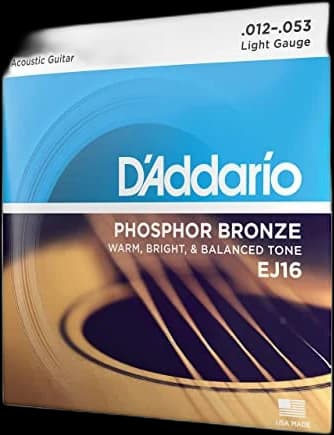
For most acoustic players, D'Addario EJ16 Phosphor Bronze Light (.012-.053) is the safest first buy: it's the uncoated set that a huge share of factory-strung acoustics already wear. On electric, Ernie Ball Regular Slinky (.010-.046) is the equivalent default.
Key takeaways
- Gauge is string thickness in thousandths of an inch — thinner strings bend easier, thicker strings hold more tone and volume.
- Phosphor bronze sounds warmer and 80/20 bronze sounds brighter; both are acoustic-only wrap alloys over a steel core.
- Coated strings cost more upfront but last several times longer before the tone goes dull, per Elixir's own materials.
- Electric strings are nickel-wound over steel, not bronze — a bronze acoustic set won't work with magnetic pickups.
At a glance
| Pick | Best for | Price* | |
|---|---|---|---|
| Most acoustic players, especially beginners | $10 | Buy on Amazon → |
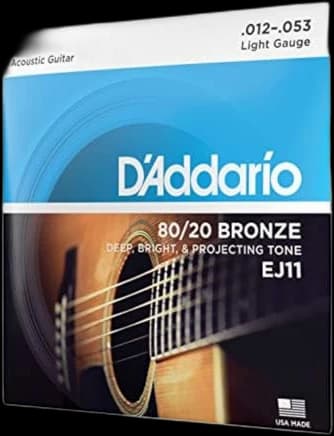 | Players who want a brighter, more traditional twang | $8 | Buy on Amazon → |
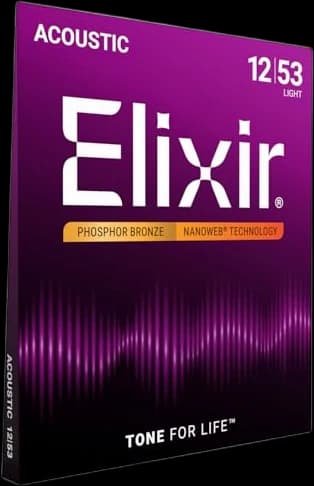 Best coated acoustic Elixir Nanoweb Phosphor Bronze Light | Frequent players who hate restringing often | $19 | Buy on Amazon → |
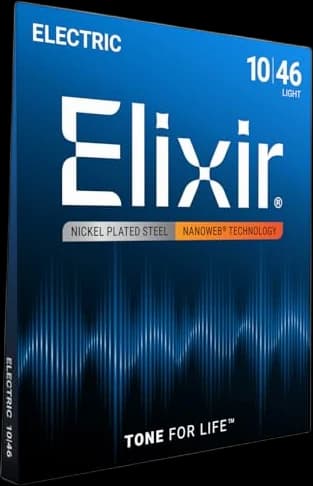 | Electric players who want longer string life | $15 | Buy on Amazon → |
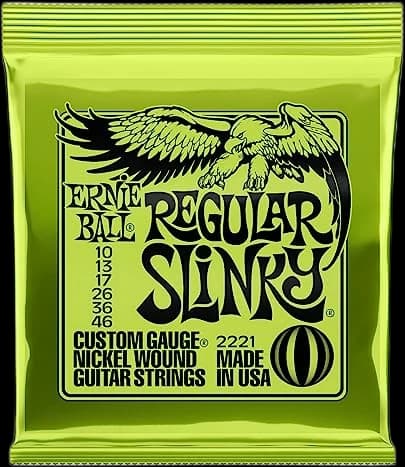 | Most electric guitars, standard 10-gauge setups | $9 | Buy on Amazon → |
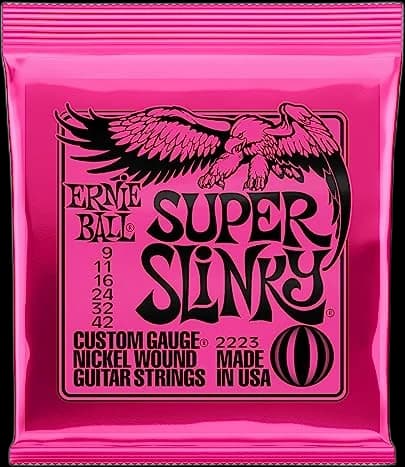 Best lighter-gauge electric Ernie Ball Super Slinky | Beginners and smaller hands on electric guitar | $8 | Buy on Amazon → |
* Prices are approximate and may vary. Please check the latest price on Amazon.
Buying guitar strings is simple once you know three things: what your guitar is (acoustic or electric), what gauge is already on it, and whether you value tone or longevity more. Get those three answers and the rest is picking a brand.
This guide covers both sides of the fretboard. For acoustic, that means choosing between phosphor bronze and 80/20 bronze, and between coated and uncoated. For electric, it means nickel-wound sets across a range of gauges, from featherlight for beginners to slightly heavier for players who want more low-end punch. The six sets below cover that range, checked against each maker's own listed specs rather than an SEO blog's.
01 · Best overall acoustic
D'Addario EJ16 Phosphor Bronze Light
The default acoustic string most guitars already wear — reliable, warm, and cheap to keep stocked.
D'Addario introduced phosphor bronze to acoustic strings in 1974, and the EJ16 remains the most common set that ships on new guitars and gets restocked at every music store. D'Addario describes the alloy as delivering warm, balanced tone with reliable intonation. At roughly ten dollars a set it's an easy default: buy a few packs, keep one on hand, and you won't be stuck mid-practice with dead strings. Skip it only if you specifically want the brighter attack of 80/20 bronze, or you'd rather pay more upfront for a coated set that lasts longer between changes.
Strengths
- + Warm, balanced tone that suits most acoustic styles
- + The most widely stocked acoustic set — easy to replace anywhere
- + Affordable enough to keep spares on hand
Trade-offs
- − Uncoated, so tone dulls within weeks of regular play
- − Less bright and present than an 80/20 bronze set
- Gauge
- .012-.053 (Light)
- Individual strings
- .012, .016, .024, .032, .042, .053
- Material
- Phosphor bronze wrap over hexagonal high-carbon steel core
- Coating
- Uncoated
- Core shape
- Hexagonal
4.7 out of 5 from 38,643 Amazon ratings
Amazon’s summary of its reviews: Customers find these guitar strings to be among the best on the market, praising their warm sound, clear mellow tone, and suitability for acoustic instruments. They appreciate the strings' feel, noting they're not too hard on fingers, and their functionality, particularly with Yamaha APX models. While they generally stay in tune well, some customers report issues with the 6th and 3rd strings breaking easily.
What buyers praise
- quality — 93% positive of 1,797 mentions
- sound quality — 93% positive of 884 mentions
- tone — 88% positive of 249 mentions
- functionality — 93% positive of 203 mentions
02 · Best for brighter acoustic tone
D'Addario EJ11 80/20 Bronze Light
D'Addario's brightest acoustic alloy, built for projection and cutting through a mix.
80/20 bronze was the original acoustic string alloy, and D'Addario still lists the EJ11 as its brightest set, describing a bold sound with crisp projection built to fill a room. If your guitar sounds a little boxy, or your phosphor bronze strings feel muted, 80/20 is the straightforward fix — same gauge as the EJ16 and a dollar or two cheaper, just a different wrap alloy. The trade-off, echoed by players on r/AcousticGuitar, is that the brightness fades a little faster than phosphor bronze, so it rewards changing strings more often if tone is what matters most to you.
Strengths
- + Brightest, most projecting tone of the acoustic sets here
- + Same gauge as the EJ16, an easy direct comparison
- + Good for recording or cutting through a mix
Trade-offs
- − Brightness fades faster than phosphor bronze as strings age
- − Can sound thin or harsh on guitars that are already bright
- Gauge
- .012-.053 (Light)
- Individual strings
- .012, .016, .024, .032, .042, .053
- Material
- 80/20 bronze wrap over hexagonal high-carbon steel core
- Coating
- Uncoated
- Alloy origin
- Co-developed by D'Addario and D'Angelico in the 1930s
4.7 out of 5 from 17,421 Amazon ratings
Amazon’s summary of its reviews: Customers find these guitar strings to be the best for acoustic instruments, offering great sound quality and value for money. They receive positive feedback for their tone, with one customer noting they keep guitars sounding bright and clear, while another mentions the low E and A strings have a warm and even bright sound. They are comfortable to play with, feeling good on fingers and being easy to tune, and customers appreciate their tuning retention. Durability receives mixed reviews, with some finding them long-lasting while others report strings breaking instantly.
What buyers praise
- quality — 90% positive of 542 mentions
- sound quality — 89% positive of 272 mentions
- value for money — 90% positive of 206 mentions
- functionality — 96% positive of 84 mentions
03 · Best coated acoustic
Elixir Nanoweb Phosphor Bronze Light
Costs more upfront, but the coating buys real weeks between changes.
Elixir was first to put a coating on acoustic strings and, per player consensus across r/Guitar and r/AcousticGuitar, still leads on longevity — gigging players report going a month or more between changes instead of a week or two. Elixir's own materials describe the Nanoweb coating as covering the entire string, including the gaps between windings where grime usually collects and deadens tone. It costs meaningfully more per set than the D'Addario uncoated picks above, but if you hate restringing or play daily, it earns that back in fewer sets bought and less time spent restringing. Skip it if you prefer the rawest possible tone the moment strings go on.
Strengths
- + Longest-lasting tone of any acoustic set here, per player reports
- + Smooth, low-friction feel under the fretting hand
- + Fewer restrings lowers long-run cost for frequent players
Trade-offs
- − Costs roughly twice as much as an uncoated D'Addario set
- − A few players say the coating changes the string's texture
- Gauge
- .012-.053 (Light)
- Individual strings
- .012, .016, .024, .032, .042, .053
- Material
- Phosphor bronze wrap wire, anti-rust plated steel core
- Coating
- Ultra-thin Nanoweb, covers the full string including winding gaps
- Type
- Coated
04 · Best coated electric
Elixir Nanoweb Electric Light
Nickel-wound with the same coating longevity as Elixir's acoustic line.
The electric version of Elixir's Nanoweb line uses the same logic as the acoustic set above: nickel-plated steel wrap wire coated in an ultra-thin polymer that Elixir says protects the string from the sweat, dust, and grime that would otherwise dull tone within weeks. Reddit's r/Guitar regulars who play daily point to Elixir as the set that lets them skip a change for a month or more. At 10-46 it's a standard, comfortable gauge for most electrics. It costs more than an uncoated Ernie Ball or D'Addario set, so it makes the most sense if you play often enough that string life is genuinely costing you time.
Strengths
- + Same coated longevity advantage as Elixir's acoustic line
- + Bright, punchy tone that holds up over weeks of play
- + Standard, comfortable 10-46 gauge
Trade-offs
- − Pricier than uncoated Ernie Ball or D'Addario electric sets
- − Coating feel takes some players a set or two to get used to
- Gauge
- .010-.046 (Light)
- Individual strings
- .010, .013, .017, .026, .036, .046
- Material
- Nickel-plated steel wrap over steel core
- Coating
- Ultra-thin Nanoweb
- Type
- Coated, nickel-wound
4.8 out of 5 from 8,109 Amazon ratings
Amazon’s summary of its reviews: Customers find these guitar strings durable, with one noting they can go months without changing, and appreciate their great sound quality and smooth feel. The strings hold their tuning for months, and customers consider them worth the price, with one mentioning they save money compared to non-coated strings. They maintain their brightness over time, and one customer describes them as "greased lightning" in terms of playability.
What buyers praise
- durability — 79% positive of 246 mentions
- sound quality — 92% positive of 199 mentions
- value for money — 74% positive of 116 mentions
- feel — 93% positive of 58 mentions
05 · Best overall electric
Ernie Ball Regular Slinky
The 10-46 gauge most electrics ship with, and the safest first buy.
Regular Slinky is Ernie Ball's best-known set and, per its own gauge chart, the 10-46 that a large share of electric guitars ship with from the factory. It's the default recommendation that turns up repeatedly on r/Guitar for players who aren't sure what gauge they already have or want — buy this, tune up, and you're playing. The nickel-plated wrap over a steel core gives a balanced, slightly warm tone that suits most genres without leaning too bright or too dark. It isn't the longest-lasting set here, so expect to change it every few weeks of regular play, sooner if your hands sweat a lot.
Strengths
- + The gauge most new electrics already ship with
- + Widely available and inexpensive
- + Balanced tone that works across genres
Trade-offs
- − Uncoated — dulls and can rust faster with humidity or sweat
- − Needs replacing every few weeks of regular play
- Gauge
- .010-.046 (10-46)
- Individual strings
- .010, .013, .017, .026, .036, .046
- Material
- Nickel-plated steel wrap over tin-plated hex steel core
- Coating
- Uncoated
- Type
- Nickel-wound
4.8 out of 5 from 131,881 Amazon ratings
Amazon’s summary of its reviews: Customers consider these guitar strings among the best available, praising their fantastic sound, great value for money, and reliable performance. They receive positive feedback for their tuning capabilities, staying in tune perfectly and working well for drop tuning. The durability receives mixed reviews - while some say they last a long time, others report that the E string broke right away.
What buyers praise
- quality — 94% positive of 3,815 mentions
- sound quality — 94% positive of 1,158 mentions
- value for money — 96% positive of 1,009 mentions
- reliability — 91% positive of 632 mentions
06 · Best lighter-gauge electric
Ernie Ball Super Slinky
The lightest common gauge, easiest on fingers still building calluses.
Super Slinky's 9-42 gauge is the set that comes up again and again on r/Guitar as the beginner-friendly answer to what gauge to start with — thinner strings need less finger strength to fret cleanly and bend, which matters most in the first few months of playing. Ernie Ball lists the same nickel-plated-steel-over-steel-core construction as its heavier Slinky sets, so the real difference is thickness and tension, not materials. The trade-off is a slightly thinner, less punchy low end than a 10-46 set. Most players who start on 9s move up to 10s once their fretting hand builds strength, and that's a normal progression, not a mistake.
Strengths
- + Lightest common gauge — easiest on beginner fingers
- + Inexpensive and widely stocked
- + Good stepping stone from a smaller-scale or nylon-string instrument
Trade-offs
- − Less low-end punch and sustain than a 10-46 set
- − Can feel loose or buzzy on guitars set up for heavier strings
- Gauge
- .009-.042 (9-42)
- Individual strings
- .009, .011, .016, .024, .032, .042
- Material
- Nickel-plated steel wrap over tin-plated hex steel core
- Coating
- Uncoated
- Type
- Nickel-wound
What "gauge" actually means
Gauge is just the string's thickness, measured in thousandths of an inch. A ".010" string is ten one-thousandths of an inch across; a ".046" is forty-six. A set is named after its thinnest string (the high E) and its thickest (the low E) — "10-46" means the high E is .010" and the low E is .046".
Thinner strings need less finger pressure to fret and bend, which is why lighter gauges suit beginners and lead players who bend a lot. Thicker strings carry more tension at the same pitch, which gives more volume, sustain, and low-end weight, but takes more finger strength and can make a poorly set-up neck buzz or need a truss-rod adjustment. There's no universally "correct" gauge — it's a trade-off between playability and tone, and most players settle on one gauge and stay there for years.
Phosphor bronze vs. 80/20 bronze (acoustic only)
Both are wrap-wire alloys used only on acoustic strings, wound around a steel core. Phosphor bronze adds phosphorus to the copper-tin bronze mix, which D'Addario markets as delivering a warmer, more balanced tone that ages gracefully. 80/20 bronze (roughly 80% copper, 20% zinc) is the older alloy, and D'Addario itself calls its 80/20 set the brightest in its acoustic line — more sparkle and projection when new, but that top-end shine fades a bit faster as the strings play in.
Neither is objectively better; it's a matter of whether you want a warmer, longer-lived voice or a brighter, more immediate one. If you're not sure, phosphor bronze is the safer first choice — it's what the large majority of factory-strung acoustics already wear.
Coated vs. uncoated: the durability trade-off
A coated string has a microscopically thin polymer layer over the wrap wire. Elixir, which pioneered the category, describes its Nanoweb coating as covering the entire string, including the gaps between windings where sweat, skin oil, and dust normally collect and deaden the tone. The upside is real: on r/Guitar and r/AcousticGuitar, players who play daily consistently report going a month or more between changes with a coated set, versus two to four weeks uncoated.
The downside is price — a coated set typically costs about twice as much as an uncoated one — and a small number of players say the coating changes the string's texture slightly under the fingers, especially right out of the pack. If you play often and hate restringing, coated pays for itself. If you play occasionally, or you want the rawest tone the moment strings go on, uncoated is the simpler, cheaper choice.
Acoustic vs. electric strings: not interchangeable
Acoustic strings use a bronze-alloy wrap (phosphor bronze or 80/20 bronze) over a steel core, chosen because that alloy resonates well and projects loudly with no amplification. Electric strings use nickel-plated (or occasionally pure nickel or stainless) steel wrap wire instead, because an electric guitar's pickups work by sensing a magnetic disturbance from the metal moving above them — bronze doesn't respond to a magnetic pickup the way steel does, so bronze acoustic strings simply won't drive an electric guitar's tone properly.
Electric string gauges also tend to run lighter overall, commonly 9s or 10s, since there's no acoustic soundboard that needs heavier strings to drive it. If you're restringing a guitar you didn't set up yourself, check whether it's acoustic or electric before buying — the two string families aren't interchangeable.
How the six picks differ
Start with what you play. On acoustic, D'Addario EJ16 is the safe, warm, inexpensive default; reach for D'Addario EJ11 if your guitar sounds a little dull and you want more brightness for the same price; step up to Elixir Nanoweb Phosphor Bronze if you're tired of restringing every few weeks.
On electric, Ernie Ball Regular Slinky (10-46) is the standard, go-anywhere gauge; Ernie Ball Super Slinky (9-42) is the easier-on-the-fingers choice for beginners or smaller hands; and Elixir Nanoweb Electric is the coated option for players who'd rather pay more and restring less.
How often to change strings
There's no fixed schedule — it depends on how often you play and how much your hands sweat. Reports on r/Guitar cluster around every four to eight weeks for players who practice most days with uncoated strings, stretching to every two or three months for casual players, and to several months for coated sets. The clearer signal than the calendar is the strings themselves: look for visible grime or discoloration in the winds, a flat or "thuddy" tone that doesn't brighten back up after tuning, strings that won't hold pitch, or actual rust. Any one of those means it's time, regardless of how many weeks it's been.
Questions people ask
What gauge strings should a beginner use?
On electric, 9s (like Ernie Ball Super Slinky) are the easiest on fingers still building calluses. On acoustic, most new guitars ship with 12s (.012-.053), which is a reasonable starting point — going lighter can sound thin and may not vibrate the top enough for full volume.
Can I put acoustic strings on an electric guitar, or the reverse?
Not sensibly. Acoustic strings use a bronze wrap that pickups don't sense well, so an electric guitar strung with them will sound very quiet and thin plugged in. Electric strings' nickel wrap will work physically on an acoustic but sounds notably thinner unplugged. Buy the set made for your guitar type.
How long do coated guitar strings actually last?
Elixir doesn't publish an exact week count, but describes its Nanoweb coating as giving the longest tone life of its lines. Players who play daily commonly report a month or more before a coated set needs changing, compared with two to four weeks for an uncoated set under the same use.
What's the real difference between phosphor bronze and 80/20 bronze?
Both wrap a steel core for acoustic guitars. Phosphor bronze (adds phosphorus to the alloy) sounds warmer and more balanced and ages more gracefully. 80/20 bronze (copper and zinc) sounds brighter and more projecting when fresh, per D'Addario's own descriptions, but that brightness fades a little faster.
Do heavier-gauge strings actually sound better?
Not universally — they carry more tension, which typically means more volume, sustain, and low end, but they also take more finger strength and can require a setup adjustment. Many experienced players stay on lighter gauges by choice for playability. Heavier isn't better; it's a different trade-off.
How often should I change my guitar strings?
Roughly every four to eight weeks if you play most days with uncoated strings, longer if you play occasionally or use a coated set. Better than a fixed schedule: watch for dull or thuddy tone, visible grime in the windings, strings that won't hold tuning, or rust — any of those means it's time.
Sources
- D'Addario EJ16 Phosphor Bronze Acoustic Guitar Strings, Light 12-53 — product page
- D'Addario EJ11 80/20 Bronze Acoustic Guitar Strings, Light 12-53 — product page
- Elixir Phosphor Bronze Acoustic Guitar Strings with Nanoweb Coating — product page
- Elixir Nickel-Plated Steel Electric Guitar Strings with Nanoweb Coating — product page
- Ernie Ball Slinky Nickel Wound Electric Guitar Strings, 6-string gauge chart — product page
- r/AcousticGuitar — "What gauge string do you guys prefer for your acoustic and why?"
- r/Guitar — "[QUESTION] how often do you change your guitar strings?"
Keep reading
Listen first
As an Amazon Associate, SlowHum earns from qualifying purchases, at no extra cost to you. Full disclosure.