The Best Guitar Pedals
Six pedal types, one honest pick each, chosen for what a beginner should actually buy first, not what looks best in a pedalboard photo.
Published September 15, 2026 · 7 min read
Quick answer
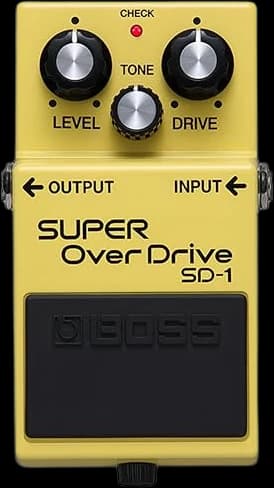
For most first-time buyers, the Boss SD-1 Super Overdrive is the single pedal worth buying first: it's cheap, hard to make sound bad, and it teaches you what gain does before you spend on anything else.
Key takeaways
- Buy by type, not by brand: one overdrive, one time-based effect, and a looper cover most of what a first pedalboard needs.
- Where a pedal sits in your signal chain changes its sound more than whether it's true bypass or buffered.
- A cheap multi-effects unit is a legitimate way to find out what you actually want before buying single pedals.
- Skip a tuner pedal here on purpose; a clip-on tuner or a dedicated guide covers that job better.
At a glance
| Pick | Best for | Price* | |
|---|---|---|---|
| A first drive pedal that stays useful for years | $70 | Buy on Amazon → |
 | Warm repeats that sit behind the guitar, not on top of it | $160 | Buy on Amazon → |
 | One pedal that covers room, hall, spring, and shimmer | $110 | Buy on Amazon → |
 Best looper Boss RC-1 Loop Station | Practicing over your own recorded chords or riffs | $93 | Buy on Amazon → |
 | Trying dozens of effects before buying single pedals | $100 | Buy on Amazon → |
 | Evening out pick attack and adding sustain to single notes | $149 | Buy on Amazon → |
* Prices are approximate and may vary. Please check the latest price on Amazon.
A first pedal purchase usually goes one of two ways: an impulse buy that gets used twice, or months of research that ends in nothing. The middle path is to buy by type, not by hype. An overdrive teaches you what gain does to your amp. A delay or reverb teaches you how time and space change a phrase. A looper turns solo practice into something closer to playing with another part. None of that requires seven pedals or a name-brand board, just one good, forgiving example of each type.
The picks below are organized by job, not by price: one pedal per type, spread from around $70 to $160, so the list works whether this is pedal number one or pedal number six.
01 · Best overdrive
Boss SD-1 Super Overdrive
The simplest, most forgiving overdrive to learn tone-shaping on.
Boss has built the SD-1 since 1981, and it hasn't needed a redesign to stay relevant: three knobs (Drive, Tone, Level), a buffered bypass that survives long cable runs, and a gain range that goes from a barely-there push to a clear crunch without ever turning harsh. It's the pedal most often recommended as a first overdrive precisely because it's hard to dial in a genuinely bad sound with it. Players chasing high-gain distortion from day one should look elsewhere; this is a warmth-and-clarity pedal, not a heavy pedal.
Strengths
- + Three knobs, no menu diving
- + Buffered bypass keeps tone consistent through a long cable run
- + Cheap enough that a mistake doesn't sting
Trade-offs
- − Lower gain ceiling than a dedicated distortion pedal
- − Buffered bypass can interact oddly with vintage-style fuzz pedals placed right after it
- Type
- Overdrive
- Controls
- Drive, Tone, Level
- Bypass
- Buffered
- Power
- 9V battery or PSA-series adapter
- Current draw
- 10 mA
- In production since
- 1981
4.7 out of 5 from 3,176 Amazon ratings
Amazon’s summary of its reviews: Customers praise this overdrive pedal for its warm, full-chord voicing sound and its ability to take gain to new levels, with one customer noting it hits the sweet spot between tube screamer and aggressive distortion. They find it superior to competitors, well-built, and reliable, with one mentioning it works great for tightening up high-gain amps. Customers appreciate its versatility, with one noting it works well with both pickup types.
What buyers praise
- sound quality — 87% positive of 90 mentions
- pedal quality — 97% positive of 78 mentions
- tone — 96% positive of 45 mentions
- versatility — 89% positive of 44 mentions
02 · Best delay
MXR Carbon Copy Analog Delay
An analog delay that teaches the difference between an echo and clutter.
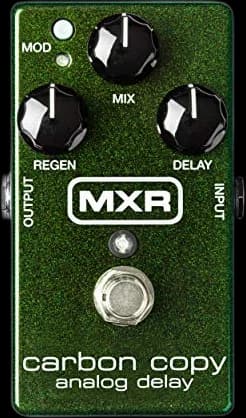
The Carbon Copy runs the signal through genuine analog bucket-brigade circuitry, which rolls off high frequencies on every repeat the way old tape echoes did, so the trails fade into a soft blur instead of staying crisp and separate. Three knobs (Delay, Mix, Regen) plus an optional modulation switch cover the range a beginner needs. Its 600ms maximum delay time is short next to digital units, and there's no tap tempo, so setting time by ear is part of the deal. For a first delay meant to sit behind the guitar rather than announce itself, that's a feature more than a limitation.
Strengths
- + Analog rolloff keeps repeats warm and in the background
- + True bypass means no tone change when it's off
- + Simple three-knob layout
Trade-offs
- − 600 ms max delay time is short next to digital pedals
- − No tap tempo; timing is set by ear
- Type
- Analog (bucket-brigade) delay
- Controls
- Delay, Mix, Regen, plus internal modulation trim pots
- Max delay time
- 600 ms
- Bypass
- True bypass
- Power
- 9V battery or Dunlop ECB003 adapter
4.6 out of 5 from 843 Amazon ratings
Amazon’s summary of its reviews: Customers praise this delay pedal for its dark, smooth sound and its ability to add air and space to their sound. The modulation button is particularly appreciated, with one customer noting how it adds a tape-style echo effect. Customers find the pedal delivers excellent performance, with one mentioning it works well both in front of an amp and in the effects loop. They appreciate its warm tonal characteristics and consider it one of the best analog delay pedals for the price.
What buyers praise
- sound quality — 91% positive of 95 mentions
- delay — 94% positive of 94 mentions
- pedal quality — 98% positive of 58 mentions
- modulation — 71% positive of 42 mentions
03 · Best reverb
TC Electronic Hall of Fame 2 Reverb
Eight usable reverb characters plus a shimmer mode, in one small box.
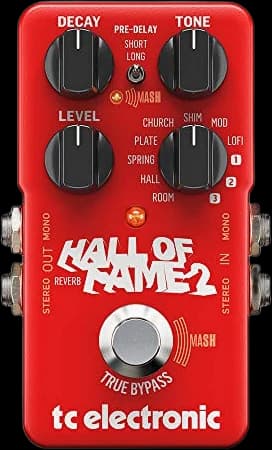
Where a single-mode reverb forces a choice up front, the Hall of Fame 2 offers eight distinct types, Room, Hall, Spring, Plate, Church, Shimmer, Mod, and LoFi, controlled by just three knobs (Decay, Tone, Level), so a beginner can try a natural room sound one night and an ambient shimmer the next without buying a second pedal. TC's TonePrint system also lets you load a preset tuned by another player. Its MASH footswitch, which reads how hard you press rather than just on/off, takes a session or two to feel intuitive but adds real expression once it clicks.
Strengths
- + Eight distinct reverb characters instead of one fixed sound
- + TonePrint lets you load a signature setting from another player
- + Small footprint
Trade-offs
- − MASH pressure footswitch takes a session or two to feel natural
- − Digital reverb; players wanting a strictly spring-amp character may prefer a dedicated spring pedal
- Type
- Digital reverb
- Reverb types
- Room, Hall, Spring, Plate, Church, Shimmer, Mod, LoFi, plus 3 TonePrint slots
- Controls
- Decay, Tone, Level
- Bypass
- Switchable true bypass or buffered
- Extra
- MASH pressure-sensitive footswitch
04 · Best looper
Boss RC-1 Loop Station
One footswitch and one knob, with a visual ring that shows exactly where the loop is.
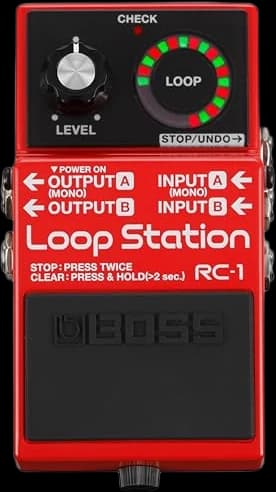
The RC-1 strips looping to its essentials: a single multi-function footswitch handles record, overdub, and stop, and a 24-segment LED ring shows loop position at a glance so there's no guessing where the downbeat lands. It records up to roughly 12 minutes in stereo, which is far more than a practice loop needs. It's a one-track looper, no layering multiple independent parts, and no undo history beyond the basics, but that ceiling is exactly what makes it approachable on day one rather than another menu to learn.
Strengths
- + Single footswitch handles record, overdub, and stop without combination presses
- + LED ring shows loop position at a glance
- + External footswitch jack for hands-free control later
Trade-offs
- − One loop track only, no layered multi-part looping
- − Minimal undo/redo beyond the basics
- Type
- Looper
- Max loop time
- Approx. 12 minutes, stereo
- Controls
- Level knob, single multi-function footswitch
- Indicator
- 24-segment circular LED
- I/O
- Mono and stereo in/out
- Power
- 9V battery or PSA-series adapter
05 · Best multi-effects
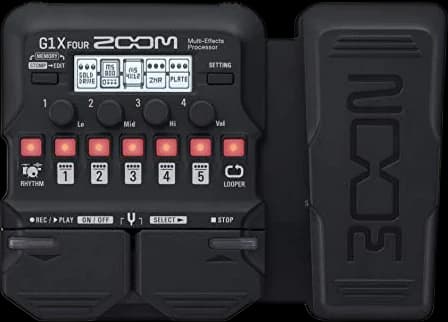
Zoom G1X Four Multi-Effects Processor
The cheapest honest way to find out which effects you actually want.
Instead of picking one type of effect, the G1X Four gives a beginner all of them: more than 70 effects, 13 amp and cabinet models, a built-in looper, a chromatic tuner, and an onboard expression pedal for volume or wah, all for less than some single boutique pedals. It runs on 4 AA batteries for around 18 hours, which makes it genuinely useful for headphone practice away from an amp. The small display means more menu navigation than a dedicated single pedal, and no individual effect is as convincing as a purpose-built boutique version, but as a way to learn what you actually reach for, it earns its slot.
Strengths
- + Amp modeling, effects, looper, and tuner in one unit
- + Built-in expression pedal for volume and wah without a separate purchase
- + Battery powered, useful with headphones away from an amp
Trade-offs
- − Small onboard display means more menu navigation than a single-purpose pedal
- − Individual effects and amp models are serviceable, not as convincing as dedicated boutique pedals
- Type
- Multi-effects processor
- Effects
- 70+ effects, 13 amp models
- Looper
- 30 seconds / 64 beats
- Extras
- Built-in expression pedal, 68 rhythm patterns, chromatic tuner
- Power
- 4 AA batteries (approx. 18 hrs) or 9V adapter
4.6 out of 5 from 5,254 Amazon ratings
Amazon’s summary of its reviews: Customers find the effects processor to be well worth its price and appreciate its versatility in creating different sounds, with one customer noting it has thousands of combinations to try. They consider it great for beginners and intermediates, with one mentioning it's particularly useful for practicing solos over backing tracks. The sound quality receives mixed reviews, with some finding it good while others describe it as "plastic." The built-in software receives mixed feedback, with customers appreciating the multiple presets but finding it confusing to customize.
What buyers praise
- quality — 82% positive of 222 mentions
- value for money — 88% positive of 156 mentions
- versatility — 87% positive of 113 mentions
- effects — 80% positive of 81 mentions
06 · Best compressor
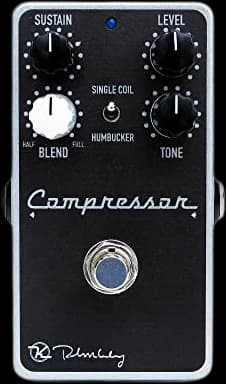
Keeley Compressor Plus
A compressor built to flatter single-coil and humbucker pickups equally.
Compression is the pedal type beginners understand last and buy last, and the Compressor Plus is built for that reality: a Release switch tuned specifically for single-coil versus humbucker pickups removes the trial-and-error most compressors demand, while a Blend control keeps the initial pick attack intact instead of squashing it flat the way older compressors do. It's true bypass, made in the USA, and priced above the other picks here on purpose; a beginner buying six pedals in one order should put this one last, not first, since its effect is subtle enough to go unnoticed before the ear is trained to hear it.
Strengths
- + Release toggle is a genuine fix for switching between guitars, not a gimmick knob
- + Blend control preserves pick-attack transients instead of flattening everything
- + True bypass
Trade-offs
- − Pricier than a basic compressor, and more control than a first-week beginner strictly needs
- − Compression is subtle; it's easy to not notice what it's doing at first
- Type
- Optical-style compressor/sustainer
- Controls
- Sustain, Level, Blend, Tone, plus fast/slow Release toggle
- Bypass
- True bypass
- Power
- 9V battery or adapter, 10 mA draw
- Build
- Made in USA
4.6 out of 5 from 829 Amazon ratings
Amazon’s summary of its reviews: Customers find this compressor pedal to be the best on the market, delivering super clean sound and excellent tone shaping capabilities. The pedal works well for both guitar and bass, with one customer noting it handles all frequencies without loss of low end. They appreciate the multiple controls, with one mentioning the blend control is essential, and consider it good value for money.
What buyers praise
- quality — 92% positive of 108 mentions
- sound quality — 72% positive of 65 mentions
- functionality — 83% positive of 59 mentions
- compression — 98% positive of 51 mentions
Signal chain order: what goes where
Pedal order changes tone more than most beginners expect. The convention most gigging guitarists settle on, in order from guitar to amp, is tuner, then compression, then gain (overdrive or distortion), then modulation, then time-based effects such as delay and reverb, last. A tuner goes first so it reads the guitar's unaltered signal. Gain pedals go before delay and reverb so the repeats and reverb tail carry the distorted tone, rather than distorting an already-echoing signal into mud.
None of this is a law; plenty of players put reverb before delay on purpose for a deliberately washed-out sound. But it's the default worth learning before anyone breaks it on purpose.
True bypass vs. buffered bypass
Every pedal is either true bypass, meaning the signal passes through unaltered when the pedal is switched off, or buffered, meaning a small circuit reshapes the signal even when off, to fight the signal loss that builds up over a long cable run. Neither is objectively better. True bypass keeps a vintage-style fuzz pedal's finicky input happy; a buffer keeps tone from turning dull and thin after twenty feet of cable and several pedals. A board with one or two buffered pedals placed deliberately through the chain, rather than all true bypass or all buffered, is a common and reasonable compromise.
One power supply, not nine batteries
A single pedal runs fine on a 9V battery. Three or four pedals on batteries turns into a drawer of half-dead 9-volts and an overdrive that quietly loses headroom mid-practice. A basic isolated power supply, one that gives every pedal its own clean, hum-free 9V, costs less than a single mid-range pedal and removes an entire category of problems: dying batteries, digital pedals hissing next to analog ones, and daisy-chain setups where one pedal's noise bleeds into the next.
Analog vs. digital: why delay and reverb split this way
Analog delay pedals, including the Carbon Copy above, pass the signal through real analog circuitry, bucket-brigade chips, which roll off high frequencies on every repeat the way a tape echo does, so the trails fade into a warm blur rather than staying crisp. Digital delay and reverb instead model the effect, which usually means longer maximum times, more preset types, and cleaner repeats. Neither is more correct. A blues or classic-rock setup usually wants the analog rolloff; an ambient or shoegaze-leaning setup usually wants the range a digital unit provides.
What a looper pedal is actually for
A looper's real job for most beginners isn't performance, it's practice. Record a chord progression, let it repeat, and solo over your own playing instead of a static backing track that doesn't react to a tempo mistake. It also surfaces timing problems fast: a loop that drifts out of sync after four bars is doing more diagnostic work than a metronome alone. Live looping, building a full song from scratch on stage, is a real use case too, but it's a second-year skill, not a first-week one.
What to skip on a first board
Skip a dedicated tuner pedal for now if budget is tight; a clip-on tuner does the same job for a fraction of the price, and the multi-effects unit above already includes one. Skip a second overdrive or distortion pedal until the first one feels limiting, which takes most players longer than they expect. And skip anything marketed as an all-in-one bundle; one well-chosen pedal per job, bought individually, is easier to resell or upgrade later than a bundle is.
How these six differ, and how to choose
If only one pedal fits the budget, the overdrive comes first: it changes what the amp does at the most basic level, and it's the cheapest lesson in tone-shaping on this list. If a solo or lead sound is the priority, add the reverb next, since dry lead tone reads as thin and unfinished, and reverb fixes that faster than anything else here. If solo practice is the actual problem being solved, the looper jumps ahead of the delay. The multi-effects unit is the odd one out: it doesn't slot into a single type, it replaces trying five types at once, and it's the right call for anyone who genuinely doesn't know yet what they'll reach for. The compressor is worth buying last; it's a real tool, but its effect is subtle enough that a first-week beginner often can't yet hear what it's doing.
Questions people ask
What's the first guitar pedal I should buy?
Most players start with a simple overdrive like the Boss SD-1 or Blues Driver. It's inexpensive, hard to make sound genuinely bad, and it's the pedal that teaches you what gain actually does to your amp before you spend money on anything else.
Do I need a power supply for guitar pedals?
Not for a single pedal; a 9V battery is fine. Once you're running three or more, a basic isolated power supply is worth it: it removes battery anxiety, keeps digital and analog pedals from bleeding noise into each other, and costs less than most single pedals.
What order should guitar pedals go in?
The common default is tuner, then compression, then overdrive or distortion, then modulation, then delay and reverb last, so time-based effects carry the tone that comes before them instead of distorting on top of an echo. It's a starting point, not a fixed rule.
Is true bypass better than buffered bypass?
Neither is universally better. True bypass keeps vintage-style fuzz pedals happy and avoids any tone coloration when a pedal is off. A buffer prevents tone loss over long cables and many pedals. Most working pedalboards mix both deliberately rather than choosing one exclusively.
What does a looper pedal actually do for practice?
It records a phrase or chord progression and repeats it, so you can solo or work on timing over your own playing instead of a static backing track. For most buyers it's primarily a practice tool; live, on-stage looping is a skill that usually comes later.
Sources
- Boss SD-1 Super Overdrive — official product page
- Boss RC-1 Loop Station — official product page
- MXR Carbon Copy Analog Delay — official product page
- TC Electronic Hall of Fame 2 Reverb — official product page
- Zoom G1X Four — official product page
- Keeley Compressor Plus — official product page
- Guitar.com: The best guitar pedals for beginners buyers guide
As an Amazon Associate, SlowHum earns from qualifying purchases, at no extra cost to you. Full disclosure.